
Biology MCQS P 3
Cell Cycle and Cell Division
1. Which of these processes is not a part of the cell cycle?
a) Duplication of genome
b) Division into daughter cells
c) Synthesis of cell organelles
d) Degeneration of centrosome
View Answer
Explanation: Cell cycle involves duplication of the genome, division of the parent cell into two daughter cells, synthesis of cell organelles for the daughter cells, but centrosomes are not degenerated.
2. Which of these is the correct order of events in the cell cycle?
a) G1 → G2 → S → M
b) G1 → G2 → M → S
c) G1 → S → G2 → M
d) S → M → G1 → G2
View Answer
Explanation: The cell cycle starts with the first gap phase or G1, followed by the synthesis phase or S phase. This is followed by the second gap phase or G2. These are parts of the interphase, which is then followed by the M phase.
3. What is the duration of cell cycle in yeast?
a) 30 minutes
b) 24 hours
c) 90 minutes
d) 48 hours
View Answer
Explanation: The duration of the cell cycle of the single celled fungi yeast takes 90 minutes. This means that it undergoes interphase and M phase to produce two new identical daughter cells through cell division.

4. The period between two M phases is called ______
a) interphase
b) prophase
c) prometaphase
d) telophase
View Answer
Explanation: Two successive M phases or mitosis phases are separated by a period of rest known as interphase. It is the phase in which newly formed daughter cells actively grow and synthesize cellular material for the next M phase.
5. How much time of the entire cell cycle is occupied by interphase?
a) 75%
b) 95%
c) 50%
d) 80%
View Answer
Explanation: The cell cycle is broadly classified into two phases-the interphase and the M phase. The M phase is the one in which actual cell division takes place. It occurs rapidly and takes up 95% of the duration of the cell cycle.
6. Identify the phase of the cell cycle.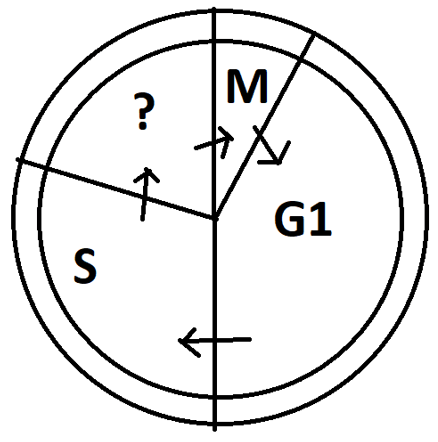
a) Prophase
b) G0
c) G2
d) Telophase
View Answer
Explanation: The phase to be identified lies between the S phase or the synthesis phase and the M phase or the mitosis phase. Hence, it is the G2 phase or the gap phase 2. Cell growth takes place during this phase.
7. Which process does the M phase of cell cycle start with?
a) Karyokinesis
b) Cytokinesis
c) Interphase
d) Spindle formation
View Answer
Explanation: The M phase of the cell cycle starts with karyokinesis or the separation of sister chromatids. It ends with cytokinesis or the division of the cytoplasm. The M phase occurs after interphase.
8. In which phase of the cell cycle does DNA replication take place?
a) Anaphase
b) Metaphase
c) Prophase
d) Interphase
View Answer
Explanation: DNA replication or synthesis takes place in the resting phase or interphase of the cell cycle. It takes place during the S phase or synthesis phase. Prophase, metaphase and anaphase are a part of M phase.
9. What is the interval between mitosis and DNA replication?
a) S phase
b) G2 phase
c) G1 phase
d) M phase
View Answer
Explanation: G1 phase or gap 1 phase is the interval between the end of mitosis or M phase and the beginning of the replication or the synthesis of DNA in the synthesis phase. G2 phase follows the S phase.
10. DNA synthesis involves an increase in chromosome number. True or false?
a) True
b) False
View Answer
Explanation: DNA synthesis does not increase the chromosome number. Only the amount of DNA in the cell increases. It doubles in quantity in order to divide it equally between two daughter cells to be produced as a result of mitosis.
11. During S phase of the cell cycle, the amount of DNA ______
a) triples
b) remains the same
c) quadruples
d) doubles
View Answer
Explanation: During S phase or synthesis phase, DNA synthesis or replication takes place. This is because at the end of every cell division, the cell splits into two daughter cells which have equal amount of DNA. Hence the amount of DNA doubles.
12. In which phase of the cell cycle does centriole duplication take place?
a) S phase
b) G2 phase
c) G1 phase
d) G0 phase
View Answer
Explanation: Centriole duplication as well as DNA duplication or synthesis takes place in the S phase or the synthesis phase of the cell cycle. DNA duplication does not take place in the gap phases G1, G2 and G0.
13. Protein synthesis takes place in _____
a) G1 phase
b) G2 phase
c) G1 and G2 phases
d) S phase
View Answer
Explanation: Proteins are synthesized in the interphase in order to help initiate the M phase or mitosis phase and so that the two daughter cells each receive adequate protein. Proteins are synthesized both in G1 and G2 phases. In G1 phase, the proteins that are required for the normal functioning and secretion of the cell are synthesized. In G2 phase, proteins that are needed for mitosis process are synthesized.
14. Which of these cells do not divide?
a) Heart cells
b) Melanocytes
c) Osteocytes
d) Liver cells
View Answer
Explanation: Melanocytes, osteocytes and liver cells show cell division. Heart cells do not show cell division as the cells have exited the G1 or first gap phase in order to enter a quiescent stage or the G0 phase.
15. In which of these animals does a haploid cell divide mitotically?
a) Humans
b) Male honey bees
c) Female honey bees
d) Rats
View Answer
Explanation: Haploid cells which have only one copy of chromosomes divide mitotically in male honey bees. This is in contrast to the general pattern of haploid germ cells dividing meiotically in most animals.
Cell The Unit of Life
1. Cells are the structural unit of life and all the organisms are made of cells.
a) True
b) False
View Answer
Explanation: Cells are the structural unit of life and all the organisms are made of cells. The size and shapes of the cells vary with organisms and their functions but on a whole most of them have identical components.
2. Which among the following is incorrect about the major discoveries in the history of cell?
a) Robert brown made the most major contribution to the history of cell by discovering nucleus
b) Cell theory was developed by Schleiden and Schwann
c) Virchow introduced the concept that genetic material is present inside the nucleus
d) Robert Hooke discovered cell in 1665
View Answer
Explanation: Robert Hooke discovered cell in 1665. Robert brown made the most major contribution to the history of cell by discovering nucleus. Cell theory was developed by Schleiden and Schwann. Virchow stated that the new cells arise from the pre-existing cells.
3. Which among the following is incorrect about types of cells?
a) In a prokaryotic cell membrane-bound organelles are absent
b) Monera is an example of prokaryotic cell
c) Eukaryotic cells contain membrane-bound organelles
d) Prokaryotic cells contain either RNA or DNA
View Answer
Explanation: In a prokaryotic cell membrane-bound organelles are absent. Monera is an example of prokaryotic cell. Eukaryotic cells contain membrane-bound organelles. Prokaryotic cells contain both RNA and DNA.
4. Which among the following is incorrect about different types of cells?
a) Size and shape of the cells vary with the functions they perform
b) In unicellular organism a single cell constitutes the entire organism
c) The components in all eukaryotic cells are more/less the same
d) Centrioles are present in plant cells but absent in animal cells
View Answer
Explanation: Size and shape of the cells vary with the functions they perform. In unicellular organism a single cell constitutes the entire organism. The components in all eukaryotic cells are more/less the same. Centrioles are present in animal cells but absent in plant cells.
5. Active transport requires energy to transport particles from lower concentration to higher concentration.
a) True
b) False
View Answer
Explanation: Active transport requires energy to transport particles from lower concentration to higher concentration. In passive transport, cell doesn’t expend any energy to transport particles across cells.
6. Energy for the transport of particles through active mode is derived from _______
a) ATP
b) ADP
c) Glucose
d) Lactic acids
View Answer
Explanation: Energy for the transport of particles through active mode is derived from ATP. In active mode of transportation, the transport of particle takes place against the concentration gradient. Therefore, active transport requires energy to transport particles.
7. Which among the following statements is incorrect about plasma membrane?
a) Plasma membrane is a selectively permeable membrane and allows only those particles that protect the cell
b) Movement of air and water takes place through diffusion and osmosis respectively
c) Osmosis and diffusion are examples of active transport
d) Active transport takes place through use of energy
View Answer
Explanation: Plasma membrane is a selectively permeable membrane and allows only those particles that protect the cell. Movement of air and water takes place through diffusion and osmosis respectively. Osmosis and diffusion are examples of passive transport. Active transport takes place through use of energy.
8. Which among the following is incorrect about the structure of plasma membrane?
a) Plasma membrane is made of lipids and proteins
b) Lipids with hydrophobic and hydrophilic end are called amphipathic lipids
c) The plasma membrane is a lipid bilayer membrane
d) The proteins that are present on the surface of the plasma membrane are called integral proteins
View Answer
Explanation: Plasma membrane is made of lipids and proteins. Lipids with hydrophobic and hydrophilic end are called amphipathic lipids. The plasma membrane is a lipid bilayer membrane. Integral proteins are not just present on the surface of the membrane but span along the entire width of the membrane.
9. Which among the following is incorrect about fluid mosaic model?
a) Plasma membrane was coined by Singer and Nicholson to be a fluid mosaic model
b) According to this model, the proteins are dispersed randomly on the surface and the interior of the plasma membrane
c) The word fluid in this model refers to the fluid flexible nature of the plasma membrane
d) The model fails to explain the cell growth and cell division
View Answer
Explanation: Plasma membrane was coined by Singer and Nicholson to be a fluid mosaic model. According to this model, the proteins are dispersed randomly on the surface and the interior of the plasma membrane. The word fluid in this model refers to the fluid flexible nature of the plasma membrane. The model explains the cell growth and cell division.
10. Which among the following is incorrect about the layers of the cell wall?
a) The cell wall is made of three main layers, namely, primary cell wall, secondary cell wall and middle lamella
b) Cell wall of a young plant is made of primary cell which composes a loose network of cellulose microfibrils
c) Secondary cell wall forms as the cell matures and composes cellulose and lignin
d) Middle lamella separates cells and is composed of sodium acetate
View Answer
Explanation: The cell wall is made of three main layers, namely, primary cell wall, secondary cell wall and middle lamella. Cell wall of a young plant is made of primary cell which composes a loose network of cellulose microfibrils. Secondary cell wall forms as the cell matures and composes cellulose and lignin. Middle lamella separates cells and is composed of calcium pectate.
11. Which among the following is incorrect about cell wall?
a) Cell wall provides mechanical supports and avoids rupture of cell in a hypotonic solution
b) Plasmodesmata are protein granules in the cell wall that provides mechanical support
c) Cell wall prevents the cell from invasion and injury
d) Cell wall is entirely permeable and rigid
View Answer
Explanation: Cell wall provides mechanical supports and avoids rupture of cell in a hypotonic solution. Plasmodesmata are tiny hole like structures that connects the cell walls of adjacent cells and facilitates communication between the cells. Cell wall is entirely permeable and rigid.
Biomolecules
a) True
b) False
View Answer
Explanation: Cell is made of macromolecules like proteins, carbohydrates, lipids, nucleic acids and water. Proteins, carbohydrates, lipids, nucleic acids and vitamins are together called Bio-molecules which mean molecules that constitute life.
2. Formation of complex substances from simpler compounds is called as _______
a) Anabolic pathway
b) Catabolic pathway
c) Degradation pathway
d) Metabolic pathway
View Answer
Explanation: Formation of complex substances from simpler compounds is called anabolic pathway. They are also called as biosynthesis pathways. These pathways consume energy. For example, formation of cholesterol from acetic acid.
3. Those metabolites that are formed during growth phase as a result of energy metabolism are called as ________
a) Primary metabolites
b) Secondary metabolites
c) Tertiary metabolites
d) Quaternary metabolites
View Answer
Explanation: Those metabolites that are formed during growth phase as a result of energy metabolism are called primary metabolites. They play a vital role in the growth, development and reproduction.
4. Which among the following is incorrect about carbohydrates?
a) Carbohydrates derive its name from the hydrates of carbon
b) The general formula of all carbohydrates is Cx(H20)y
c) Carbohydrates are defined as optically active polyhydroxy aldehydes or ketones or the compounds that produce such units on hydrolysis
d) Glyceraldehyde is the smallest carbohydrate
View Answer
Explanation: Carbohydrates derive its name from the hydrates of carbon. Earlier, carbohydrates are assumed to obey the formula Cx(H20)y but later most of the carbohydrates. Carbohydrates are defined as optically active polyhydroxy aldehydes or ketones or the compounds that produce such units on hydrolysis. Glyceraldehyde is the smallest carbohydrate.
5. Carbohydrates are classified as monosaccharides, oligosaccharides and polysaccharides based on their behavior on hydrolysis.
a) True
b) False
View Answer
Explanation: Carbohydrates are classified as monosaccharides (1monosaccharide unit), oligosaccharides (2-10 monosaccharide units) and polysaccharides (more than 10 monosaccharide units) based on their behavior on hydrolysis.
6. Which among the following is incorrect about different saccharides?
a) Polysaccharides are used to store food whereas most of the monosaccharides are used for instantaneous energy
b) Most of the polysaccharides are sweet in taste and therefore are also called sugars
c) Starch can be digested whereas cellulose can’t be digested
d) Saccharides are also classified as ketose and aldose
View Answer
Explanation: Polysaccharides are used to store food whereas most of the monosaccharides are used for instantaneous energy. Most of the monosaccharides and disaccharides are sweet in taste whereas polysaccharides don’t taste sweet. Starch can be digested whereas cellulose can’t be digested. Saccharides are also classified as ketose and aldose.
7. Which among the following is incorrect about fructose and glucose?
a) Fructose is also called as pyranose and it’s a ketose sugar
b) Glucose and fructose can be obtained by hydrolysis of sucrose
c) Both fructose and glucose have the same molecular formula
d) Both of them taste sweet
View Answer
Explanation: Fructose is also called as furanose and it’s a ketose sugar. Glucose and fructose can be obtained by hydrolysis of sucrose. Both fructose and glucose have the same molecular formula. Both of them taste sweet.
8. Polysaccharides are formed by _______
a) Glycosidic linkages
b) Peptide linkage
c) Phospho-diester linkage
d) Vanderwaal forces
View Answer
Explanation: Polysaccharides are formed by glycosidic linkages of monosaccharides. Proteins are formed by peptide linkages of amino acids. Nucleic acids are formed through Phospho-diester linkage between nucleotides.
9. Sucrose is also called as ____
a) Invert sugar
b) Dextrose
c) Laevose
d) Milk sugar
View Answer
Explanation: Sucrose is also called as invert sugar. Sucrose is dextrorotatory and on hydrolysis gives more amount of fructose than that of glucose. Fructose being laevorotatory turns the entire mixture to laevorotatory.
10. Which among the following is incorrect about polysaccharides?
a) Cellulose can’t be digested by mammals unless they contain microbes that digest cellulose in their gut
b) Polysaccharides mainly act as the food storage or structural materials
c) Starch comprises of two forms, namely, amylose (water insoluble) and amylopectin (water soluble)
d) Amylopectin has α-1, 4-linkage and 1, 6-glycosidic linkage
View Answer
Explanation: Cellulose can’t be digested by mammals unless they contain microbes that digest cellulose in their gut. Polysaccharides mainly act as the food storage or structural materials. Starch comprises of two forms, namely, amylose (water soluble) and amylopectin (water insoluble). Amylopectin has α-1, 4 and 1, 6-glycosidic linkage.
11. Primary storage of food in animals is through _______
a) Fats
b) Glucose
c) Glycogen
d) Galactose
View Answer
Explanation: Primary storage of food in animals is through fats. Secondary storage occurs by formation of glycogen which is stored in liver. When energy is required, fats initially break to produce energy. When the entire fats in the body gets depleted glycogen breaks to produce energy. Plants store food as starch.
Transport in Plants
1. Vascular bundle is composed of _________
a) xylem
b) phloem
c) both xylem and phloem
d) cambium
View Answer
Explanation: Vascular bundle is mainly composed of xylem and phloem. There is presence of intra-vascular cambium and inter-vascular cambium in between them in different stages of their life cycle.
2. Which kind of transport is present in xylem?
a) No transport
b) Unidirectional
c) Bidirectional
d) Multidirectional
View Answer
Explanation: Xylem transports water and minerals in a particular direction from roots to leaves via stem. The movement of phloem is usually bidirectional and sometimes multidirectional.
3. Cytoplasmic streaming is a form of active transport for short distances.
a) True
b) False
View Answer
Explanation: Cytoplasmic streaming aids active transport of substances for short distances. It is a type of symplastic movement and observed in cells of Hydrilla and Tradescantia.
4. Mineral Nutrients are taken up by ________
a) leaves
b) stems
c) branches
d) roots
View Answer
Explanation: Mineral nutrients are taken up by roots from the soil. It is then passed to the leaves via stem the sink organs such as branches, fruit, seed, embryo etc.
5. Minerals are re-exported by __________
a) leaves
b) stems
c) branches
d) roots
View Answer
Explanation: Minerals are obtained from the soil by the roots reach the leaves. From the leaves, they are then distributed to different sinks as per requirement of the organs.
6. Who is the Father of Plant Physiology?
a) Stephan Hales
b) Schwendener
c) Melvin Calvin
d) Lipmann
View Answer
Explanation: Stephan Hales is the Father of Plant Physiology. Schwendener was the first to propose stomatal movements are due to turgor changes in the guard cells. Melvin Calvin received Nobel Prize in 1961 for mapping the pathway of carbon assimilation in photosynthesis. Lipmann is known as the father of ATP Cycle.
7. The theory proposed to explain the mechanism of stomatal movement?
a) The starch-sugar interconversion theory
b) Theory of photosynthesis in guard cell
c) Theory of glycolate metabolism
d) Active potassium transport ion concept
View Answer
Explanation: Steward in 1964 proposed a modified scheme of inter-conversion of starch and sugar for stomatal movement. Theory of photosynthesis in guard cells was given by Von Mohl in 1856 and proposed that chloroplasts in the guard cells photosynthesize leading to production of sugar. Theory of glycolate metabolism was given by Zelitch in 1963 and he proposed that production of glycolic acid in the guard cells is a necessary factor in stomatal opening. Active Potassium Pump theory was given by Fujino. Levitt & Rashke in 1975 supported the theory of the K+ ion transport active mechanism requires ATP.
8. Plants lose water mainly by the process of _____
a) Guttation
b) Exudation
c) Transpiration
d) Evaporation
View Answer
Explanation: Transpiration is the major cause of water loss in plants. Evaporation is the second main reason while guttation and exudation are removal of extra water from the plant.
9. Root system in a plant develops well when __________
a) deficiency of copper
b) absorption of water increases
c) deficiency of auxin
d) deficiency of ABA
View Answer
Explanation: Root system in a plant develops well when absorption of water increases. Deficiency of copper of leads to necrosis. Deficiency of auxin leads to excess differentiation of xylem. Deficiency of ABA leads to non-closure of stomata even during water stress conditions.
10. Water entering roots through diffusion is a ____________
a) endosmosis
b) osmosis
c) passive absorption
d) active absorption
View Answer
Explanation: Water entering roots through diffusion is a passive absorption. Osmosis requires a presence of semi-permeable membrane which is absent in case of roots and soil. Endosmosis is the process of entry of water inside the guard cells when the DPD inside the cell is higher than the surrounding medium.
Mineral Nutrition
1. Any mineral ion concentration that reduces that dry wt. of tissues by 10% is called as ___________
a) critical concentration
b) toxic concentration
c) beneficial concentration
d) optimum concentration
View Answer
Explanation: Toxic concentration is the concentration that reduces the dry wt. of tissues by 10 percent. Critical concentration is the concentration below which the growth of plant starts to retard. Beneficial concentration is the concentration which is favorable for higher growth of plant. Optimum concentration is the concentration which should be maintained for stable growth of plant.
2. Which of the following statements if wrong about manganese toxicity?
a) Appearance of brown spots surrounded by chlorotic veins
b) Deficiency of Iron
c) Deficiency of Calcium
d) Excess of Magnesium
View Answer
Explanation: Manganese toxicity is visible by appearance of brown spots surrounded by chlorotic veins. Also deficiency of iron, calcium and magnesium are symptoms of manganese toxicity as its excess concentration affects their functioning.
3. Which of the following is not a function of soil?
a) It holds water
b) It supplies air to roots
c) It acts as a matrix that destabilizes the plant
d) It harbors nitrogen fixing bacteria
View Answer
Explanation: Plants take their nutrition from minerals present in the soil. Many macro and micronutrients are present in the soil. The soil also harbors nitrogen fixing bacteria that fix nitrogen in order for uptake by plants. It performs several other functions like holding water and supplying air to root’s respiration. It also acts as a matrix for stabilization of the plant.
4. Minerals are transported through _________ along the _________ stream of water.
a) xylem, descending
b) phloem, descending
c) xylem, ascending
d) phloem, ascending
View Answer
Explanation: Minerals are transported through xylem along the ascending stream of water. Phloem is used for the translocation of solutes and sometimes organic nitrogen compounds. Phloem exhibits both upward and downward movement of food along with the movement of water in the adjacent cells.
5. The translocation of mineral elements through the phloem is observed by radioisotope methods.
a) True
b) False
View Answer
Explanation: With the use of radioisotope methods, the translocation of mineral elements through the xylem has been observed by scientists. It is transported to different parts of plants along with the ascending flow of water.
6. Which of the following elements do not get translocated to younger parts?
a) N
b) P
c) K
d) Ca
View Answer
Explanation: Elements such as N, P and K get readily mobilized from older parts to younger ones before the death of the plant or before new growth appears. Ca, being a part of the structure of the cell wall and middle lamella does not move to the younger parts.
7. Statement A: Minerals are present in the soil in the form of charged particles.
Statement B: Concentration of minerals is lower in root than in soil.
a) Both the statements are true
b) Both the statements are false
c) Statement A is true but Statement B is false
d) Statement B is true but Statement A is false
View Answer
Explanation: Minerals are present as charged ions in the soil which can be easily transported to the plant in the same form or after conversion to a more stable form. The concentrations of minerals are always more in the root than in the soil. The root extracts the minerals required from the soil with the help of active absorption.
8. Statement A: The outward movement is influx.
Statement B: The inward movement is efflux.
a) Both the statements are true
b) Both the statements are false
c) Statement A is true but Statement B is false
d) Statement B is true but Statement A is false
View Answer
Explanation: The movement of ions is called flux. The inward movement into the cells is influx. The outward movement is called efflux. Both the processes are active in nature.
9. Mineral ions are exported from older parts to younger parts of plant before leaf fall.
a) True
b) False
View Answer
Explanation: Mineral ions are moved from mature organs to younger organs of plants before senescence. In deciduous plants, elements are removed to other parts before all the leaves fall.
10. Statement A: The process of absorption of minerals is divided into 2 phases.
Statement B: One phase of absorption is passive while the other is active.
a) Both the statements are true
b) Both the statements are false
c) Statement A is true but Statement B is false
d) Statement B is true but Statement A is false
View Answer
Explanation: The process of absorption of minerals is demarcated into two main phases. The first is the uptakes of ions into the outer space of cell-the apoplast via passive process. The second phase is the slow uptake of ions into the inner space of cell–the symplast via active process.
Photosynthesis in Higher Plants
a) Chlorophyll b
b) Grana
c) Chlorophyll e
d) A single chlorophyll a molecule
View Answer
Explanation: The reaction center in the light-harvesting complex is formed by a single “chlorophyll a” molecule. This chlorophyll a molecule has the capability to absorb different wavelengths of light energy. It is mainly known for the process called photoionization of chlorophyll.
2. Which of the following is not related to the light reaction?
a) Also called Photochemical phase
b) Light absorption
c) Electron transport
d) Water splitting
View Answer
Explanation: Electron transport is not related to light reaction. It is because light reaction is mainly based on photochemical processes like light absorption, water splitting, the formation of ATP and NADPH, etc. where electron transport is not included.
3. How many light-harvesting systems are there in light reaction?
a) Two
b) One
c) Three
d) Four
View Answer
Explanation: The photosynthetic pigments are organized into two groups of light-harvesting systems. They are mainly composed of many pigments bonded to proteins. These light-harvesting systems are present within PS I and PS II.
4. The harvesting systems are named in the order of their functioning sequence.
a) True
b) False
View Answer
Explanation: It is a false statement. Light-harvesting systems are named in the sequence of their discovery time and not based on the order of their functioning sequence. PS I was found first and later PS II.
5. Which pigment is absent in each photosystem?
a) One molecule of chlorophyll a
b) Two molecules of chlorophyll b
c) One molecule of chlorophyll b
d) One molecule of xanthophyll
View Answer
Explanation: One molecule of chlorophyll a is absent in each photosystem forming a light-harvesting system also known as the antenna. These pigments make photosynthesis more efficient. The reaction center is formed by this one molecule of chlorophyll a.
6. The reaction center is different in both the photosystems.
a) True
b) False
View Answer
Explanation: It is true since chlorophyll a has an absorption peak at 700 nm for PS I. For PS II, it has got an absorption maximum at 680 nm. Hence, the names P700 and P680 were given for the reaction centers.
7. PS I is the photosystem present only in _______ photosynthesis.
a) Amoeba
b) Bacterial
c) Fungal
d) Plant
View Answer
Explanation: PS I is the only photosystem present in bacterial photosynthesis. It lacks PS II since it is having less complexity for photosynthesis, they only require one photosystem.
8. Which among the following are raw materials required for the light reaction?
a) NADPH2 and H2O
b) ADP and OH2
c) ATP only
d) ADP, H2O, and NADP
View Answer
Explanation: ADP, H2O, and NADP are the main required materials for light reaction. The water undergoes photolysis i.e. it splits into hydrogen and oxygen. ADP gets converted into ATP and NADP to NADPH.
9. ______ discovered the two-pigment system theory of light reaction?
a) Emerson
b) Hill
c) Arnon
d) Mathew
View Answer
Explanation: Emerson was the scientist who proposed the two-pigment theory of light reaction. Robert Hill was the scientist who found the light reaction or photochemical phase. Arnon coined the term phosphorylation.
10. Which of the following is most sensitive to higher wavelengths of sunlight?
a) Photolysis
b) Chlorophyll
c) PS I
d) PS II
View Answer
Explanation: Photosystem I is most sensitive to higher wavelengths of sunlight. It is because its absorption maxima are 700nm which gives it more strength to capture wavelengths of light. PS II is not as much sensitive as PS I since it has absorption peak only at 680nm.
11. How many electrons and protons are produced during the photolysis of water?
a) 4 electrons and 3 protons
b) 1 electron and 2 protons
c) 3 electrons and protons
d) 4 electrons and 4 protons
View Answer
Explanation: Four electrons and four protons are produced at the end of the photolysis of water. Two molecules of water get converted into 4H+ and 4e– along with free oxygen. The ions used for this splitting is Mn2+, Ca2+, and Cl–.
Respiration in Plants
1. Where does the energy required to carry life processes come from?
a) Food
b) House
c) Earth
d) Galaxy
View Answer
Explanation: All the energy required for life processes is obtained by the oxidation of some macromolecules that we call as food. All living organisms need energy to carry out daily life activities.
2. Which of the following can synthesise their food?
a) Yellow plants
b) Green plants
c) Animals
d) Mycoplasma
View Answer
Explanation: Only green plants and cyanobacteria can prepare their food, by the process of photosynthesis. They trap light energy and convert it into chemical energy that is stored in the bonds of carbohydrates.
3. What kind of organisms are fungi?
a) Saprophytes
b) Carnivores
c) Omnivores
d) Herbivores
View Answer
Explanation: Fungi are generally saprophytes which are dependent on dead and decaying matter. Animals are heterotrophic, i.e., they obtain food from plants directly (herbivores) or indirectly (carnivores).
4. In green plants, all the cells, tissues and organs carry out photosynthesis.
a) True
b) False
View Answer
Explanation: In green plants, not all cells, tissues and organs photosynthesise, only cells containing chloroplasts, that are most often located in the superficial layers, carry out photosynthesis.
5. What is meant by cellular respiration?
a) Breakdown of water
b) Breakdown of air to consume energy
c) Breakdown of food materials to release energy
d) Breakdown of soil to release energy
View Answer
Explanation: Cellular respiration is the mechanism of breakdown of food materials within the cell to release energy and the trapping of this energy for the synthesis of ATP.
6. Where does the photosynthesis take place in eukaryotes?
a) Mitochondria
b) Cytoplasm
c) Chloroplasts
d) Vacuoles
View Answer
Explanation: Photosynthesis takes place within the chloroplasts in the eukaryotes whereas the breakdown of complex molecules to yield energy takes place in the cytoplasm and the mitochondria.
7. The breaking of which of the following bonds leads to release of energy?
a) P-P bonds
b) C-C bonds
c) N-N bonds
d) S-S bonds
View Answer
Explanation: The breaking of the C-C bonds of complex compounds through oxidation within the cells, leads to the release of a considerable amount of energy. This process is known as respiration.
8. Which of the following compounds are not oxidised to release energy?
a) Proteins
b) Fats
c) Carbohydrates
d) DNA
View Answer
Explanation: Nucleic acids like DNA and RNA are never oxidised to release energy because these are integrated parts of the cell and they are used to carry or express different genes in the human beings which carry out different functions like the formation of proteins, fats and carbohydrates.
9. During oxidation within a cell, all the energy is released into a single step.
a) True
b) False
View Answer
Explanation: During oxidation within a cell, all the energy contained in the respiratory substrate is not released in a single step because then all the energy would be lost in a single step and the cell would not be able to store the synthesised energy for its future use.
10. Which of the following acts as the energy currency of the cell?
a) ATP
b) Enzymes
c) Proteins
d) DNA
View Answer
Explanation: ATP or Adenosine Triphosphate acts as the energy currency of the cell. The energy which is released by the oxidation of respiratory substrates is stored in ATP so that we can use it for future purposes.
11. Which of the following is used as a precursor for the biosynthesis of other molecules?
a) Phosphorous substrate
b) Nitrogen substrates
c) Carbon skeletons
d) Sulphur skeletons
View Answer
Explanation: Carbon skeletons are used as precursors for the biosynthesis of other biomolecules as the oxidation of these carbon skeletons leads to the formation of ATP which is stored by the cells to be utilised in various-energy requiring processes of the organisms.
12. Which of the following gases do plants require for respiration?
a) O2
b) CO2
c) N2
d) H2O
View Answer
Explanation: Plants do not require CO2, N2 or water vapour for respiration. Like human beings, plants also require oxygen for respiration so that they can release CO2. It is through photosynthesis, that they require carbon dioxide and release oxygen in a very large amount.
13. By the use of which of the following structures, plants exchange gases?
a) Stem
b) Root
c) Bark
d) Stomata
View Answer
Explanation: Plants, unlike animals, have no specialised organs for gaseous exchange but they use stomata and lenticels for this purpose. Plants can easily get along without any specialised respiratory organs.
14. Why plants can get along without the need for specialised respiratory organs?
a) It would be an extra expense
b) They don’t like it
c) Each plant part takes care of its own needs
d) Oxygen is easily available for all the parts of the plants
View Answer
Explanation: There are several reasons why plants can get along without respiratory organs.
i. Each plant part takes care of its own gas-exchange needs
ii. Plants do not present great demands for gas exchange
iii. The distance that gases must diffuse is not large.
15. What are lenticels?
a) Openings on the surface of the bark
b) Openings on the surface of roots
c) Pores on leaves
d) Pores on stem
View Answer
Explanation: In stems, the living cells are organised in thin layers inside and beneath the bark. They also have openings called lenticels. The cells in the interior are dead and only provide mechanical support.
Plant Growth and Development
1. All the cells of the plant are descendants of which of the following?
a) Apical tissue
b) Intercalary tissue
c) Meristem
d) Zygote
View Answer
Explanation: All cells of a plant are descendants of the zygote. Trees continue to increase in height or girth over some time. However, the leaves, flowers and fruits of the same tree appear and fall periodically and sometimes repeatedly.
2. Development is the sum of how many processes?
a) One
b) Two
c) Three
d) Four
View Answer
Explanation: Development is the sum of two processes-growth and differentiation. To begin with, it is essential and sufficient to know that the development of a mature plant from a zygote follows a precise and highly ordered succession of events.
3. What is the first step in the process of plant growth?
a) Seed fermentation
b) Seed desiccation
c) Seed germination
d) Seed dormancy
View Answer
Explanation: The first step in the process of plant growth is seed germination. The seed germinates when favourable conditions are available like the presence of oxygen, water and certain enzymes. If these conditions are not available, then a seed may suspend its activities and will germinate only when these conditions become available.
4. Which of the following is the most fundamental characteristic of a living being?
a) Growth
b) Differentiation
c) Height
d) Heart
View Answer
Explanation: Growth is regarded as one of the most fundamental and conspicuous characteristics of a living being. Growth can be defined as an irreversible permanent increase in the size of an organ or its part or even of an individual cell.
5. Growth occurs by only anabolic processes.
a) True
b) False
View Answer
Explanation: Growth is accompanied by metabolic processes which include both anabolic and catabolic processes, that occur at the expense of energy. Therefore, for example, expansion of a leaf is growth.
6. Unlimited growth of the plant, is due to the presence of which of the following?
a) Meristems
b) Tissues
c) Apical cells
d) Special organs
View Answer
Explanation: Unlimited growth of the plants is due to the presence of meristems which are actively dividing cells and are present at the tips of root and shoot. The cells of these meristems are small and have dense protoplasm. They also have a high nucleo-cytoplasmic ratio.
7. Which of the following kinds of growth is exhibited by plants?
a) Closed-form of growth
b) The open form of growth
c) Both open and closed form of growth
d) Fused form of growth
View Answer
Explanation: Open form of growth is exhibited by the plants as at the tips of root and shoot, continuously dividing cells of meristems are present which are ultimately responsible for their unlimited growth. Viruses cannot multiply in these continuously dividing cells.
8. Which of the following meristem is responsible for the primary growth of the plant?
a) Apical meristem
b) Lateral meristem
c) Vascular cambium
d) Cork cambium
View Answer
Explanation: Root apical meristem and shoot apical meristem are responsible for the primary growth of the plants and principally contribute to the elongation of the plants along their axis.
9. Which of the following meristem is not responsible for the secondary growth of plants?
a) Lateral meristem
b) Vascular cambium
c) Apical meristem
d) Cork cambium
View Answer
Explanation: In dicotyledonous plants and gymnosperms, the lateral meristems, vascular cambium and cork cambium appear later in life. These are the meristems that cause an increase in the girth of the organs in which they are active. This is known as secondary growth of the plant.
10. Growth is a consequence of which of the following?
a) Increase in the amount of protoplasm
b) Increase in the amount of DNA
c) Increase in the amount of cytoplasm
d) Increase in the amount of RNA
View Answer
Explanation: Growth at a cellular level is principally a consequence of the increase in the amount of protoplasm. Since an increase in protoplasm is difficult to measure directly, one generally measures some quantity which is more or less proportional to it.
11. One single maize root apical meristem can give rise to how many new cells per hour?
a) 1700
b) 18,000
c) 17,500
d) 17,000
View Answer
Explanation: One single root apical meristem can give rise to more than 17,500 new cells per hour, whereas cells in watermelon may increase in size by up to 3,50,000 times. In the former, growth is expressed as an increase in cell number and the latter expresses growth as an increase in the size of the cell.
12. Growth of a pollen tube is measured in terms of its surface area.
a) True
b) False
View Answer
Explanation: The growth of a pollen tube is measured in terms of its length, an increase in surface area denotes the growth in a dorsiventral leaf. Growth is, therefore, measured by a variety of parameters.
13. In how many phases the period of growth is divided?
a) One
b) Two
c) Three
d) Four
View Answer
Explanation: The period of growth is generally divided into three phases, namely, meristematic, elongation and maturation. Growth is measured by a variety of parameters like increase in fresh weight, dry weight, length, area, volume and cell number.
14. The root and shoot apex of a plant represent which phase of the growth?
a) Maturation
b) Elongation
c) Meristematic
d) Elevation
View Answer
Explanation: The constantly dividing cells, both at the root apex and the shoot apex, represent the meristematic phase of growth. The cells in this region are rich in protoplasm and possess large conspicuous nuclei.
15. Which of the following is not a characteristic of the cell walls of root apex meristem?
a) Secondary in nature
b) Thin
c) Cellulosic
d) Abundant plasmodesmatal connections
View Answer
Explanation: The cell walls of root and shoot apex meristem are primary, thin and cellulosic with abundant plasmodesmatal connections. The cells proximal to the meristematic zone represent the phase of elongation.
Digestion and Absorption
1. Which of the following is not a major component of the food?
a) Carbohydrates
b) Proteins
c) Vitamins
d) Fats
View Answer
Explanation: The major components of our food are carbohydrates, proteins and fats. Vitamins and minerals are also required in small quantities in our diet.
2. What does food provide for us?
a) Energy and water
b) Energy and organic material
c) Energy and nitrogen
d) Only energy
View Answer
Explanation: Food is one of the basic requirements of all living organisms. Food provides energy and organic materials for growth and repair of tissues. The water we take in plays an important role in metabolic processes.
3. What is digestion?
a) Conversion of complex bio-macromolecules to simple absorbable forms
b) Conversion of complex biomolecules to a simple form
c) Conversion of complex bio-micromolecules to a simple form
d) Conversion of simple biomolecules to complex form
View Answer
Explanation: This process of conversion of complex food substances to simple absorbable forms is called digestion and is carried is out by our digestive system by mechanical and biochemical methods.
4. Bio-micromolecules in food cannot be utilised by our body in their original formal.
a) True
b) False
View Answer
Explanation: Bio-macromolecules in food cannot be utilised by our body in their original form as they are too big to be absorbed by our blood capillaries or the lacteals, therefore they have to be broken down into very small substances so that they can get easily absorbed.
5. What does our digestive system consists of?
a) Alimentary canal and associated glands
b) Alimentary canal only
c) Digestive glands only
d) Mucous glands
View Answer
Explanation: The human digestive system consists of the alimentary canal and the associated glands. The alimentary canal begins with an anterior opening-the mouth, and it opens out posteriorly through the anus.
6. Where does the mouth lead into the alimentary canal?
a) Pharynx
b) Larynx
c) Oral cavity
d) Tongue
View Answer
Explanation: The mouth leads to the buccal cavity of the alimentary canal. The buccal cavity is also known as the oral cavity. The oral cavity has a number of teeth and a muscular tongue.
7. According to food habit, what kind of teeth are present in human beings?
a) Bunodont
b) Secodont
c) Selenodont
d) Lophodont
View Answer
Explanation: In human beings, cusps of teeth are small and blunt. These kid of teeth are called as bunodont teeth. Secodont, selenodont and lophodont teeth are present in carnivores, cattle and elephant respectively.
8. What is a diphyodont type of dentition?
a) Two types of teeth only
b) Two phases of gums and teeth
c) Three types of teeth
d) Two sets of teeth during life
View Answer
Explanation: Diphyodont is a type of dentition which consists of two sets of teeth during the entire life cycle of the organism. Majority of mammals including human beings form two sets of teeth during their life. One set which is the milky teeth get replaced by the new set of teeth by the age of 12-13 years.
9. How many different types of teeth are present in humans?
a) Two
b) Three
c) Four
d) Five
View Answer
Explanation: There are 4 different types of teeth present in a human being which include- incisors, canines, pre-molars and molars. The last set of molars or the wisdom teeth are vestigial in human beings.
10. Which of the following makes the hard chewing surface of the teeth?
a) Enamel
b) Dentine
c) Root canal
d) Pulp cavity
View Answer
Explanation: The hard chewing surface of the teeth is made up of enamel that helps in the mastication of food. Heterodont type of dentition is present in human beings.
11. By which of the following structures tongue is attached to the oral cavity?
a) Fingulum
b) Lingulum
c) Frenulum
d) Papillae
View Answer
Explanation: The tongue is a freely movable muscular organ attached to the floor of the oral cavity by the frenulum. The upper surface of the tongue has small projections called papillae, some of which bear taste buds.
12. What does the question mark represent in the following figure?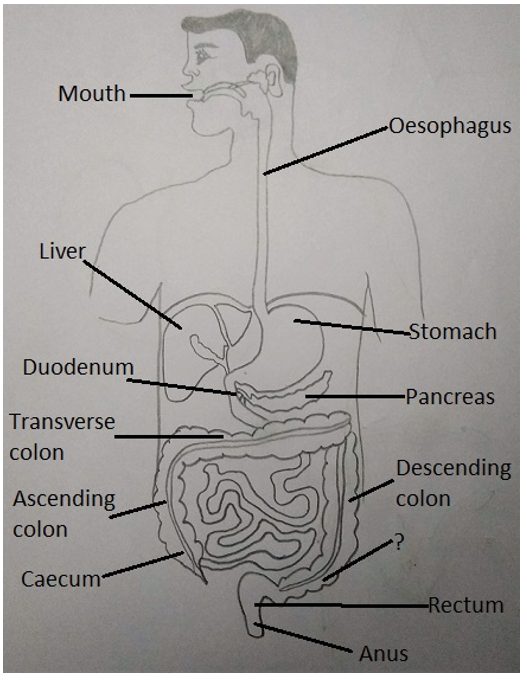
a) Transverse colon
b) Ascending colon
c) Descending colon
d) Sigmoid colon
View Answer
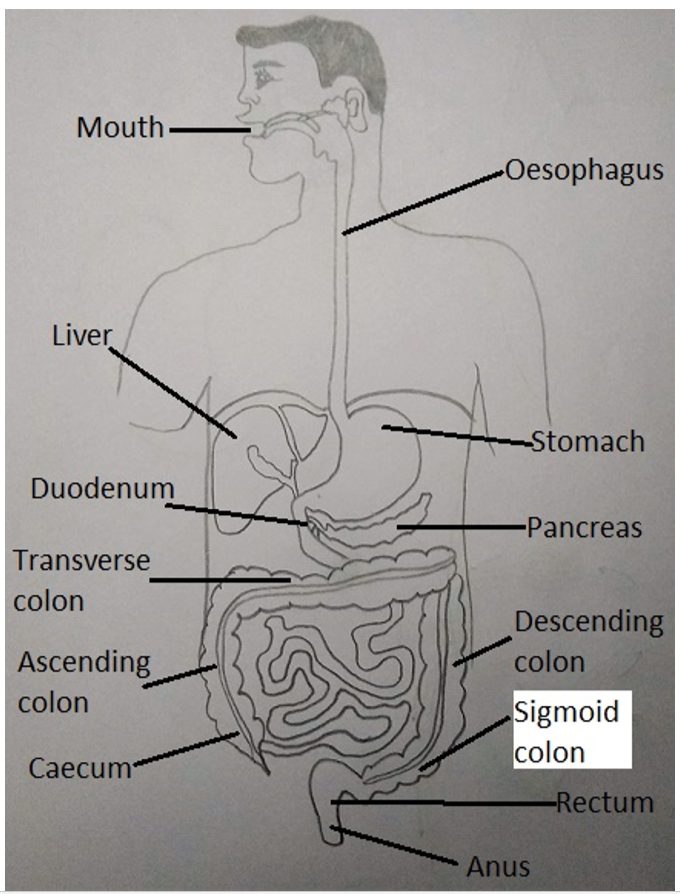
Explanation: The given figure represents the human digestive system. General organisation of the human digestive system is as follows:
13. The oral cavity leads into the trachea.
a) True
b) False
View Answer
Explanation: The oral cavity leads into a short pharynx which serves as a common passage for food and air. Arrangement of tonsils in a ring-like manner in the pharynx is called as Waldeyer’s ring.
14. Epiglottis is made up of which of the following tissues?
a) Ligament
b) Tendon
c) Cartilage
d) Bone
View Answer
Explanation: A cartilaginous flap called epiglottis prevents the entry of food into the glottis- the opening of the windpipe-during swallowing. The oesophagus and the trachea open into the pharynx.
15. Which of the following is not correct regarding oesophagus?
a) Thick
b) Long tube
c) Passes through neck
d) Extends posteriorly
View Answer
Explanation: The oesophagus is a thin, long tube which extends posteriorly passing through the neck, thorax and diaphragm and leads to a ‘J’ shaped bag-like structure called a stomach.
Comments
Post a Comment