
Biology MCQS P 4
Breathing and Exchange of Gases
This set of Class 11 Biology Chapter 17 Multiple Choice Questions & Answers (MCQs) focuses on “Breathing and Exchange of Gases”. These MCQs are created based on the latest CBSE syllabus and the NCERT curriculum, offering valuable assistance for exam preparation.
1. Gaseous exchange is held by ________
a) osmosis
b) simple diffusion
c) facilitated diffusion
d) co-transport
View Answer
Explanation: Gaseous exchange is a passive process. It is held by simple diffusion. Diffusion pressure for every gas is called partial pressure. At the time of diffusion, gases move from high partial pressure to low partial pressure.
2. What is the primary site for exchange of gases in lungs?
a) Larynx
b) Trachea
c) Alveoli
d) Bronchi
View Answer
Explanation: Alveoli are the primary site for exchange of gases in lungs. Exchange of gases is found only in respiratory zone of the lungs, as they are covered by simple squamous epithelium.

3. Solubility of carbon dioxide is ________ than oxygen.
a) more
b) less
c) 50 times more
d) equal
View Answer
Explanation: The solubility of carbon dioxide is 20-25 times higher than that of oxygen, therefore the amount of carbon dioxide that can diffuse through the diffusion membrane per unit difference in partial pressure is much higher compared to that of oxygen.
4. What is the concentration of oxygen in expired air?
a) 19%
b) 4%
c) 10%
d) 16%
View Answer
Explanation: Inspired air contains 19.6% oxygen and expired air has 15.7% oxygen. So approximately 4% oxygen goes to blood from air. In the same way inspired air contains carbon dioxide 0.04% and expired air has 3.6% carbon dioxide so approximately 3.56% carbon dioxide goes to air from blood.
5. Partial pressure of oxygen in alveolar air is ________
a) 159 mm Hg
b) 90 mm Hg
c) 104 mm Hg
d) 45 mm Hg
View Answer
Explanation: The Partial pressure of oxygen in alveolar air is 104 mm Hg, its value in arterial blood is 40 mm Hg. So, oxygen goes from alveolar air to arterial air. At the time of diffusion, gases move from high partial pressure to low partial pressure.
6. On which of the following factors diffusion does not depend?
a) Solubility of gases
b) Thickness of the respiratory membrane
c) Partial pressure difference
d) Molecular weight of gases
View Answer
Explanation: Diffusing capacity depends on solubility of gases, thickness of the respiratory membrane, partial pressure difference. These all factors play an important role in the exchange of gases through the process of simple diffusion.
7. Which one of the following does not consist diffusion membrane?
a) Thin squamous epithelium of alveoli
b) Cuboidal epithelium of alveoli
c) Basement membrane
d) Endothelium of blood capillaries
View Answer
Explanation: Alveoli is made up of simple squamous epithelium. Diffusion membrane is made up of three major layers: Thin squamous epithelium of alveoli, endothelium of blood capillaries, basement substances in between them.
8. Carbon dioxide is _______ times more soluble than oxygen.
a) 20-25
b) 5-10
c) 15-20
d) 25-30
View Answer
Explanation: The solubility of carbon dioxide is 20-25 times higher than that of oxygen, therefore the amount of carbon dioxide that can diffuse through the diffusion membrane per unit difference in partial pressure is much higher compared to that of oxygen.
9. What is the partial pressure of carbon dioxide in alveolar air and in deoxygenated blood respectively?
a) 50 mm Hg, 45 mm Hg
b) 104 mm Hg, 45 mm Hg
c) 45 mm Hg, 40 mm Hg
d) 40 mm Hg, 45 mm Hg
View Answer
Explanation: In alveolar air, partial pressure of carbon dioxide is 40 mm Hg and its value in deoxygenated blood is 45 mm Hg. So, carbon dioxide moves from arterial blood to alveoli. In this way, according to partial pressure exchange of gases takes place.
10. Right comparison of partial pressure of oxygen and partial pressure of carbon dioxide in the atmospheric air than in alveolar air is _________
a) partial pressure of oxygen lesser, partial pressure of carbon dioxide higher
b) partial pressure of oxygen higher, partial pressure of carbon dioxide lesser
c) partial pressure of oxygen lesser, partial pressure of carbon dioxide higher
d) partial pressure of oxygen lesser, partial pressure of carbon dioxide lesser
View Answer
Explanation: Partial pressure of oxygen in atmospheric air is 159 mm Hg and in alveoli is 104 mm Hg. Partial pressure of carbon dioxide in atmospheric air is 0.3 mm Hg and in alveoli is 40 mm Hg.
Body Fluids and Circulation
1. Which of the following is the most commonly used body fluid?
a) Blood
b) Plasma
c) Lymph
d) Serum
View Answer
Explanation: Blood is the most commonly used body fluid by most of the higher organisms including humans for the transportation of essential nutrients to the body tissues. Another body fluid, lymph also helps in the transport of certain substances.
2. Which of the following is absent on blood?
a) Fluid matrix
b) Plasma
c) Fibroblast
d) Formed elements
View Answer
Explanation: Fibroblast are special cells which are responsible for the formation of fibres in the areolar tissue which is a type of connective tissue. Blood is a special type of connective tissue which consists of a fluid matrix, plasma and formed elements.
3. How much percentage of plasma is present in the blood?
a) 35%
b) 45%
c) 50%
d) 55%
View Answer
Explanation: Plasma constitutes nearly 55% of the blood. 90-92% of plasma is water and proteins contribute 6-8 per cent of it. Fibrinogens, albumins and globulins are the major proteins.
4. Which of the following are needed for clotting of blood?
a) Fibrinogen
b) Albumin
c) Globulin
d) Magnesium ions
View Answer
Explanation: Fibrinogens are needed for clotting or coagulation of blood. Globulins primarily are involved in defence mechanisms of the body and the albumins help in the osmotic balance.
5. What is plasma without clotting factors known as?
a) Blood
b) Serum
c) Lymph
d) Fluid
View Answer
Explanation: Plasma without the clotting factors is known as serum. Factors for coagulation or clotting of blood are also present in the plasma in an inactive form.
6. Which of the following is not a formed element?
a) Erythrocytes
b) Leucocytes
c) Platelets
d) Lymph
View Answer
Explanation: Erythrocytes, leucocytes and platelets are collectively called as formed elements. They constitute nearly 45% of the blood. A reduction in these number can lead to numerous disorders.
7. RBCs are formed in the thymus.
a) True
b) False
View Answer
Explanation: RBCs are formed in the red bone marrow in the adults. RBCs are devoid of the nucleus in most of the mammals and are biconcave in shape. They have a red coloured iron-containing pigment called haemoglobin.
8. What is the average life span of RBCs?
a) 120 seconds
b) 120 hours
c) 120 days
d) 120 weeks
View Answer
Explanation: RBCs have an average life span of about 120 days after which they are destroyed in the spleen which is also known as the graveyard of RBCs. These molecules play a significant role in the transport of gases.
9. What is the colour of leucocytes?
a) White
b) Black
c) Red
d) Colourless
View Answer
Explanation: Leucocytes which are also known as white blood cells because they are colourless in nature as they lack haemoglobin. They are nucleated and are relatively lesser in number as compared to RBCs.
10. WBCs are characterised into 4 main categories.
a) True
b) False
View Answer
Explanation: WBCs are characterised into 2 main categories- granulocytes and agranulocytes. Neutrophils, eosinophils and basophils are different types of granulocytes while lymphocytes and monocytes are the agranulocytes.
11. Which of the following are the most abundant in WBCs?
a) Neutrophils
b) Basophils
c) Eosinophils
d) Lymphocytes
View Answer
Explanation: Neutrophils are the most abundant cells of the total WBCs as they constitute about 60-65 per cent of the total. Basophils are the least amongst as they constitute only 0.5-1 per cent of the total WBCs.
12. Which of the following is not secreted by basophils?
a) Histamine
b) Serotonin
c) Heparin
d) Serum
View Answer
Explanation: Basophils secrete histamine, serotonin and heparin which are involved in the inflammatory reactions. Histamine acts as a vasodilator while serotonin acts as a vasoconstrictor.
13. Which of the following WBCs are involved in allergic reactions?
a) Basophils
b) Eosinophils
c) Neutrophils
d) Monocytes
View Answer
Explanation: Eosinophils resist infections and are also associated with allergic reactions. Neutrophils and monocytes are phagocytic cells which destroy foreign organisms entering the body.
14. Lymphocytes constitute how much per cent of the total WBCs?
a) 10-15%
b) 20-25%
c) 40-50%
d) 56%
View Answer
Explanation: Lymphocytes constitute for about 20-25% of the total WBCs. These are of two major types-B and T forms. Both B and T lymphocytes are responsible for the immune responses of the body.
15. Platelets are produced from which of the following cells?
a) Erythrocytes
b) Thrombocytes
c) Megakaryocytes
d) Lymphocytes
View Answer
Explanation: Platelets are also called thrombocytes which are the cell fragments produced from megakaryocytes which are the special cells in the bone marrow.
Excretory Products and their Elimination
1. Which of the following is not included in the excretory system of humans?
a) Cloaca
b) Kidneys
c) Ureters
d) Urethra
View Answer
Explanation: In humans, the excretory system consists of a pair of kidneys, one pair of ureters, a urinary bladder, and urethra. Kidneys are reddish-brown and bean-shaped structures.
2. Where are the kidneys situated?
a) Between the 7th and 10th ribs
b) Between the last thoracic and third lumbar vertebra
c) Between the 8th and 9th ribs
d) Between the first and second thoracic vertebra
View Answer
Explanation: Kidneys are reddish-brown, bean-shaped structures situated between the levels of the last thoracic and third lumbar vertebra close to the dorsal inner wall of the abdominal cavity.
3. What is the average weight of a human kidney?
a) 40 g
b) 100 g
c) 120 g
d) 10 g
View Answer
Explanation: Each kidney of an adult human measures for about 10-12 cm in length, 5-7 cm in width, and 2-3 cm in thickness with an average weight of 120-170 grams.
4. Through which of the following nerves and blood vessels enter the kidneys?
a) Hilum
b) Tubules
c) Pelvis
d) Medulla
View Answer
Explanation: Through the hilum, the nerves, the ureters and the blood vessels enter the kidneys. The hilum is a notch which is present towards the centre of the inner concave surface of the kidney.
5. Inside the kidney, there are three zones.
a) True
b) False
View Answer
Explanation: The outer layer of the kidney is a tough capsule. Inside the kidney, there are two zones, an outer cortex, and an inner medulla. Inner to the hilum, a broad funnel-shaped space is presently called the renal pelvis.
6. Which of the following is responsible for the formation of Columns of Bertini?
a) Medulla
b) Renal pelvis
c) Calyces
d) Cortex
View Answer
Explanation: Cortex is mainly responsible for the formation of columns of Bertini. The portion of the cortex which extends in between the medullary pyramids as renal columns form the columns of Bertini. The medulla region of the kidney is divided into a few conical masses called medullary pyramids which project into the calyces.
7. Which of the following is incorrectly marked in the given diagram?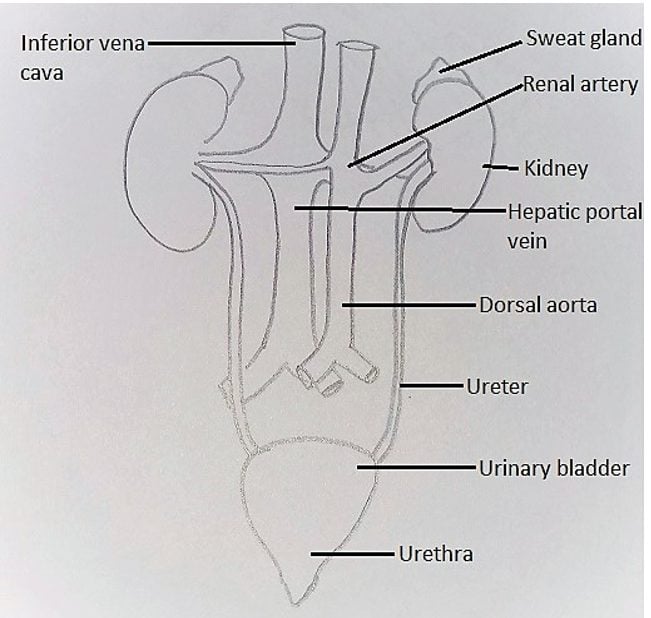
a) Renal artery and inferior vena cava
b) Hepatic portal vein and sebaceous gland
c) Dorsal aorta and ureter
d) Urinary bladder and urethra
View Answer
Explanation: The correct labelling of the given diagram is as shown below:
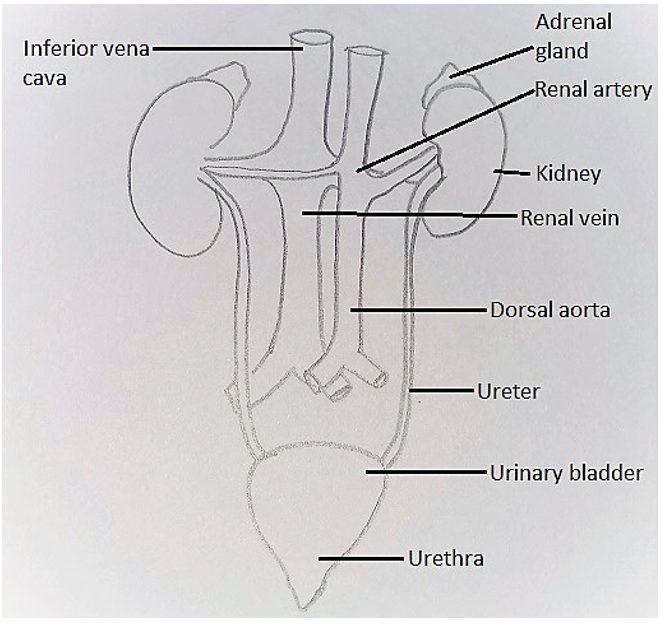
The given diagram represents the human urinary system. The human urinary system is a complex excretory system which is responsible for the concentration of urine and elimination of urea from the body.
8. How many nephrons are present in each kidney?
a) One million
b) One billion
c) One trillion
d) Two million
View Answer
Explanation: Each kidney has approximately one million complex tubular structures called nephrons. These nephrons are the structural and functional units of the kidneys.
9. In how many parts a nephron is divided?
a) One
b) Two
c) Three
d) Four
View Answer
Explanation: Each nephron is divided into two parts- the glomerulus and the renal tubule. The glomerulus is a tuft of capillaries while the renal tubule begins with a double-walled cup-like structure called Bowman’s capsule.
10. What will happen if the diameter of the afferent arteriole is less than efferent arteriole?
a) Dilute urine
b) Concentrated urine
c) No ultrafiltration
d) Black urine
View Answer
Explanation: The afferent arteriole is a fine branch of the renal artery which has ha wider lumen than the efferent arteriole which carries blood away from the glomerulus. If the afferent arteriole diameter is less than the efferent arteriole, then ultrafiltration is not possible.
11. What does the question mark represents in the given figure?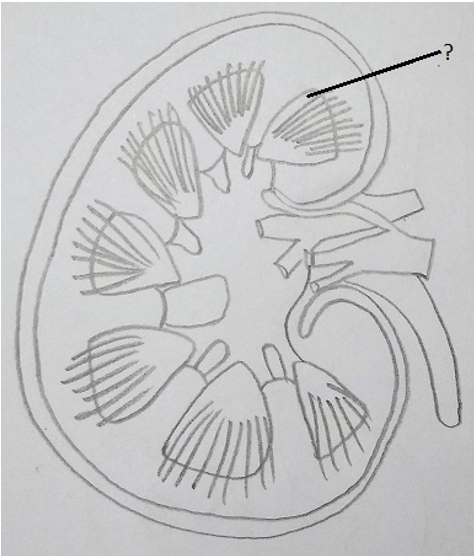
a) Cortex
b) Medulla
c) Medullary pyramid
d) Renal pelvis
View Answer
Explanation: The correct labelling of the given figure is as shown:
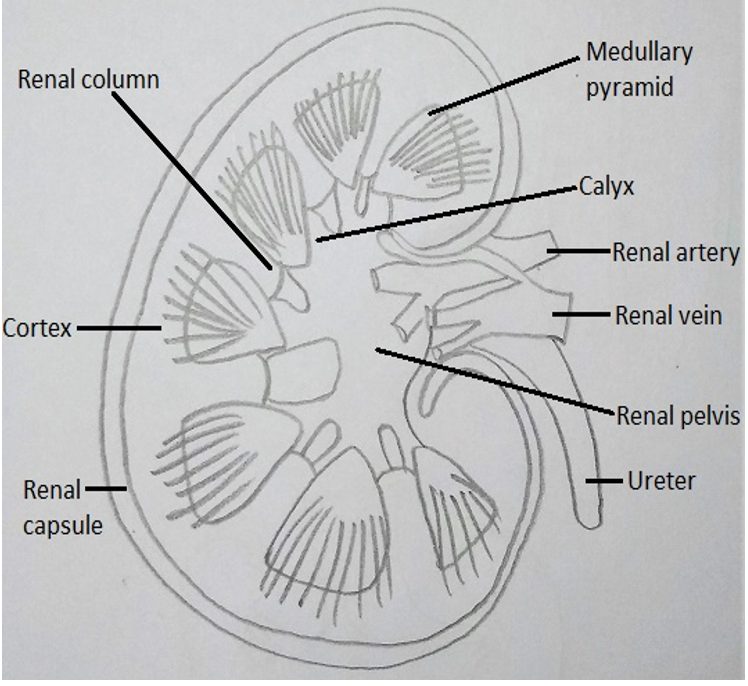
This figure represents the longitudinal section or a diagrammatic view of a kidney.
12. Starfishes are aminotelic organisms.
a) True
b) False
View Answer
Explanation: Starfishes are aminotelic organisms as they excrete amino acids directly into the urine. Hippuric acid is an excretory waste formed by the combination of benzoic acid and glycine in mammals.
13. What are osmoregulators?
a) Animals which cannot change their body osmolarity
b) Animals which can change their osmolarity sometimes
c) Animals which can change their osmolarity
d) Animals which cannot excrete out waste
View Answer
Explanation: Osmoregulators are the animals that cannot change their body osmolarity according to their external environment. They cannot tolerate a wide range of salinity.
14. Which of the following organism is not an osmoconformer?
a) Hagfish
b) Spongilla
c) Marine invertebrates
d) Skates
View Answer
Explanation: Osmoconformers are the animals that can change their body osmolarity according to the external environment like hagfish, marine invertebrates, sharks, and skates.
15. Which of the following is not an adaptation of kangaroo rat?
a) Drinks water
b) Feeds on fatty seeds
c) Excretes concentrated urine
d) The nasal counter current system
View Answer
Explanation: Kangaroo rat does not drink water as it feeds on fatty seeds because 1g of fat oxidation produces a double amount of water. It excretes out concentrated urine and has a nasal counter current system.
Locomotion and Movement
1. Which of these do not involve flagellar movement?
a) Swimming of spermatozoa
b) Maintenance of water current in sponges
c) Locomotion of some protozoans
d) Movement of macrophages in blood
View Answer
Explanation: The movement of macrophages in blood does not involve the use of flagella. Macrophages are phagocytic in nature and are a part of the immune system. They show amoeboid movement.
2. What percentage of body weight of an adult human is contributed by muscles?
a) 20-30%
b) 10-20%
c) 40-50%
d) 30-40%
View Answer
Explanation: 40-50% of the total body weight of an adult human is contributed by muscles. Muscles are required for numerous processes of the body in order to survive and locomote. They are of mesodermal origin.
3. Which of these is not a property of muscles?
a) Extensibility
b) Excitability
c) Degradability
d) Elasticity
View Answer
Explanation: 40-50% of the total body weight of an adult human is contributed by muscles. Muscles have several properties such as elasticity, extensibility, excitability and contractibility. Degradability is not a property.
4. Which of these is not a basis of classification for muscles?
a) Excitability
b) Appearance
c) Location
d) Regulation of activities
View Answer
Explanation: Muscles have several properties such as elasticity, extensibility, excitability and contractibility. Muscles can be classified on the basis of appearance, location and regulation of activities.
5. Which of these statements is not true regarding skeletal muscles?
a) They are also called voluntary muscles
b) They help in the movement of food through the oesophagus
c) They have striations
d) They are involved in changing of body posture
View Answer
Explanation: Skeletal muscles are also known as voluntary muscles. They have striations and are also known as striated muscles. They are involved in changing of body posture but not in the movement of food through the oesophagus.
6. Which of these is not a characteristic of cardiac muscles?
a) They work continuously
b) They are branched
c) They are not striated
d) They are involuntary
View Answer
Explanation: Cardiac muscles are the muscles of the heart. Cardiac muscles are involuntary muscles that work continuously to pump blood throughout the body. They are branched and are striated in appearance.
7. What is fascia made of?
a) Collagen
b) Keratin
c) Microtubules
d) Muscle fibres
View Answer
Explanation: Fascia is a layer of connective tissue that surrounds the fascicles or muscle bundles in a muscle. It is made out of collagen. Each muscle bundle contains a number of muscle fibres or muscle cells.
8. Identify the structure shown in the figure.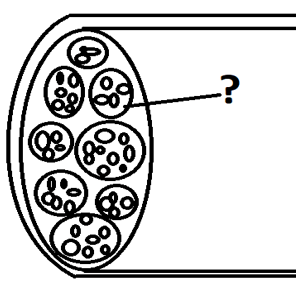
a) Fascia
b) Muscle fibre
c) Sarcolemma
d) Fascicle
View Answer
Explanation: The diagram given is that of the cross-sectional view of a muscle. The structure shown is a fascicle or a muscle bundle. A number of fascicles or muscle bundles are surrounded by a collagenous fascia.
9. Identify the structure shown in the figure.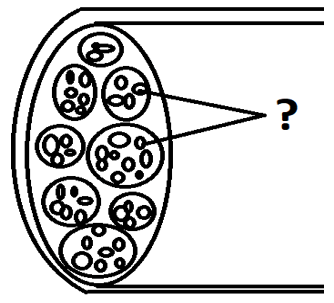
a) Fascicle
b) Muscle bundles
c) Muscle fibres
d) Fascia
View Answer
Explanation: The diagram given is that of the cross-sectional view of a muscle. The structures shown are muscle fibres or muscle cells. A number of muscle fibres are grouped together into a muscle bundle.
10. A muscle fibre is a syncytium. True or false?
a) True
b) False
View Answer
Explanation: A muscle fibre or a muscle cell possesses many nuclei or is multinucleated. Hence, it is a syncytium. A number of muscle fibres or muscle cells are grouped together into a muscle bundle or fascicle.
11. Which of these ions are abundant in the sarcoplasmic reticulum?
a) Magnesium
b) Sodium
c) Potassium
d) Calcium
View Answer
Explanation: The sarcoplasmic reticulum is the endoplasmic reticulum present in the sarcoplasm of the muscle cell or the muscle fibre. The sarcoplasmic reticulum contains a large number of calcium ions.
12. Which of these structures has alternate dark and light bands on it?
a) Fascicles
b) Sarcolemma
c) Myofibrils
d) Fascia
View Answer
Explanation: Each muscle cell or muscle fibre contains filaments in its sarcoplasm which are arranged in a parallel manner. These filaments are known as myofibrils and they have alternate dark and light bands.
13. What does the A band of a myofibril contain?
a) Troponin
b) Actin
c) Myosin
d) Tropomyosin
View Answer
Explanation: The A band or anisotropic band contains the protein myosin. The A band is also known as the dark band. The light bands, also called the I bands or the isotropic bands contain the protein actin.
14. Which of these statements is false regarding myofibrils?
a) The A band is also known as the light band
b) Myosin is parallel to the longitudinal axis of myofibril
c) Light bands contain actin
d) Anisotropic bands contain myosin
View Answer
Explanation: Actin and myosin lie parallel to the longitudinal axis of the myofibril and also to each other. The A band or the anisotropic band or the dark band contains myosin while the light band contains actin.
15. Actin filaments are thicker than myosin filaments. True or false?
a) True
b) False
View Answer
Explanation: Actin and myosin lie parallel to the longitudinal axis of the myofibril and also to each other. The A band contains myosin while the light band contains actin. Actin filaments are thinner than myosin filaments.
Neural Control and Coordination
1. Which of the following integrates all the activities of the organs?
a) The neural and endocrine system
b) The neural and digestive system
c) Digestive and excretory system
d) Excretory and Respiratory system
View Answer
Explanation: In our body, the neural and the endocrine system jointly coordinate and integrate all the activities of the organs so that they function in a synchronised fashion.
2. Which network does the neural system provide?
a) Cell to cell connection only
b) Point to point connection
c) Organ to organ connection only
d) Tissue to tissue connection only
View Answer
Explanation: The neural system provides an organized network of point to point connections for quick coordination. These functions of the organs or the organ systems must be coordinated in our body to maintain homeostasis.
3. What is meant by coordination?
a) Only two organs interact
b) Only three organs interact
c) Only two organs systems interact
d) Two or more organs interact
View Answer
Explanation: Coordination is the process through which two or more organs interact and complement the functions of one another. For example, the functions of muscles, lungs, heart, blood vessels, kidney, and other organs are coordinated while performing physical exercises.
a) Chemical integration through cell secretions
b) Chemical integration through cell division
c) Chemical integration through hormones
d) Chemical integration through tissues
View Answer
Explanation: The endocrine system provides chemical integration through the hormones. The neural and the endocrine systems jointly coordinate and regulate the physiological functions in the body.
5. Which of the following functions is not performed by neurons?
a) Detect the stimuli
b) Receive the stimuli
c) Transmit the stimuli
d) Secrete the stimuli
View Answer
Explanation: The neurons are not responsible for secreting the stimuli. Instead, their main functions include-detecting, receiving and transmitting stimuli over large distances in our body.
6. What kind of neurons is present in Hydra?
a) Apolar neurons
b) Unipolar neurons
c) Bipolar neurons
d) Multipolar neurons
View Answer
Explanation: The neural organisation is very simple in lower invertebrates. For example, Hydra neural organisation just consists of a network of neurons. Apolar or non-polar types of neurons are present in hydra.
7. The neural system of lower invertebrates is better than the insects.
a) True
b) False
View Answer
Explanation: The neural system of insects is better organised than the lower invertebrates as a brain is present along with several ganglia and neural tissues. The vertebrates have a more developed neural system.
8. How can a nerve cell be distinguished from other cells of the body?
a) Presence of granules in nucleus
b) Presence of different nucleus
c) Presence of neurites
d) Presence of ribosomes
View Answer
Explanation: A nerve cell can be distinguished from other cells of the body by the presence of neurites. Neurites are any projection from the cell body of the neuron-like dendrites or the axons.
9. What is the full form of PNS?
a) Peripheral neural systole
b) Peripheral nervous system
c) Peritubular neural systole
d) Peritubular nervous system
View Answer
Explanation: PNS stands for the Peripheral nervous system. The PNS comprises of all the nerves of the body associated with the central nervous system-brain and the spinal cord.
10. How many different types of PNS fibres are there?
a) One
b) Two
c) Three
d) Four
View Answer
Explanation: The nerve fibres of the PNS are of two types:
i. Afferent fibres which transmit impulses from tissues/organs to CNS
ii. Efferent fibres which transmit regulatory impulses from CNS to the concerned tissues/organs.
11. The peripheral nervous system has how many divisions?
a) Two
b) Three
c) Four
d) Five
View Answer
Explanation: The PNS is divided into two major divisions called somatic neural system and autonomic neural system. The somatic neural system relays impulses from CNS to the skeletal muscles while ANS transmits impulses from CNS to the smooth muscles.
12. The visceral nervous system is the part of the peripheral nervous system.
a) True
b) False
View Answer
Explanation: Visceral nervous system is the part of the peripheral nervous system that comprises the whole complex of nerves, fibres, ganglia, and plexuses by which impulses travel from the CNS to the viscera and vice-versa.
13. Which of the following is not a part of a neuron?
a) Cell body
b) Lignin
c) Dendrites
d) Axon
View Answer
Explanation: A neuron is a microscopic structure composed of three major parts, namely, call body, dendrites, and axon. The cell body contains cytoplasm with typical cell organelles and certain granular bodies called Nissl’s granules.
14. What are the short repeatedly branched fibres called?
a) Axon
b) Cell body
c) Neurite
d) Dendrite
View Answer
Explanation: Short and repeatedly branched fibres are called dendrites. These branches project out of the cell body of the neuron. These branches also contain Nissl’s granules in their cytoplasm.
15. What does each branch of axon terminate into?
a) Synaptic knob
b) Vesicles
c) Tubules
d) Another cell
View Answer
Explanation: Each branch of an axon terminates into a synaptic knob. The axon is a long fibre which is branched at the end. Each branch terminates as a bulb-like structure called a synaptic knob. These knobs consist of some synaptic vesicles which contain some neurotransmitters like acetylcholine.
Chemical Control and Coordination
1. Which of the following is incorrect regarding the endocrine glands?
a) They are known as ductless glands
b) Their secretions are called hormones
c) Hormones are secreted through ducts in the bloodstream
d) These glands lack ducts
View Answer
Explanation: Endocrine glands lack ducts and are hence, known as ductless glands. Their secretions are called hormones. As these glands do not have ducts, therefore they release their secretions directly into the bloodstream.
2. Which of the following is not an endocrine gland?
a) Pituitary gland
b) Sebaceous gland
c) Pineal gland
d) Adrenal gland
View Answer
Explanation: Pituitary, pineal, thyroid, adrenal, pancreas, parathyroid, thymus, and gonads are the organised endocrine bodies in our body. The endocrine glands and their hormones constitute the endocrine system.
3. Hypothalamus is the basal part of which of the following?
a) Forebrain
b) Midbrain
c) Hindbrain
d) Mesencephalon
View Answer
Explanation: The hypothalamus is the basal part of the diencephalon, forebrain and it regulates a wide spectrum of body functions. It contains several groups of neurosecretory cells called nuclei which produce hormones.
a) One
b) Two
c) Three
d) Four
View Answer
Explanation: The hormones produced by the hypothalamus are of two types:
i. Releasing hormones-which stimulate the secretion of pituitary hormones
ii. Inhibiting hormones-which inhibit the secretion of pituitary hormones.
5. Where do the hypothalamic hormones originate?
a) Nerve endings
b) Synaptic vesicles
c) Hypothalamic neurons
d) Axons
View Answer
Explanation: The hypothalamic hormones originate in the hypothalamic neurons, pass through axons, and are released from their nerve endings. These hormones reach the pituitary gland through a portal circulatory system and regulate the function of the anterior pituitary.
6. Gonadotrophins inhibits the release of growth hormones from the pituitary gland.
a) True
b) False
View Answer
Explanation: Somatostatin from the hypothalamus inhibits the release of growth hormones from the pituitary gland. Gonadotrophin releasing hormones stimulate the pituitary synthesis and release of gonadotrophins.
7. Which part of the pituitary is under the direct control of the hypothalamus?
a) Posterior part
b) Anterior part
c) Dorsal part
d) Ventral part
View Answer
Explanation: The posterior pituitary is under the direct neural regulation of the hypothalamus. The pituitary gland is located in a bony cavity called Sella turcica and is attached to the hypothalamus by a stalk.
8. In how many parts, the pituitary is divided?
a) One
b) Two
c) Four
d) Five
View Answer
Explanation: The pituitary is anatomically divided into two major portions known as adenohypophysis and neurohypophysis. Adenohypophysis consists of two portions, pars distalis, and pars intermedia.
9. Which of the following hormone is not secreted by the pars distalis region of the pituitary?
a) Prolactin
b) Growth hormone
c) Follicle-stimulating hormone
d) Oxytocin
View Answer
Explanation: The pars distalis region of pituitary produces growth hormone, prolactin, thyroid-stimulating hormone, adrenocorticotrophic hormone, luteinizing hormone, and follicle-stimulating hormone.
10. Oxytocin and vasopressin are synthesised by the pituitary.
a) True
b) False
View Answer
Explanation: Posterior pituitary stores and releases two hormones called oxytocin and vasopressin, which are actually synthesised by the hypothalamus and are transported axonally to the neurohypophysis.
11. Low secretion of the growth hormone causes which of the following diseases?
a) Acromegaly
b) Gigantism
c) Dwarfism
d) Thyroid
View Answer
Explanation: Low secretion of growth hormone results in stunted growth and which is known as dwarfism while the over secretion of the growth hormone causes the abnormal growth of the body leading to gigantism.
12. Which of the following diseases is hard to diagnose?
a) Gigantism
b) Goitre
c) Dwarfism
d) Acromegaly
View Answer
Explanation: Excess secretion of growth hormones in adults especially in middle age can result in severe disfigurement which is known as Acromegaly, which may lead to serious complications. The disease is hard to diagnose in the early stages and often goes undetected for many years.
13. Which of the following hormones regulate the growth of mammary glands?
a) Prolactin
b) TSH
c) FSH
d) ACTH
View Answer
Explanation: Prolactin regulates the growth of the mammary glands and the formation of milk in them. ACTH stimulates the synthesis and steroid hormones called glucocorticoids from the adrenal cortex.
14. Which of the following hormones are known as gonadotrophins?
a) LH and Oxytocin
b) LH and vasopressin
c) LH and FSH
d) FSH and Oxytocin
View Answer
Explanation: LH and FSH stimulate the gonadal activity and are therefore referred to as gonadotrophins. In males, LH stimulates the synthesis and secretion of hormones called androgens from the testis.
15. Which of the following is not a function of LH and FSH in females?
a) Induces ovulation
b) Secretion of androgens
c) Maintaining corpus luteum
d) Stimulates the growth of follicles
View Answer
Explanation: FSH stimulates the growth and development of the ovarian follicles in females. LH induces ovulation of fully mature follicles and maintains the corpus luteum, formed from the remnants of Graafian follicles after ovulation in females.
Comments
Post a Comment