
Biology MCQS P 6
Microbes in Human Welfare
1. What is the average size of a microbe?
a) Less than 1 mm
b) More than 1 cm
c) Less than 0.1 mm
d) More than 0.1 mm
View Answer
Explanation: Microbes are microorganisms which have a size less than 0.1 mm. Besides macroscopic plants and animals, microbes are the major components of biological systems on this earth.

2. Microbes are only present in hot and humid areas.
a) True
b) False
View Answer
Explanation: Microbes occur everywhere- in soil, water, air, inside our bodies and that of other animals and plants. They are present even at sites where no other life-form could possibly exist- sites such as deep inside geysers, deep in the soil, etc.
3. Which of the following is not related to microbes?
a) Microbes are not ideal for biotechnology
b) Microbes produce chemicals during their metabolism
c) Microbes can be grown on artificial medium
d) Microbes can live in highly acidic medium
View Answer
Explanation: Microbes can be grown on artificial cultures media where they form colonies. During their metabolism, microbes produce chemicals, some of which are used by human beings. Microbes can live in highly acidic as well as an alkaline medium. Microbes are certainly ideal for biotechnology.
a) Bacteria
b) Protozoa
c) Viroids
d) Worms
View Answer
Explanation: Microbes are diverse in nature and include- protozoa, bacteria, fungi and microscopic animal and plant viruses, viroids and also prions that are proteinaceous infectious agents.
5. Which shape of bacteria has been represented in the following diagram?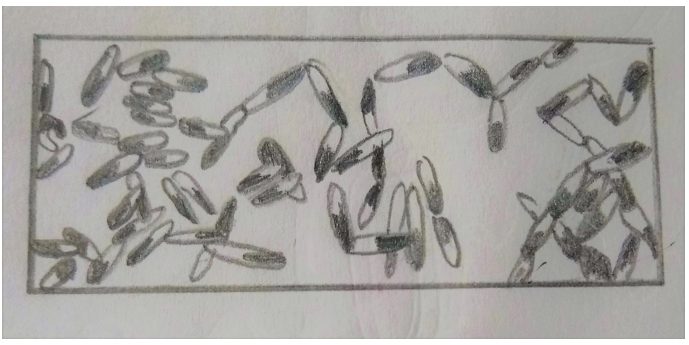
a) Rod-shaped
b) Comma shaped
c) Spiral shaped
d) Spherical shaped
View Answer
Explanation: The following diagram represents rod-shaped bacteria, magnified 1500X. Some examples of rod-shaped bacteria include Lactobacillus, Morganella, Bacillus anthracis, Klebsiella pneumoniae.
6. Which shape of bacteria has been shown in the following diagram?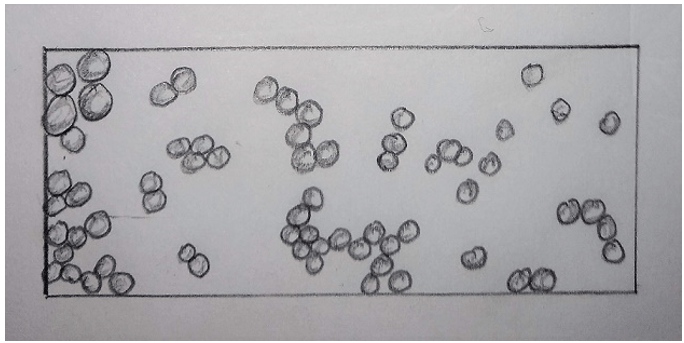
a) Rod-shaped
b) Comma shaped
c) Spiral shaped
d) Spherical shaped
View Answer
Explanation: The following diagram represents spherical shaped bacteria, magnified 1500X. Some examples of Spherical shaped bacteria include Staph aureus, Staph epidermidis, Staph haemolyticus, Strep pyrogenes, etc.
7. The following diagram represents ____________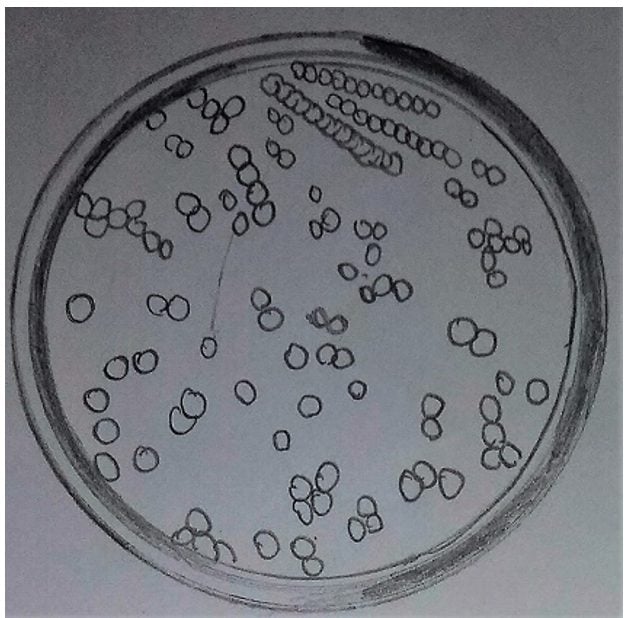
a) Plate with worms
b) Colonies of bacteria on a petri dish
c) Onion root cells on a plate
d) Cheek cells
View Answer
Explanation: The following diagram represents colonies of bacteria on a petri dish. Microbes like bacteria and many fungi can be grown on nutritive media to form colonies, that can be seen with naked eyes.
8. All microbes are harmful to humankind.
a) True
b) False
View Answer
Explanation: Although microbes cause a large number of diseases in human beings, various animals and plants, but not all microbes are harmful. Several microbes are useful to humans in diverse ways like in household products, industrial products, agricultural products, etc.
9. In the following diagram, what does the question mark represent?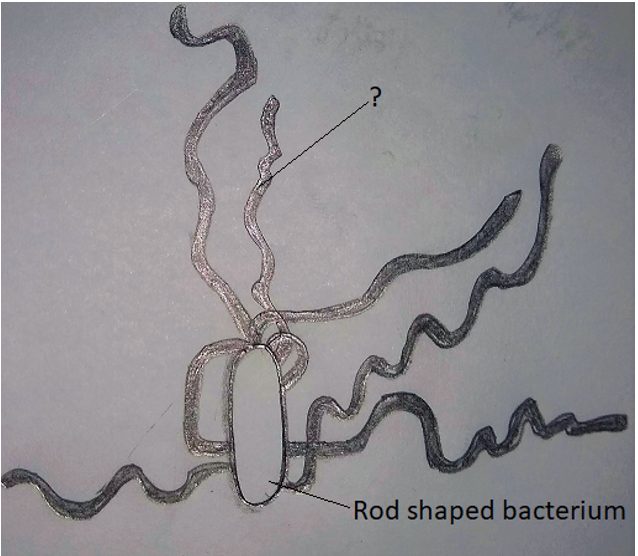
a) Cilia
b) Flagella
c) Hair
d) Pseudopodia
View Answer
Explanation: The question mark in the following figure represents flagella of a rod-shaped bacterium. It is 50,000X magnified image of a bacterium.

10. Adenoviruses cause _________
a) Respiratory infections
b) Gastric problems
c) Intestinal perforation
d) Heart attack
View Answer
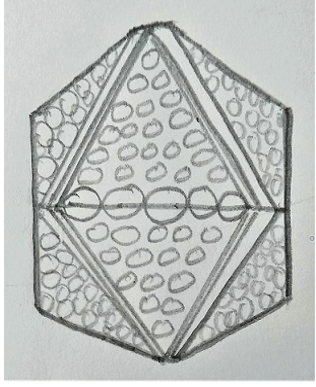
Explanation: Adenoviruses cause respiratory infections. These are non-enveloped viruses with a double-stranded DNA genome. The following diagram shows an adenovirus:
Biotechnology Principles and Processes
1. Who gave the definition of Biotechnology?
a) The European Federation of Biotechnology (EFB)
b) National Center for Biotechnology Information (NCBI)
c) National Institutes of Health (NIH)
d) National Centre for Cell Science (NCCS)
View Answer
Explanation: The European Federation of Biotechnology (EFB) has given a definition of biotechnology as ‘The integration of natural science and organisms, cells, parts thereof, and molecular analogues for products and services’.
2. What are the two views does the definition of Biotechnology encompass?
a) Medical biotechnology and Agricultural biotechnology
b) Traditional biotechnology and Modern molecular biotechnology
c) Blue biotechnology and Red biotechnology
d) Green biotechnology and Animal biotechnology
View Answer
Explanation: The European Federation of Biotechnology (EFB) has given a definition of biotechnology that encompasses both traditional view and modern molecular biotechnology. Traditional biotechnology is mainly based on fermentation technology using micro-organisms. Modern biotechnology is a combination of biology and production technology based on genetic engineering.
3. The two core techniques that enabled the birth of modern biotechnology are _____
a) red biotechnology and green biotechnology
b) classical and traditional biotechnology
c) genetics and mathematics
d) genetic engineering and maintenance of a sterile environment
View Answer
Explanation: Genetic engineering and maintenance of a sterile environment are the two core techniques that gave birth to modern biotechnology. Genetic engineering uses techniques to alter the chemistry of genetic material and exploit them. While maintenance of a sterile environment enables the growth of only the desired organisms in large quantities for the manufacture of biotechnological products.
4. _____ is a product of biotechnology.
a) Bacteria
b) Skin
c) Vaccine
d) Plants
View Answer
Explanation: Vaccine is a product of biotechnology. The maintenance microbial contamination-free environment is necessary for chemical engineering processes. This environment enables the growth of the desired organism only. Thus, producing the organism in large quantities for the manufacture of biotechnological products like antibiotics, vaccines, enzymes, etc.
5. The techniques of _______ overcome the limitation of traditional hybridization procedures.
a) immunology
b) modern hybridization
c) genetic engineering
d) cell biology
View Answer
Explanation: Traditional hybridization procedures lead to the inclusion and multiplication of undesirable genes along with the desired genes. The techniques of genetic engineering such as recombinant DNA, use of gene cloning and gene transfer overcome the limitation of traditional hybridization procedures.
6. What initiates the replication in DNA?
a) DNA ligase
b) Origin of replication
c) Termination sequences
d) Histone proteins
View Answer
Explanation: In a chromosome, there is a specific DNA sequence called the origin of replication, which is responsible for initiating replication. DNA ligase is an enzyme which helps in joining of DNA. Termination sequences are the site at which DNA replication terminates while histones are the proteins around which DNA is wound.
7. _____ is an autonomously replicating circular extra-chromosomal DNA.
a) Bacteria
b) Nitrogenous base
c) RNA
d) Plasmid
View Answer
Explanation: Plasmid is typically a small circular DNA strand in the cytoplasm of a bacterium or protozoan. It is a genetic structure in a cell that can replicate independently of the chromosomes. They are commonly used in recombinant DNA technology.
8. Restriction enzymes are _______
a) ligases
b) sticky ends
c) molecular scissors
d) vectors
View Answer
Explanation: Restriction enzymes are molecular scissors. They are also known as restrictase. They are short nucleotide sequences that recognize the specific sites and cleave the DNA at or near specific recognition sites within molecules.
9. Plasmid DNA acts as _____ to transfer the piece of DNA attached to it into the host organism.
a) protein
b) carrier
c) vector
d) antibody
View Answer
Explanation: A vector is a DNA molecule used as a vehicle to artificially carry foreign genetic material into another cell. Plasmid DNA is commonly used as a vector to insert the gene of interest in the desired organism.
10. Making multiple copies of the desired DNA template is called ______
a) cloning
b) transferring
c) r-DNA technology
d) genetic engineering
View Answer
Explanation: The term cloning means making multiple copies of the desired DNA template which are genetically identical. This process can be natural or artificial. The clone then replicates itself inside the host body.
11. ______ organism’s plasmid was used for the construction of first recombinant DNA.
a) Cyanobacteria
b) Bacillus subtilis
c) Saccharomyces cerevisiae
d) Salmonella typhimurium
View Answer
Explanation: The first recombinant DNA was constructed by linking a gene encoding antibiotic resistance with a native plasmid of Salmonella typhimurium. This experiment was successfully conducted by Stanley Cohen and Herbert Boyer in 1972.
Biotechnology and its Applications
1. What does the second critical research area of biotechnology provide?
a) Optimum conditions for the catalyst
b) The pure form of catalyst
c) An impure form of catalyst
d) Purification of products
View Answer
Explanation: There are three critical research areas in biotechnology. They are 1. It provides the best catalyst in the form of an improved organism (transformants) usually a microbe or pure enzyme. 2. It creates optimum conditions for the catalyst by the method of genetic engineering. 3. Purification of products by downstream processing.
2. What is the green revolution related to?
a) Milk
b) Agriculture
c) Water
d) Animals
View Answer
Explanation: The green revolution is related to agriculture. It occurred between 1950-1960 and mainly focused on increasing agricultural production. It started in Mexico.
3. Who was the leader of the green revolution?
a) Verghese Kurien
b) Neel Kranti
c) Napoleon Bonaparte
d) Norman Borlaug
View Answer
Explanation: The Green revolution is related to Norman Borlaug. Neel Kranti is the name assigned to the blue revolution by the Indian government. Napoleon Bonaparte led the French revolution while the “Father of White Revolution” is Verghese Kurien.
4. Who led the green revolution in India?
a) Neel Kranti
b) Verghese Kurien
c) M.S. Swaminathan
d) M.K. Gandhi
View Answer
Explanation: The green revolution in India was founded by M.S. Swaminathan. It was a part of the green revolution led by Norman Borlaug. It focused on increasing the agricultural yield, especially in states of Haryana, Punjab and Uttar Pradesh.
5. GMO stands for _______
a) Genetically Matured Organisms
b) Genetically Mental Organs
c) Genetically Modified Organisms
d) Genetically Mutant Organism
View Answer
Explanation: GMO stands for Genetically Modified Organisms. The genes of these organisms have been manipulated to obtain the desired product. GMO can be a plant, bacteria, fungi or animal.
6. An important objective of biotechnology in the area of agriculture is ________
a) to decrease seed number
b) to produce pest-resistant varieties of plants
c) to increase phosphorous, nitrogen production
d) to reduce the number of plants
View Answer
Explanation: An important objective of biotechnology in the area of agriculture is to produce pest-resistant varieties of plants. This will help in less wasting of crops with high yield. It will also give more products in less time and space.
7. A GM crop is _______
a) mature crop
b) infected crop
c) raised to green manure
d) transgenic crop
View Answer
Explanation: GM stands for Genetically Modified. A GM crop is a transgenic crop in which the genes of the desired crop are changed by manipulations using various methods. This method gives a high yield without waste of crops.
8. An example of abiotic stress is ________
a) pest
b) insect
c) drought
d) vectors
View Answer
Explanation: Abiotic stress is the negative impact of the non-living factors on the environment. Stress is created when this non-living factor influences the environment beyond its normal range. Examples of abiotic stress are drought, cold, heat, salt, etc.
9. GM rice is enriched with vitamin _____
a) K
b) D
c) A
d) E
View Answer
Explanation: GM rice is enriched with vitamin A. it is also known as golden rice. Gm rice produces beta carotene which is a precursor of vitamin A. Vitamin A is important for growth and development and for good vision.
10. Bt toxin is produced by a bacterium called ______
a) Bacillus thuringiensis
b) Bacillus anthracis
c) Bacillus thermophilus
d) Bacillus subtilis
View Answer
Explanation: Bt stands for Bacillus thuringiensis. It is a bacterium that produces Bt toxin. In plants the gene of this toxin provides resistance against insects, thus there is no need for spraying insecticides on plants.
11. GMOs can minimize the use of fertilizers.
a) True
b) False
View Answer
Explanation: GMOs can minimize the use of fertilizers. GMO’s itself has genes that can fight against the infectious organism’s thus giving high yield. It also has high nutritional content.
12. ________ was the first transgenic crop.
a) Potato
b) Brinjal
c) Cotton
d) Tobacco
View Answer
Explanation: The first transgenic crop (GMO) was tobacco. It was developed in the year 1983. It was first commercially released in China in 1992. It was a virus-resistance plant.
Organisms and Populations
1. What is a group of individuals belonging to the same species within an ecosystem called?
a) Species
b) Population
c) Biomes
d) Manipulation
View Answer
Explanation: A group of individuals belonging to the same species within an ecosystem is called population. The population is the level of the organization after an organism. Various organisms come together and start residing at the same place known as population.
2. For what is the interaction among organisms is necessary?
a) Attraction
b) Survival
c) Infection
d) Death
View Answer
Explanation: The interaction among organisms is necessary for survival within their environment. Survival is the state of being alive. Organisms are inter-depending on one another of their well-being.
3. Maximum productivity is found in which of the following ecosystem?
a) Grassland
b) Desert
c) Temperate forests
d) Tropical rainforests
View Answer
Explanation: Maximum productivity is found in an ecosystem of tropical rainforests. It is a place where there is no dry season and continuous precipitation. It is also known as evergreen forests.
a) Botanical gardens
b) Grasslands
c) Rivers
d) Forests
View Answer
Explanation: Botanical gardens are a man-made terrestrial ecosystem. It is a place where various plants are collected, cultivated, preserved and displayed for the purposes of research and education. It is also used for the conservation of rare and endangered species of plants.
5. Which type of forest is found near the equator?
a) Coniferous forests
b) Grasslands
c) Tropical forests
d) Deciduous forests
View Answer
Explanation: Tropical forests are found near the equator. They are situated 28° above (north) or below (south) of the equator. These are the forests where there is continuous rainfall and maximum diversity is observed.
6. Which of the following is an example of an artificial ecosystem?
a) Forest
b) Rice field
c) Lake
d) Grassland
View Answer
Explanation: Rice field is an artificial man-made ecosystem. It is mainly practiced in China where paddy is the staple food. This ecosystem involves paddy (rice), fishes, microbes and various other environmental factors such as space and time.
7. What are the functional units of nature, where organisms interact with each other and their surroundings?
a) Stratification
b) Zonation
c) Environment
d) Ecosystem
View Answer
Explanation: The functional unit of nature, where organisms interact with each other and their surroundings is called an ecosystem. An ecosystem consists of biotic and abiotic components that interact within a system. The components are linked together with various nutrient cycles and energy flows.
8. What is the place where a particular organism lives called?
a) Factors
b) Niche
c) Habitat
d) Environment
View Answer
Explanation: The place where a particular organism lives called a habitat. It is a place where an organism can find shelter, food, mates for reproduction and, protection from predators. It depends on both biological and physical factors present within it.
9. What is the physical space occupied by the organism called?
a) Trophic niche
b) Unique niche
c) Multidimensional niche
d) Spatial niche
View Answer
Explanation: The spatial niche is the physical space occupied by the organism. It is also known as a habitat niche. It is a microhabitat, space occupied by the same species of an organism. The same habitat cannot be occupied by two different species.
10. Which type of components are proteins, lipids, and carbohydrates?
a) Biotic
b) Artificial
c) Abiotic
d) Temperate
View Answer
Explanation: Proteins, lipids, and carbohydrates are the abiotic components. They are the non-living factors present or used in an environment. Some other examples of abiotic factors are sunlight, water, air, etc.
11. Which one of the following is a man-made aquatic ecosystem?
a) Desert
b) Aquarium
c) Pond
d) River
View Answer
Explanation: Aquarium is an example of a man-made aquatic ecosystem. It is a place where aquatic animals and plants either marine or freshwater are displayed, conserved and studied. It has at least one transparent side for observation.
12. Which one of the following is an abiotic factor?
a) Bacteria
b) Plants
c) Climate
d) Animals
View Answer
Explanation: Climate is an abiotic factor affecting the stability of an ecosystem. It is the long-term average of atmospheric conditions or weather. It tells about various weather conditions such as rainfall, temperature, snow, etc. of a particular region.
13. Which of the following is an artificial ecosystem?
a) Forests
b) Croplands
c) Deserts
d) Estuaries
View Answer
Explanation: Cropland is an example of an artificial man-made ecosystem. It consists of crops like rice, wheat, maize, sugarcane, etc. The components of any cropland are producers (any crop along with weeds), consumers (primary, secondary, tertiary) and decomposers.
14. What kind of interaction does an ecosystem involve?
a) Individual
b) Population
c) Biotic factors
d) Communities and their physical environment
View Answer
Explanation: An ecosystem involves interaction among communities and their physical environment. It is the functional unit of nature. It involves biotic and abiotic components. This ecosystem may be natural or artificial (man-made).
15. Which of the following an abiotic component?
a) Light
b) Plants
c) Planktons
d) Animals
View Answer
Explanation: Among the following light is the odd one out since it is an abiotic factor. It is one of the limiting factors important for plant growth and development. It is an essential component required for photosynthesis and plant life.
Ecosystem
1. What can be visualized as a functional unit of nature?
a) Humans
b) Ecosystem
c) Vehicles
d) Plants
View Answer
Explanation: An ecosystem consists of biotic and abiotic components that interact within a system. The components are linked together with various nutrient cycles and energy flows. Thus it can be visualized as a functional unit of nature.
2. What are the two basic categories of an ecosystem?
a) Aquatic and terrestrial
b) Aquatic and forest
c) Ponds and lakes
d) Rivers and forests
View Answer
Explanation: The terrestrial and aquatic are two basic categories of an ecosystem. Deserts, forests, and grasslands are included in the terrestrial ecosystems; while, ponds, lakes, rivers, wetlands, and estuary are included in the aquatic ecosystems.
3. What is the characteristic of each type of ecosystem?
a) Interaction between living things
b) Interaction between biotic and abiotic factors
c) Interaction between abiotic factors
d) Fights among individuals
View Answer
Explanation: The characteristic of each type of ecosystem is the interaction between biotic and abiotic factors. The components are linked together with various nutrient cycles and energy flows. Thus it can be visualized as a functional unit of nature.
4. What is the horizontal distribution of different species occupying different levels?
a) Stratification
b) Niche
c) Ecosystem
d) Zonation
View Answer
Explanation: The horizontal distribution of different species occupying different levels is called zonation. It is a spatial pattern occurring horizontally along the ground. The zones are according to such parameters such as altitude or depth.
5. What is the spatial pattern that occurs vertically called?
a) Zonation
b) Ecosystem
c) Stratification
d) Niche
View Answer
Explanation: The spatial pattern that occurs vertically is called stratification. It is the vertical distribution of species determined by the height of the organisms. For example trees, herbs, shrubs, and grasses occupying top, middle and bottom strata respectively.
6. In which of the following aspect do the components of the ecosystem are seen to function as a unit?
a) Community
b) Productivity
c) Speciation
d) Niche
View Answer
Explanation: The components of the ecosystem are seen to function as a unit when the aspect is productivity. Productivity is the amount of generation organic matter i.e. biomass in a unit time in that ecosystem.
7. In which of the following aspect do the components of the ecosystem are seen to function as a unit?
a) Speciation
b) Community
c) Niche
d) Decomposition
View Answer
Explanation: The components of the ecosystem are seen to function as a unit when the aspect is decomposition. It is a part of the nutrient cycle in which organic substances are broken down into simpler organic matter.
8. In which of the following aspect do the components of the ecosystem are seen to function as a unit?
a) Community
b) Speciation
c) Energy flow
d) Niche
View Answer
Explanation: The components of the ecosystem are seen to function as a unit when the aspect is energy flow. It is the calorific amount of energy that moves from the sun and up to each subsequent level of the food chain in an environment.
9. In which of the following aspect do the components of the ecosystem are seen to function as a unit?
a) Niche
b) Community
c) Speciation
d) Nutrient cycle
View Answer
Explanation: The components of the ecosystem are seen to function as a unit when the aspect is nutrient cycling. It is the flux and exchange of nutrients (organic and inorganic matter) back into the production of living matter.
10. Which of the following is an abiotic component of a pond?
a) Bacteria
b) Fungi
c) Water
d) Fishes
View Answer
Explanation: Water is an abiotic component of a pond ecosystem. Water is essential for the growth and transfer of gases, nutrients within the organisms. The pond is an example of a fresh-water ecosystem.
11. Which of the following climatic conditions regulate the functioning of a pond?
a) Fishes
b) Temperature
c) Plants
d) Planktons
View Answer
Explanation: Various climatic conditions such as temperature, sunlight, day-length regulate the rate of the functioning of a pond. Pond ecosystem performs all the functions of any ecosystem i.e., conversion of inorganic into organic material with the help of energy.
12. Which of the following is an autotrophic component of a pond?
a) Fungi
b) Fishes
c) Submerged plants
d) Water
View Answer
Explanation: The submerged, floating, and marginal plants found at the edges are autotrophic components of a pond. These are the organisms (producers) that can produce their own food using light, water, carbon dioxide, or other chemicals.
13. Which of the following is an autotrophic component of a pond?
a) Fungi
b) Phytoplankton
c) Water
d) Fishes
View Answer
Explanation: The phytoplanktons are the autotrophic component of a pond. These are microscopic algae and primary producers that provide food for creatures including zooplankton, fishes, snails, shrimps, etc.
14. Which of the following is the consumer of a pond ecosystem?
a) Fungi
b) Sunlight
c) Water
d) Zooplankton
View Answer
Explanation: The zooplankton is the consumer of a pond ecosystem. It is a microscopic, heterotrophic organism that feeds on phytoplankton. It is found in the free-swimming and bottom-dwelling forms.
15. Which of the following is the decomposer of a pond ecosystem?
a) Fungi
b) Zooplankton
c) Phytoplankton
d) Aquatic plants
View Answer
Explanation: The fungi are decomposers of a pond ecosystem. Fungi are heterotrophic, unicellular eukaryotes that lack chloroplasts. They decompose the dead and decaying matter and provide essential nutrients to the producers.
Biodiversity and Conservation
1. What is an important reason for the conservation of natural resources?
a) Disturb the ecological balance
b) Preserve the biological diversity
c) Disruption of quality of the environment
d) Hampering the biological species
View Answer
Explanation: The materials or substances occurring in nature that exist without the actions of humankind are known as natural resources. The conservation of natural resources is important for the preservation of natural, biological diversity.
2. For what reason is the conservation of natural resources important?
a) Maintaining the ecological processes
b) Disturbing the ecological balance
c) Extinction of biological species
d) Disruption of quality of the environment
View Answer
Explanation: The materials or substances (biotic and abiotic) occurring naturally and without the actions of humankind are known as natural resources. The conservation of natural resources is important for the preservation of biological diversity and maintaining ecological processes.
3. What is the correct full form of IUCN?
a) International Union for Conservation of Nuts
b) International Union for Conservation of Nature
c) International Union for Conservation of Natural habitat
d) International Union for Conservation of Numbers
View Answer
Explanation: International Union for Conservation of Nature (IUCN) was founded on 5 October 1948 in France by Julian Huxley. It is working in the field of conservation of nature and sustainable use of natural resources.
a) Indeterminate
b) Rare
c) Vulnerable
d) Endangered
View Answer
Explanation: Those species whose number of individuals is greatly reduced to a critical level and are at a high risk of extinction in the wild are known as endangered species. Some examples of endangered species are Brown spider monkey, Bengal tiger, Ganga river dolphin, Indian Rhino, Black buck, etc.
5. What are the species called whose number of individuals is greatly reduced recently and is decreasing continuously?
a) Endangered
b) Rare
c) Vulnerable
d) Indeterminate
View Answer
Explanation: Those species whose number of individuals is greatly reduced recently and is decreasing continuously and are at a high risk of endangerment in the wild are known as vulnerable species. Some examples of vulnerable species are Barasingha, Nilgiri Langur, Yak, Olive Ridley Turtle, Sloth bear, etc.
6. What are the species called whose members are few and live in a small geographical area called?
a) Endangered
b) Rare
c) Indeterminate
d) Vulnerable
View Answer
Explanation: Those species called whose members are few and live in a small geographical area and are very uncommon, scarce, or infrequently encountered are known as rare species. Some examples of rare species are Malabar Giant Squirrel, Gee’s Golden Langur, Dugong, Indian Giant Flying Squirrel, etc.
7. What are the species called whose members are in danger of extinction but the reason is unknown called?
a) Endangered
b) Vulnerable
c) Rare
d) Indeterminate
View Answer
Explanation: The species called whose members are in danger of extinction but the reason is unknown, no enough information is available to decide their true nature are called indeterminate species. Some examples of intermediate species are Short-eared rabbit of Sumatra, Three-banded armadillo of Brazil, Rhinoceros, etc.
8. Which utilitarian states that humans derive countless direct economic benefits from nature?
a) Big utilitarian
b) Broadly utilitarian
c) Narrowly utilitarian
d) Small utilitarian
View Answer
Explanation: The humans derive countless direct economic benefits from nature is stated by the narrowly utilitarian argument. All the world commercial things provided to us by forests are included in this. It usually deals with the benefit of humans.
9. How many species of plants contribute to the traditional medicines used by native peoples around the world?
a) 2,500
b) 2,000
c) 5,000
d) 25,000
View Answer
Explanation: The species of plants contribute to the traditional medicines used by native peoples around the world are approximately 25,000. Some examples of traditional plants used for medicinal purposes are ginger, garlic, chamomile, tulsi, etc.
10. How many species of plants are used for the production of the drugs currently sold in the market worldwide?
a) 2 %
b) 35 %
c) 25 %
d) 5 %
View Answer
Explanation: Almost 25 percent of plant species are used for the production of the drugs currently sold in the market worldwide. Some plants used for the production of drugs are camphor tree, coca plant, poppy, turmeric, etc.
11. Which utilitarian states that biodiversity is important for many ecosystem services that nature provides?
a) Narrowly utilitarian
b) Broadly utilitarian
c) Big utilitarian
d) Small utilitarian
View Answer
Explanation: The biodiversity is important for many ecosystem services that nature provides is stated by the broadly utilitarian argument. It involves the conservation of biodiversity by humans because it is their moral responsibility and they derive many benefits from nature.
12. What is exploring molecular, genetic, and species-level diversity for products of economic importance called?
a) Biopiracy
b) Biofuel
c) Bioprospecting
d) Biodiversity
View Answer
Explanation: Exploring molecular, genetic, and species-level diversity or the search for plant and animal species for products of economic importance such as medicinal drugs and other commercially valuable compounds is known as bioprospecting. The compounds explored are used in various fields such as academic, agriculture, bioremediation, pharmaceuticals, nanotechnology, industrial purposes, etc.
13. What percent of the total oxygen in the Earth’s atmosphere is released by the Amazon forest?
a) 50 %
b) 20 %
c) 40 %
d) 2 %
View Answer
Explanation: The Amazon rainforest is the world’s largest tropical rainforest and is also known as the Amazon Jungle or Amazonia. Approximately 20 percent of the total oxygen in the Earth’s atmosphere is released by the Amazon forest by the process of photosynthesis.
14. Which one of the following is an example of conservation?
a) No use of natural resources
b) The wise use of natural resources
c) Excess use of natural resources
d) Complete use of natural resources
View Answer
Explanation: Conservation refers to the sustainable and wise use of natural resources to ensure they are available for future generations. It involves practices such as controlled usage, recycling, and protection of biodiversity. Overuse or complete depletion of resources would lead to environmental degradation.
Environmental Issues
1. In which part of the atmosphere is the good ozone found?
a) Ionosphere
b) Stratosphere
c) Lithosphere
d) Hydrosphere
View Answer
Explanation: The stratosphere found in the upper layer of the atmosphere has good ozone. This layer acts as a shield and absorbs the harmful, injurious ultraviolet (UV) radiations from the sun.
2. How is the thickness of the ozone in a column of air from the ground to the top of the atmosphere measured?
a) Dobson units
b) Hertz
c) Centimeter
d) Ampere
View Answer
Explanation: Dobson unit (DU) is used to measure the thickness of the ozone in a column of air from the ground to the top of the atmosphere. A layer of pure ozone that is 0.01 mm thick at standard temperature and pressure is equivalent to one Dobson unit.
3. Who enhances the degradation of ozone?
a) Hydrogen
b) Chlorofluorocarbons
c) Oxygen
d) Water vapors
View Answer
Explanation: Chlorofluorocarbons (CFCs) enhances the degradation of ozone by disturbing the cycle of ozone formation. CFCs upon entering in stratosphere react with UV and release chlorine ions. These ions act as catalysts and degrade ozone releasing molecular oxygen.
4. In which region is the depletion of ozone particularly marked?
a) Equatorial region
b) Temperate region
c) Tropical region
d) Antarctic region
View Answer
Explanation: The stratosphere found in the upper layer of the atmosphere has good ozone. This layer acts as a shield and absorbs the harmful, injurious ultraviolet (UV) radiations from the sun. In the Antarctic region, the depletion of ozone particularly marked.
5. What does the continuous depletion of ozone lead to?
a) Proper rains
b) Ozone formation
c) Ozone hole
d) Good yield
View Answer
Explanation: Due to the continuous degradation of ozone, the depletion of ozone occurs. This thinning in the layer of ozone is known as the ozone hole.
6. Which of the following is an effect of the high dose of UV-B?
a) Night-blindness
b) Snow-blindness
c) Fatigue
d) Nausea
View Answer
Explanation: UV-B is the shorter wavelength of UV. It penetrates deeper into the skin causing aging of skin and cancers. A high dose of UB-B leads to snow-blindness, also known as arc eye or photokeratitis.
7. Which protocol was signed to control the emission of ozone-depleting substances?
a) France Protocol
b) Germany Protocol
c) India Protocol
d) Montreal Protocol
View Answer
Explanation: To control the emission of ozone-depleting substances an international treaty, known as the Montreal Protocol, was signed. It was signed in 1987 by more than 175 countries in Montreal (Canada).
Comments
Post a Comment