
Chemistry MCQS P 4
Coordination Compounds
1. Which of the following is the coordination entity in K2[Zn(OH)4]?
a) K+
b) Zn2+
c) OH–
d) [Zn(OH)4]2-
View Answer
Explanation: A coordination entity consists of a central metal atom bonded to a fixed number of atoms/molecules. Here, K+ is the counter ion, OH is the molecule bonded to the central atom which is Zn.

2. The central atom/ion of a coordination complex is also referred to as ________
a) Lewis acid
b) Lewis base
c) Bronsted-Lowry acid
d) Bronsted-Lowry base
View Answer
Explanation: A Lewis acid is a species that can accept an electron pair. All cations are Lewis acids. Since the central atom of a coordination complex is metal and always accept electrons, it is a Lewis acid.
3. Identify the Lewis acid in K3[Al(C2O4)3].
a) K+
b) Al
c) Al3+
d) [Al(C2O4)3]3-
View Answer
Explanation: Aluminium ion is the Lewis acid as it can accept 3 electrons from the donor atom to form the complex [Al(C2O4)3]3-.
4. Which of the following is the central atom/ion in [CoCl(NH3)5]2+?
a) Co
b) Co2+
c) Co3+
d) Cl–
View Answer
Explanation: The central ion in the given complex ion is cobalt as it accepts electrons to form a bond with Cl atom and ammonia molecules. Since the primary valence of Co in this compound is +3, the ion in Co3+.
5. Which of the following cannot be a ligand?
a) Ni2+
b) Cl–
c) H2O
d) NH3
View Answer
Explanation: The ions/molecules bound to the central atom/ion is called a ligand. Ni2+ is a metal ion, and according to Werner the secondary valences can be satisfied only by neutral molecules or negative ions. Cl–, H2O and NH3 are all possible ligands.
6. How many donor atoms can EDTA4- ligand bind through?
a) 2
b) 4
c) 6
d) 8
View Answer
Explanation: EDTA4- is a hexadentate ligand which can bind through two nitrogen and four oxygen atoms to a central metal ion, giving it a total of 2 + 4 = 6 donor atoms.
7. A protein can exist in a coordination entity as a ligand.
a) True
b) False
View Answer
Explanation: A protein is a macromolecule that consists of atoms that may donate electrons to a metal ion to form a coordinate bond, and hence act as a ligand.
8. Which is the donor atom in the coordinate bond shown below?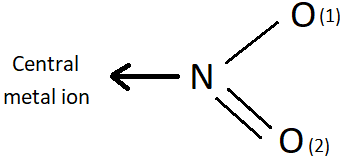
a) N
b) O1
c) O2
d) Both N and O
View Answer
Explanation: This is nitrito-N, formed by ambidentate ligand NO2- ion when it bonds through its N atom to the central metal ion. The other form is nitrito-O, which is formed when NO2- coordinates through the O1 atom.
9. The SCN– ion is a unidentate ligand.
a) True
b) False
View Answer
Explanation: SCN– is an ambidentate ligand that can either bond through S atom or N atom to a central atom/ion. But, at a time there is only a single donor atom, either S or N, making it a unidentate ligand. For a fact, all ambidentate ligands are unidentate.
10. Coordination number is a characteristic of which of the following?
a) Central atom
b) Ligand
c) Coordination entity
d) Coordination compound
View Answer
Explanation: Coordination number is also known as the secondary valence of a central metal ion in a complex and is defined as the number of donor atoms it is directly bonded to. Hence, coordination number is a quantity associated with the metal ion.
11. What is the coordination number of chromium in K3[Cr(C2O4)3]?
a) 1
b) 2
c) 3
d) 6
View Answer
Explanation: There are three oxalate groups attached to the central ion in the given compound, but since oxalate is a didentate ligand, there are a total of 6 donor atoms to which the metal is directly bonded. Thus, the CN of Cr in K3[Cr(C2O4)3] is 6.
12. Identify the coordination sphere in the compound K4[Fe(CN)6].
a) K+
b) Fe2+
c) [Fe(CN)6]4-
d) CN–
View Answer
Explanation: The coordination sphere refers to the square bracket within which the central atom/ion and the groups attached to it are enclosed. This is a non-ionisable group as compared to the entity outside the bracket, which is ionisable and is known as the counter ion.
Haloalkanes and Haloarenes
1. Monohalo, dihalo, trihalo and tetrahalo are types of haloalkanes and haloarenes based on the ______
a) type of halogen atom
b) number of halogen atoms
c) nature of carbon atom
d) hybridisation of C atom to which halogen is bonded
View Answer
Explanation: Haloalkanes may be classified as mono, di, tri, tetra and so on depending on the number of halogen atoms present in their structure.
2. A monohaloarene is an example of a/an __________
a) aliphatic halogen compound
b) aromatic halogen compound
c) alkyl halide
d) side chain substituted aryl halide
View Answer
Explanation: A monohaloarene is a compound in which the halogen is directly attached to the benzene ring. Side chain substituted aryl halides are also aromatic halogen compounds with the halogen not directly attached to the benzene ring.
3. What is the general formula for haloalkanes? (X=halogen atom, n = 1, 2, 3…)
a) CnH2nX
b) CnH2n+1X
c) CnH2n-1X
d) CnH2n-3X
View Answer
Explanation: The general formula for haloalkanes is CnH2n+1X where X is a halogen atom and n = 1, 2, 3… The formulae CnH2n-1X and CnH2n-3X are that of haloalkenes and haloalkynes respectively.
4. Which of the following compounds contains an allylic carbon?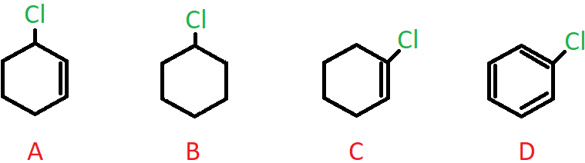
a) A
b) B
c) C
d) D
View Answer
Explanation: A sp3 hybridised C atom present adjacent to a C-C double bond is called an allylic carbon, and when the halogen atom is bonded to this carbon, it is called an allylic halide.
5. Which of the following categories does the compound shown belong to?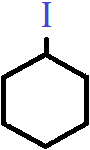
a) Primary haloalkane
b) Secondary haloalkane
c) Tertiary haloalkane
d) Haloarene
View Answer
Explanation: The compound shown is cyclohexyl iodide, in which the halogen atom is bonded to an alkyl group that is alicyclic in nature. Since there are effectively two alkyl groups attached to the carbon bonded to the halogen atom, it is classified as secondary or 2° cyclo alkyl halide.
6. What is the nature of the circled C atom in the following compound?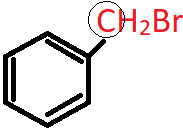
a) sp2 hybridised
b) allylic
c) benzylic
d) vinylic
View Answer
Explanation: The circled C atom is sp3 hybridised and is attached directly to an aromatic ring, hence it is a benzylic carbon and the compound is a 1o benzylic halide.
7. In which of the following cases will the compound be a tertiary (3°) halogen compound? (X=halogen atom)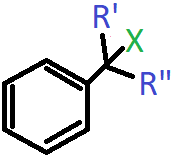
a) R’=R”=H
b) R’=CH3, R”=H
c) R’=H, R”=CH3
d) R’=R”=CH3
View Answer
Explanation: When R and R’ both are CH3 groups, then the carbon atom bonded to the halogen will have three alkyl groups attached to it including the benzene ring.
8. Which of the following is a vinylic halide?
a) CH2=CHCHCl2
b) CH3CHClCH3
c) (CH3)2C=CHCH2Cl
d) CH3CH=CClCH2CH3
View Answer
Explanation: In CH3CH=CClCH2CH3, the Cl is bonded directly to the C atom of a C-C double bond, and hence it is a vinylic halide. CH3CHClCH3 is an alkyl halide whereas CH2=CHCHCl2 and (CH3)2C=CHCH2Cl are allylic halides.
9. The compound C6H5F is an example of a ________ halide.
a) allylic
b) benzylic
c) vinylic
d) aryl
View Answer
Explanation: In C6H5F, the F atom is directly attached to the sp2 hybridised carbon atom of an aromatic ring, i.e., benzene.
10. The compound in which a CH2Br group is attached to a benzene ring is an aryl halide.
a) True
b) False
View Answer
Explanation: The Br atom is bonded to a carbon atom which is attached to sp2 hybridised carbon of benzene. This is an example of a side chain substituted aryl halide.
Alcohols, Phenols, and Ethers
1. What is the general formula for an aliphatic alcohol? (R=alkyl group)
a) R-H
b) R-OH
c) R-CHO
d) R-COOH
View Answer
Explanation: Alcohols are compounds having OH group attached to an alkyl group and are hence hydroxy derivatives of hydrocarbons.
2. Which of the following is true regarding polyhydric alcohols?
a) It should have one or more OH groups
b) It should have two or more OH groups
c) It should have three or more OH groups
d) It should have more than four OH groups
View Answer
Explanation: Alcohols may be classified as mono-, di- tri- or polyhydric depending on whether it has one, two, three or more OH groups in its structure. Di- and trihydric alcohols are also classified as polyhydric.
3. Which of the following types of alcohol contain a bond between sp2 hybridised carbon and OH group?
a) Primary allylic alcohols
b) Secondary allylic alcohols
c) Tertiary allylic alcohols
d) Vinylic alcohols
View Answer
Explanation: Allylic alcohols are those in which OH group is attached to a sp3 hybridised carbon adjacent to a C-C double bond, i.e., an allylic carbon. Whereas, vinylic alcohols contain OH group attached directly to a C-C double bond.
a) Primary
b) Monohydric
c) Allylic
d) Vinylic
View Answer
Explanation: The given compound contains a sp3 hybridised C-OH bond and is allylic. Ince it has only one alkyl group attached to the C bonded to the OH group, it is primary and the presence of only one OH group makes it monohydric.
5. Choose the most suitable classification for the shown compound?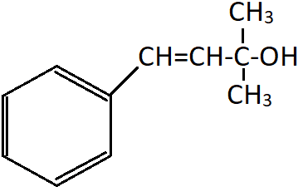
a) Secondary alcohol
b) Allylic alcohol
c) Dihydric alcohol
d) Benzylic alcohol
View Answer
Explanation: The compound shown is a monohydric, tertiary alcohol in which the OH group is attached to the C next to a C-C double bond, hence make it allylic.
6. Primary alcohols van be benzylic in nature.
a) True
b) False
View Answer
Explanation: Benzylic alcohols contain a sp3 C-OH bond next to an aromatic ring, which means that the C atom can have zero or two alkyl groups attached to it along with the ring and OH group.
7. Which of the following is not a vinylic alcohol?
a) CH2=CH-OH
b) HO-CH=CH-CH3
c) CH2=CH-CH2-OH
d) CH3-CH2-CH=CH-OH
View Answer
Explanation: Vinylic alcohols contain an OH group bonded to a sp2 hybridised carbon of a double bond. CH2=CH-CH2-OH is an allylic alcohol.
8. Which of the following compounds contain an aryl carbon?
a) Ethanol
b) Benzyl alcohol
c) Vinyl alcohol
d) Phenol
View Answer
Explanation: The sp2 hybridised carbon of an aromatic ring to which the hydroxyl group is attached is called an aryl carbon. In phenol, the OH group is attached to an aryl carbon.
9. R-O-R, where R represent an alkyl or aryl group is the general formula of which compound?
a) Ether
b) Ester
c) Aldehyde
d) Ketone
View Answer
Explanation: Ethers are compounds where the hydrogen of a hydrocarbon is replaced by an alkoxy or aryloxy group. It may also be thought of as compounds formed when the hydrogen of the OH group of an alcohol is replaced by an alkyl or aryl group.
10. When the alkyl groups attached to either side of the oxygen atom of an ether id different, it is known as _______ ether.
a) simple
b) symmetrical
c) mixed
d) diethyl
View Answer
Explanation: If the alkyl or aryl groups on either side of O atom is different, it is known as a mixed or unsymmetrical ether.
11. Identify the simple ether from the following.
a) CH3OC2H5
b) C2H5OC6H5
c) C6H5OCH3
d) C6H5OC6H5
View Answer
Explanation: Since C6H5OC6H5 has the same aromatic ring on both sides of the oxygen atom, it a simple or symmetrical ether.
12. Which of the following is not an aromatic ether?
a) CH3-O-C6H5
b) CH3-O-CH2CH3
c) C2H5-O-C6H5
d) C6H5-O-C6H5
View Answer
Explanation: Aromatic ethers are those in which at least one of the groups on either side of O atom is an aryl group. In CH3-O-CH2CH3, both the groups are alkyl and is hence an aliphatic ether.
13. Diethyl ether is a mixed ether.
a) True
b) False
View Answer
Explanation: Diethyl ether consists of ethyl (C2H5) groups on either side of O, hence it is a simple symmetrical ether.
Aldehydes, Ketones, and Carboxylic Acids
1. Which of the following methods cannot produce aldehydes?
a) Oxidation of primary alcohols
b) Dehydrogenation of secondary alcohols
c) Ozonolysis of alkenes
d) Hydration of ethyne with acid
View Answer
Explanation: The dehydrogenation of secondary alcohols give ketones. Aldehydes are obtained by the dehydrogenation of primary alcohols.
2. Which of the following reactions can produce ketones?
a) Oxidation of primary alcohols
b) Dehydrogenation of primary alcohols
c) Dehydrogenation of tertiary alcohols
d) Oxidation of secondary alcohols
View Answer
Explanation: Oxidation and dehydrogenation of secondary alcohols results in ketones. The same reactions with primary alcohols give aldehydes.
3. Conversion of propyne to acetone requires three important reagents. Identify which of the following is not one of the three?
a) Water
b) Zinc dust
c) H2SO4
d) HgSO4
View Answer
Explanation: Addition of water to propyne in the presence of H2SO4 and HgSO4 gives acetone. Zinc dust is an important reagent in the ozonolysis of alkenes.
4. What is the catalyst used in the hydrogenation of acetyl chloride to produce ethanal?
a) Pt over BaSO4
b) Pt over CuSO4
c) Pd over BaSO4
d) Pd over CuSO4
View Answer
Explanation: Acyl chlorides are hydrogenated in the presence of catalyst palladium over barium sulphate. This is known as Rosenmund reaction.
5. Which of the following carbonyl compounds can be prepared from Rosenmund reaction?
a) Methanal
b) Acetone
c) Butanone
d) Benzaldehyde
View Answer
Explanation: Rosenmund reaction is exclusively used for the preparation of aldehydes by the substitution of chloride by hydrogen. Given this, methanal cannot be formed from this reaction because its corresponding acyl chloride, i.e., formyl chloride, is unstable at room temperature. Benzaldehyde is formed from benzoyl chloride.
6. Which of the following is required in Stephen reaction?
a) LiCl
b) NiCl2
c) SnCl2
d) TiCl4
View Answer
Explanation: Nitriles are converted to respective imines with SnCl2 in the presence of HCl, which on hydrolysis gives corresponding aldehyde.
7. Which of the following compounds helps in reducing esters to aldehydes?
a) BINAL-H
b) DIBAL-H
c) DIPT
d) TBAF
View Answer
Explanation: DIBAL-H or diisobutylaluminium hydride is a reducing agent which are used to reduce nitriles to imines or esters to aldehydes. These are important in the preparation of aldehydes.
8. Identify ‘X’ in the reaction given below.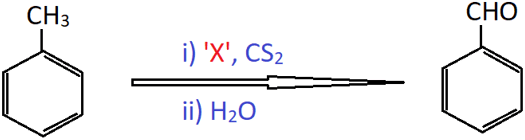
a) CrO3
b) CrO2Cl2
c) Alkaline KMnO4
d) Anhydrous AlCl3
View Answer
Explanation: This is known as Etard reaction. The chromyl chloride oxidises the methyl group to a chromium complex in CS2. This complex on hydrolysis gives benzaldehyde.
9. Benzaldehyde can be obtained from the hydrolysis of the product formed during side chain chlorination of toluene.
a) True
b) False
View Answer
Explanation: Side chain chlorination of toluene in the presence of light (represented by hv) gives benzal chloride which on hydrolysis gives benzaldehyde. This is an important commercial method for the production of benzaldehyde.
10. Identify the reagent(s) for the conversion of chlorobenzene to 3-chlorobenzaldehyde.
a) CrO3 and (CH3CO)2O
b) CrO2Cl2; H2O
c) Cl2/hv; H2O
d) CO, HCl and CuCl
View Answer
Explanation: When benzene or its derivative is treated with CO and HCl in the presence of anhydrous AlCl3 or CuCl, it gives a benzaldehyde or substituted benzaldehyde. This is known as Gatterman-Koch reaction.
11. Acetyl chloride reacts with _______ to give butan-2-one.
a) cadmium chloride
b) methyl magnesium chloride
c) dimethyl cadmium
d) diethyl cadmium
View Answer
Explanation: For butan-2-one to form from acetyl chloride, the Cl group needs to be replaced by an ethyl group. This ethyl group is obtained from diethyl cadmium which is produced from the reaction between ethyl magnesium bromide and cadmium chloride.
12. What is formed after the hydrolysis of the product of the reaction between benzonitrile and methyl magnesium bromide in dry ether?
a) Phenyl acetaldehyde
b) Acetophenone
c) 1-Phenylpropanone
d) Benzaldehyde
View Answer
Explanation: When a nitrile is treated with a Grignard reagent in the presence of dry ether, an addition product is formed which on hydrolysis gives a ketone.
13. Friedel-Crafts benzoylation of benzene gives ________
a) acetophenone
b) propiophenone
c) benzophenone
d) no reaction
View Answer
Explanation: When benzene is treated with benzoyl chloride in the presence of anhydrous aluminium chloride, it forms benzophenone which is an aromatic ketone.
14. Identify the reagent for the conversion of but-2-ene to ethanal.
a) O3/H2O-Zn dust
b) H2O, H2SO4, HgSO4
c) PCC
d) DIBAL-H
View Answer
Explanation: But-2-ene on ozonolysis followed by reaction with water and zinc dust gives ethanal or sometimes a mixture of an aldehyde and ketone depending on the substitution pattern.
15. Which of the following reactions does not give benzaldehyde?
a) Rosenmund reaction
b) Etard reaction
c) Gatterman-Koch reaction
d) Friedel-Craft acylation reaction
View Answer
Explanation: Friedel-Crafts acylation of benzene produces an aromatic ketone and not benzaldehyde. Benzene on Gatterman-Koch reaction gives benzaldehyde, so does toluene on Etard reaction. Rosenmund reaction also gives benzaldehyde but from benzoyl chloride.
Amines
1. When two alkyl groups are attached to the nitrogen atom in an amine, it is known as a _______ amine.
a) primary
b) secondary
c) tertiary
d) aromatic
View Answer
Explanation: Amines are classified as secondary or 2° when two of the hydrogen atoms of ammonia are replaced by an alkyl group and the third H remains attached as it is.
2. When only two hydrogen atoms are attached to the nitrogen of an amine, it is classified as a ________
amine.
a) primary
b) secondary
c) aliphatic
d) aromatic
View Answer
Explanation: When an amine has two hydrogen atoms individually bonded to the nitrogen, it means that the third group is an alkyl or aryl substituent. This is called as a primary or 1° amine as only one H atom is replaced.
3. Which of the following is not a classification of amines?
a) Primary
b) Secondary
c) Tertiary
d) Quaternary
View Answer
Explanation: Amines may be classified as primary, secondary or tertiary depending on whether 1, 2 or 3 hydrogen atoms of NH3 are replaced by alkyl/aryl groups respectively. Quaternary ammonium compounds are a different class of compounds where all four hydrogen atoms of ammonium salts are replaced by alkyl/aryl groups.
4. What is the most suitable classification of the following amine?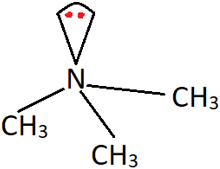
a) Secondary amine
b) Dialkyl amine
c) Tertiary amine
d) Aromatic amine
View Answer
Explanation: This is trimethylamine, in which all the three hydrogen atoms are replaced by methyl (CH3) groups. Hence, it is a tertiary or 3° amine.
5. Which of the following is a 2° amine?
a) CH3CH2NHCH3
b) (CH3)3N
c) (CH3CH2CH2)2NCH3
d) C6H5NH2
View Answer
Explanation: The three groups attached to CH3CH2NHCH3 are one methyl group, one ethyl group and one hydrogen atom. This means that two of the hydrogen atoms are replaced and hence, it is a 2° or secondary amine.
6. Benzylamine is an aryl amine.
a) True
b) False
View Answer
Explanation: Aryl amines are aromatic amines in which the nitrogen atom is directly bonded to the benzene ring. Whereas in benzylamine (C6H5CH2NH2), the nitrogen is attached to the side chain of the aromatic ring. Hence, it is an arylalkyl amine.
7. Which of the following is the most suitable classification for C6H5NHCH3?
a) Tertiary amine
b) Aliphatic amine
c) Arylalkyl amine
d) Mixed amine
View Answer
Explanation: In the given amine, there are two substituents, one methyl group and one phenyl group. Hence, it is a secondary aryl amine and since both the substituent groups are different, it is a mixed amine.
8. Which of the following is an arylalkyl amine?
a) C6H5NHC6H5
b) C6H5NH2
c) (C6H5CH2)NH
d) (C6H5)3N
View Answer
Explanation: Arylalkyl amines are aromatic amines which are side chain substituted, i.e., the nitrogen is not directly attached to the phenyl group but to a side chain of the benzene ring. In (C6H5CH2)NH, there are two same groups attached to the nitrogen where it is attached to a benzyl carbon, instead of an aryl carbon.
9. Which of the following categories does CH3-NH-CH3 not belong to?
a) Secondary amine
b) Simple amine
c) Aliphatic amine
d) Mixed amine
View Answer
Explanation: There are two hydrogen that replaced by CH3 group, making it a secondary amine and since both the replacing groups are identical, it is a simple amine. Also, it is aliphatic in nature as both the substituents are alkyl groups.
10. Aromatic amines cannot have an alkyl group attached to N atom.
a) True
b) False
View Answer
Explanation: There can be an alkyl group attached to an aromatic amine, but at least one of the substituents should be a phenyl group in aryl amine. For arylalkyl amines (which are also aromatic), the benzene ring is not directly linked to the nitrogen.
11. (C3H7)N(CH3)(C2H5) is not a ________ amine.
a) secondary
b) tertiary
c) aliphatic
d) mixed
View Answer
Explanation: In the given amine, all the three hydrogens of NH3 are replaced by one each of propyl, ethyl and methyl groups, and is a tertiary or 3° amine. Since all the three groups are alkyl and different, it is an aliphatic mixed amine.
12. The compound shown is a _______ amine.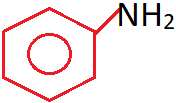
a) 1° aryl
b) 1° arylalkyl
c) 2° aryl
d) 2° arylalkyl
View Answer
Explanation: Only one hydrogen atom is replaced by an aromatic group, in which the nitrogen is directly linked to the sp2 hybridised carbon of benzene ring. Hence, it is a primary aromatic aryl amine.
13. Which of the following best describes the amine (CH3CH2)3N?
a) Secondary, simple
b) Secondary, mixed
c) Tertiary, simple
d) Tertiary, mixed
View Answer
Explanation: All the three hydrogen atoms of ammonia are replaced by the same ethyl group in (CH3CH2)3N, which makes is a 3° simple amine.
14. Which of the following is a primary arylalkyl amine?
a) CH3NH2
b) C6H5CH2NH2
c) C6H5NH2
d) (C6H5)2NH
View Answer
Explanation: Since it should be primary, it should have an alkyl/aryl group attached to the NH2 molecule, and because it is arylalkyl, the nitrogen should be linked to an sp3 hybridised benzyl carbon rather than to an aryl carbon.
15. The compound CH3NHC6H5 is a ______ amine.
a) aliphatic simple
b) aliphatic mixed
c) aromatic simple
d) aromatic mixed
View Answer
Explanation: Since the compound consists of a benzene ring, it invariably is an aromatic amine. Moreover, it also contains an alkyl methyl group beside the phenyl group and this makes it a mixed amine.
Biomolecules
1. Which of the following carbohydrates does not satisfy the formula Cx(H2O)y?
a) Fructose
b) Glucose
c) Deoxyribose
d) Lactose
View Answer
Explanation: Initially, most of the carbohydrates had the general formula Cx(H2O)y. Later on it was found out that few of the compounds either fit into this formula but were not carbohydrates or they did not conform to this formula but were hydrates of carbon.
2. Which of the following carbohydrates does not have the formula C12H22O11?
a) Galactose
b) Sucrose
c) Allolactose
d) Maltose
View Answer
Explanation: Galactose is a monosaccharide with the formula C6H12O6. Sucrose, allolactose and maltose are disaccharides with the same chemical formula C12H22O11.
3. The compound with the formula C2(H2O)2 is a ______
a) carbohydrate
b) carboxylic acid
c) aldehyde
d) monosaccharide
View Answer
Explanation: The compound is acetic acid (CH3COOH). Even though it has the general formula Cx(H2O)y of carbohydrates, it is not one. This is one the flaws of the general formula definition of carbohydrates.
4. Identify the correct formula for the carbohydrate rhamnose?
a) C5H10O5
b) C6H12O5
c) C6H12O6
d) C12H22O11
View Answer
Explanation: Rhamnose is an example of a carbohydrate that does not satisfy the general formula Cx(H2O)y. Its formula is C6H12O5.
5. Which of the following class of compounds is not a part of the large group of carbohydrates?
a) Polyamino aldehydes
b) Polyhalo aldehydes
c) Polyhydroxy ketones
d) Polyhydroxy carboxylic acids
View Answer
Explanation: Polyamino aldehydes and polyhalo aldehydes do not contain an OH group. Polyhydroxy carboxylic acids do not contain a CHO or a keto group. These also do not produce OH substituted compounds on hydrolysis.
6. Which of the following carbohydrates is not a sugar?
a) Glucose
b) Fructose
c) Lactose
d) Cellulose
View Answer
Explanation: Glucose, fructose and lactose are examples of compounds that are sweet in taste and are called sugars. Cellulose is a non-sugar that is tasteless, water insoluble and amorphous.
7. Which of the following is not a polysaccharide?
a) Cellulose
b) Stachyose
c) Starch
d) Glycogen
View Answer
Explanation: Polysaccharides are those carbohydrates which yield a very large number of monosaccharide units (>10) on hydrolysis. Stachyose (C24H42O21) is a tetrasaccharide that gives four monosaccharide units on hydrolysis.
8. Identify the monosaccharide from the following.
a) Deoxyribose
b) Sucrose
c) Maltose
d) Fructose
View Answer
Explanation: Monosaccharides are the simplest carbohydrates which cannot be hydrolysed into simpler units. Deoxyribose (C5H10O4) is a monosaccharide.
9. Raffinose is an example of a ________
a) monosaccharide
b) disaccharide
c) trisaccharide
d) tetrasaccharide
View Answer
Explanation: Raffinose (C18H32O16) is an oligosaccharide which on hydrolysis gives three different monosaccharides, galactose, glucose and fructose. Hence, it is a trisaccharide.
10. Which of the following disaccharides gives two same monosaccharide units on hydrolysis?
a) Maltose
b) Sucrose
c) Lactose
d) Lactulose
View Answer
Explanation: When any carbohydrate undergoes hydrolysis and produces two separate units of monosaccharides, it is a disaccharide. The used units that are produced may be same. Maltose on hydrolysis gives two units of glucose itself.
11. Sucrose consists of which of the following monosaccharide units?
a) Fructose, galactose
b) Fructose, glucose
c) Galactose, glucose
d) Glucose, glucose
View Answer
Explanation: Sucrose is a disaccharide, also known as common sugar, composed of two different monosaccharide units, glucose and fructose, which are obtained on hydrolysis.
12. Which of the following disaccharides does not consist of two glucose units?
a) Trehalose
b) Cellobiose
c) Isomaltose
d) Lactulose
View Answer
Explanation: Lactulose is a disaccharide which is composed of two different monosaccharide units namely, galactose and fructose. Whereas trehalose, cellobiose and isomaltose are disaccharides consisting of two glucose units.
13. All monosaccharides are reducing sugars.
a) True
b) False
View Answer
Explanation: All monosaccharides whether aldose or ketose, are reducing sugars. This is because they have an aldehyde group or can tautomerize in solution to form an aldehyde group, which reduces Fehling’s solution and Tollen’s reagent.
14. Which of the following is a non-reducing sugar?
a) Galactose
b) Glucose
c) Fructose
d) Sucrose
View Answer
Explanation: Sucrose is a non-reducing disaccharide which cannot convert to an open chain with a free aldehyde group and hence cannot reduce Fehling’s solution and Tollen’s reagent.
15. Glucose is an aldohexose.
a) True
b) False
View Answer
Explanation: Glucose is an aldehydic carbohydrate (with CHO) group at end of chain) with six carbon atoms (hexose). Its formula is C6H12O6.
Polymers
1. Which of the following is a co-polymer?
a) Polythene
b) Bakelite
c) PVC
d) Polyacrylonitrile
View Answer
Explanation: A polymer formed from on type of monomer is called a homopolymer. Polythene, PVC and PAN are homopolymers. A polymer formed from two or more different monomers is a co-polymer or a mixed polymer.
2. Polymers are not classified on the basis of which of the following?
a) Source
b) Number of monomers
c) Method of preparation
d) Structure
View Answer
Explanation: Polymers are very large molecules formed by joining together huge number of simple units, or monomers. They are mainly classified on the basis of their source, structure, mode of synthesis and molecular forces.
3. Which of the following types of polymers is not based on the classification by the source?
a) Natural
b) Semi-synthetic
c) Elastomers
d) Synthetic
View Answer
Explanation: On the basis of source, polymers are classified as natural, semi-synthetic or synthetic. Elastomers are a class of polymers based on the molecular forces.
a) Rayon
b) Starch
c) Cellulose
d) RNA
View Answer
Explanation: The polymers obtained from plants and animals are called natural polymers. Rayon is a semi-synthetic polymer which is derived from a natural polymer by chemical modification. Cellulose on acetylation with acetic anhydride in sulphuric acid gives cellulose acetate polymer or rayon.
5. Which of the following polymers has a structure as shown?
a) Low-density polythene
b) High-density polythene
c) Polyvinyl chloride
d) Bakelite
View Answer
Explanation: The shown structure has unconnected linear chains with some intermediate branches. This is a branched chain polymer. They are irregularly packed and have lower density and strength than linear polymers.
6. All macromolecules are polymers.
a) True
b) False
View Answer
Explanation: Polymers consists of thousands of repeating units, and are macromolecules because of their very large size and high molecular mass (103 to 107 u). However, a macromolecule may or may not contain repeating monomer units (for example, chlorophyll). Therefore, all polymers are macromolecules, but all macromolecules are not polymers.
7. The synthesis of which of the following polymers involves the repeated loss of small molecules?
a) Polythene
b) Buna-S
c) Buna-N
d) Nylon-6,6
View Answer
Explanation: Condensation polymers are formed by the repeated condensation reaction between two different bi-functional or tr-functional monomeric units, along with the loss of small molecules like water, alcohol, HCl, etc. Nylon-6,6 is formed by the condensation of hexamethylene diamine and adipic acid, resulting in loss of water molecules.
8. The compound [-CH2-CH(C6H5)–]n is a ________
a) homopolymer
b) co-polymer
c) condensation polymer
d) network polymer
View Answer
Explanation: [-CH2-CH(C6H5)–]n is a homopolymer with a linear structure. It is obtained from the addition polymerisation of the monomer styrene, C6H5CH=CH2.
9. Which of the following is not an elastomer?
a) Buna-S
b) Buna-N
c) PVC
d) Neoprene
View Answer
Explanation: Elastomers are polymers that have rubber like elastic properties. The polymer chains are held together by the weakest intermolecular forces, which facilitate the stretching of the polymer. PVC is a plastic and not an elastomer.
10. Which of the following fibres does not have dipole-dipole interactions?
a) Nylon
b) Terylene
c) Dacron
d) Orlon
View Answer
Explanation: Fibres are polymers which have strong intermolecular forces between the chains, either by hydrogen bonding or dipole-dipole interactions. In case of polyamides (nylon), the forces are hydrogen bonding, whereas in polyesters (terylene, dacron) and polyacrylonitriles (orlon) it is dipole-dipole interactions.
11. What are the intermolecular forces in acrilan?
a) Hydrogen bonds
b) Dipole-dipole interaction between carbonyl groups
c) Dipole-dipole interaction between carbonyl and cyano groups
d) Van der Waals forces
View Answer
Explanation: Acrilan is a fibre of polyacrylonitrile. It forms strong intermolecular bonds through dipole-dipole interactions between the carbonyl and cyano groups.
12. Which of the following has the weakest intermolecular forces?
a) Buna-N
b) Nylon-6,6
c) Polythene
d) Polystyrene
View Answer
Explanation: Elastomers (buna-N) have the weakest intermolecular forces whereas fibres (nylon-6,6) have very strong intermolecular forces due to hydrogen bonds and dipole-dipole forces. Thermoplastic polymers (polythene, polystyrene) have intermolecular attractions intermediate to that of elastomers and fibres.
13. The polymer shown is a _______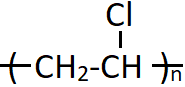
a) elastomer
b) fibre
c) thermoplastic
d) thermosetting plastic
View Answer
Explanation: The shown polymer is polyvinyl chloride. It is a dense linear polymer which is capable of repeatedly softening on heating and hardening on cooling.
14. ________ undergoes permanent deformation on heating.
a) Polythene
b) PVC
c) Teflon
d) Bakelite
View Answer
Explanation: Bakelite is a cross-linked thermosetting polymer, which on heating undergoes extensive cross-linking and undergo permanent change. They cannot be reused.
15. Terylene is a thermoplastic polymer prepared from addition polymerisation.
a) True
b) False
View Answer
Explanation: Terylene, also known as polyethylene terephthalate, is a thermoplastic polymer of the polyester family. Terylene is made from the condensation polymerisation of terephthalic acid and ethylene glycol.
Chemistry in Everyday Life
1. Drugs that block the binding site of an enzyme form a substrate are called ______
a) inhibitors
b) poisons
c) messengers
d) receptors
View Answer
Explanation: Drugs that either prevent the enzyme from holding the substrate or prevent it from providing functional groups that attack the substrate, are called enzyme inhibitors. These inhibit the catalytic activity of enzymes.
2. Which of the following drugs will inhibit the activity of the shown enzyme?
a) A
b) B
c) C
d) D
View Answer
Explanation: The shape of the active site resembles a triangle, which means that the substrate should also have a similar shape. The drug that will inhibit the activity of this enzyme should closely resemble the substrate and block the active site. These are called competitive inhibitors.
3. All drugs block enzyme activity by occupying the active site before the substrate.
a) True
b) False
View Answer
Explanation: Drugs prevent the attachment of substrate to enzymes by two different ways. One is the competitive approach where it occupies the active site, and the other is non-competitive way in which it does not occupy the active site.
a) competitive inhibitor
b) non-competitive inhibitor
c) competitive messenger
d) receptor
View Answer
Explanation: Non-competitive inhibitors are drugs that affect the catalytic activity of enzymes by changing the shape of the active site by binding to the enzyme at some other site. This prevents the substrate from binding to the enzyme.
5. A certain compound occupied a site Y of an enzyme near to the active site. This immediately resulted in the change of shape of the active site. Y is called a/an ______
a) inactive site
b) binding site
c) non-competitive site
d) allosteric site
View Answer
Explanation: When a drug binds to an enzyme from a site other than the active site, it is called an allosteric site. Binding to this site causes the change in shape of active site such that the substrate cannot recognise it.
6. If the bond between the enzyme and inhibiting drug is very strong, which of the following takes place?
a) The active site slowly regains its original shape
b) The enzyme develops a new active site
c) The enzyme is blocked temporarily
d) The body synthesizes a new enzyme
View Answer
Explanation: When there is a strong covalent bond between the enzyme and the drug, the enzyme is blocked permanently. This results in the degradation of the entire drug-enzyme complex and the synthesis of a new enzyme.
7. Which of the following is incorrect regarding receptors?
a) They have constant shape
b) They are proteins
c) The shape of receptors binding site changes to fit the messenger
d) They are present in the cell membrane
View Answer
Explanation: Receptors are proteins that are embedded in the cell membrane with the binding site protruding outwards. They change the shape of the binding site to accommodate the incoming messenger and facilitate communication.
8. Which of the following is not a reason for the selectivity of receptors towards messengers?
a) Shape of binding site
b) Structure
c) Amino acid composition
d) Location in the membrane
View Answer
Explanation: There are lots of different types of receptors in the body at different locations. They interact with different kinds of chemical messengers. Their selectivity for one messenger over the other is because of the difference in their binding sites, structure and composition of amino acids.
9. The drugs that are used when there is a lack of natural chemical messenger is called ______
a) antagonists
b) agonists
c) analgesics
d) narcotics
View Answer
Explanation: Agonists are drugs that replicate the behaviour and properties of the chemical messenger and activate the receptor. These are used when the actual messenger is not present in the body.
10. Antagonists do not allow the transfer of message through receptors.
a) True
b) False
View Answer
Explanation: Antagonists bind to the receptor at the binding site and inhibit its natural communicative function. This prevents the message to be passed into the cell.
Comments
Post a Comment