
Chemistry MCQs Test P 15
Vsepr Theory
1. Which of the following species has 120° bond angles?
(a) NCl3
(b) PH3
(c) ClF3
(d) BCl3

2. Which of the following species has a trigonal planar shape?
(a) NO3–
(b) CO2
(c) N3
(d) NO2–
3. Which of the following has a linear shape?
(a) NO2–
(b) NO2+
(c) O3
(d) SO2
4. If MX6 is a regular octahedral molecule, then how many X-M-X bonds are 180°?
(a) 2
(b) 4
(c) 3
(d) 6
5. Find the molecule in which the central atom is having one lone pair of electrons
(a) NH3
(b) PCl5
(c) H2O
(d) CH4
6. In BrF3, lone pairs are present at the equatorial positions. This is to minimise
(a) bp-bp repulsion only
(b) lp-lp repulsion only
(c) lp-bp repulsion only
(d) both (b) and (c)
7. Find the species with a maximum bond angle
(a) NH4+
(b) SCl2
(c) NH3
(d) PCl3
8. XeF6 is
(a) Distorted octahedral
(b) Tetrahedral
(c) Octahedral
(d) Planar
9. Number of bond pair and lone pair electrons present on N atom in NO3– are
(a) 3, 1
(b) 4, 0
(c) 2, 2
(d) 1, 3
10. Find the molecule with the least bond angle
(a) BeF2
(b) CH4
(c) NH3
(d) H2O
Answer
Hydrocarbons
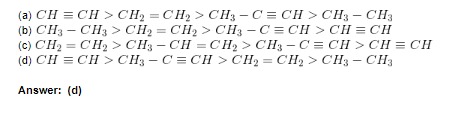
1. Find the correct order of increasing acidity
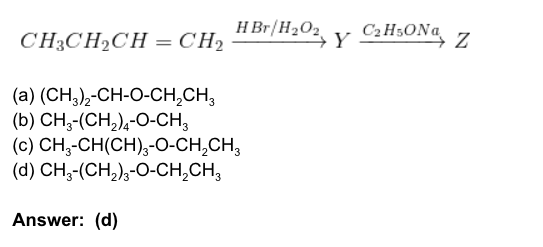
2. Identify Z in the given reaction:
3. The product obtained on heating 2-Bromopentane with potassium ethoxide in ethanol is
(a) 1-pentene
(b) 2-cis-pentene
(c) trans-2-pentene
(d) 2-ethoxy pentane
Answer: (c)
4. Choose the process by which liquid hydrocarbons can be converted to gaseous hydrocarbons
(a) hydrolysis
(b) oxidation
(c) cracking
(d) distillation under reduced pressure
Answer: (c)
5. Which one of the following halide can be used in the Friedel-Crafts reaction?
(a) Isopropyl chloride
(b) Bromobenzene
(c) Chlorobenzene
(d) Chloroethene
Answer: (a)
6. Which one of the following compound forms salt on reaction with NaNH2?
(a) C2H2
(b) C2H6
(c) C6H6
(d) C2H4
Answer: (a)
7. Which among the following reagent can be used to distinguish between CH2BrCH=CH2 from CH3CH=CHBr?
(a) Br2/CCl4
(b) cold KMnO4
(c) AgNO3/C2H5OH
(d) Ag(NH3)2OH
Answer: (c)
8. Isopropyl iodide is formed after reaction of propene with HI, this is due to
(a) more stable free radical
(b) homolysis
(c) more stable carbanion
(d) more stable carbocation
Answer: (d)
9. C6H5CHO is formed when C6H6 is treated with CO and HCl in the presence of anhydrous AlCl3. Name of the reaction is:
(a) Friedel crafts reaction
(b) Gattermann Koch reaction
(c) Rosenmund reaction
(d) Stephen reaction
Answer: (b)
10. A compound having a bond angle 180° is
(a) alkyne
(b) alkane
(c) alkene
(d) cycloalkane
Answer: (a)
Structure of Atom
1. How many orbitals can have the following set of quantum numbers, n = 3, l = 1, m1 = 0 ?
(a) 3
(b) 1
(c) 4
(d) 2
Answer: (b)
2. Electronic configuration of the outer shell of the element Gd with atomic number 64 is
(a) 4f4 5d5 6s1
(b) 4f3 5d5 6s2
(c) 4f5 5d4 6s1
(d) 4f7 5d1 6s2
Answer: (d)
3. Maximum number of electrons in a subshell can be
(a) 4l + 2
(b) 4l – 2
(c) 2n2
(d) 2l + 1
Answer: (a)
4. The orientation of atomic orbitals depends on their
(a) spin quantum number
(b) magnetic quantum number
(c) azimuthal quantum number
(d) principal quantum number
Answer: (b)
5. A gas X has Cp and Cv ratio as 1.4, at NTP 11.2 L of gas X will contain_______ number of atoms
(a) 1.2 × 10²³
(b) 3.01 × 10²³
(c) 2.01 × 10²³
(d) 6.02 × 10²³
Answer: (d)
6. Number of unpaired electrons in N2+
(a) 3
(b) 1
(c) 2
(d) 0
Answer: (b)
7. The excitation energy of a hydrogen atom from its ground state to its third excited state is
(a) 12.75 eV
(b) 0.85 eV
(c) 10.2 eV
(d) 12.1 eV
Answer: (a)
8. 3p orbital has _____ radial nodes
(a) three
(b) two
(c) one
(d) none
Answer: (c)
9. A 0.66 kg ball is moving with a speed of 100 m/s. Find its wavelength
(a) 6.6 × 10⁻³⁴ m
(b) 6.6 × 10⁻³² m
(c) 1.0 × 10⁻³² m
(d) 1.0 × 10⁻³⁵ m
Answer: (d)
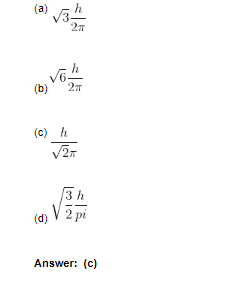
10. Orbital angular momentum of p electrons is
s Block Elements
1. Which of the compounds is known as Slaked lime?
(a) CaO
(b) CaSO4
(c) Ca(OH)2
(d) CaCO3
Answer: (c)
2. Which of the ions have maximum hydration energy?
(a) Sr2+
(b) Ca2+
(c) Mg2+
(d) Be2+
Answer: (d)
3. As compared to K, Na has
(a) higher ionization potential
(b) lower melting point
(c) lower electronegativity
(d) larger atomic radius
Answer: (a)
4. Which one is the most stable carbonate?
(a) BaCO3
(b) MgCO3
(c) CaCO3
(d) BeCO3
Answer: (a)
5. Plaster of Paris (POP) is
(a) CaSO4 H2O
(b) CaSO4 2H2O
(c) CaSO4
(d) CaSO4 1/2H2O
Answer: (d)
6. Which oxide is amphoteric?
(a) BaO
(b) CaO
(c) BeO
(d) MgO
Answer: (c)
7. Be shows the diagonal relationship with
(a) Na
(b) Al
(c) Mg
(d) B
Answer: (b)
8. The tendency to lose their valance electron easily by alkali metals makes them
(a) strong reducing agent
(b) weak reducing agent
(c) strong oxidising agent
(d) weak oxidising agent
Answer: (a)
9. Which one is known as a fusion mixture?
(a) Na2CO3 + NaHCO3
(b) Na2CO3 + NaOH
(c) Na2CO3 + K2SO4
(d) Na2CO3 + K2CO3
Answer: (d)
10. Find the incorrect trend for alkaline earth metals
(a) atomic size Be < Mg < Ca < Sr
(b) second ionization energy Be < Mg < Ca < Sr
(c) Hydration enthalpy Sr < Ca < Mg < Be
(d) Density Ca < Mg < Be < Sr
Answer: (b)
Thermodynamics
1. What will be the value of ΔH, if the forward and reverse reactions have the same energy of activation?
(a) ΔH = ΔG = ΔS = 0
(b) ΔS = 0
(c) ΔG = 0
(d) ΔH = 0
Answer: (d)
2. What will be the entropy change (ΔS), when an ideal gas undergoes a change in the pressure from pi to pf isothermally?
(a)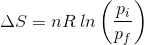
(b)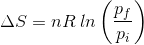
(c)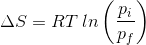
(d)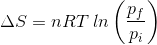
Answer: (a)
3. Find out the relationship between x, y and z considering below three reactions



(a) y = 2z – x
(b) x = y – z
(c) x = y + z
(d) z = x + y
Answer: (c)
4. What is the molar entropy change for melting of ice at 0℃, if ΔHf = 1.435 kcal/mol?
(a) 0.526 cal/(mol K)
(b) 5.26 cal/(mol K)
(c) 10.52 cal/(mol K)
(d) 21.04 cal/(mol K)
Answer: (b)
5. What is the function of a catalyst in a chemical reaction?
(a) decrease rate constant of reaction
(b) increases activation energy of reaction
(c) reduces enthalpy of reaction
(d) does not affect the equilibrium constant of reaction
Answer: (d)
6. What will be the work done by 3 moles of an ideal gas when it expands spontaneously in a vacuum?
(a) zero
(b) infinite
(c) 3 joules
(d) 9 joules
Answer: (a)
7. Find the temperature at which the below reaction will be in equilibrium if the enthalpy and entropy change for the reaction is 30 kJ mol-1 and 105 J K-1 mol-1 respectively
Br2(l) + Cl2(g) → 2BrCl(g)
(a) 273 K
(b) 300 K
(c) 450 K
(d) 285.7 K
Answer: (d)
8. Which is true for the entropy of a spontaneous reaction?
(a) ΔS(system) – ΔS(surroundings) > 0
(b) ΔS(system) + ΔS(surroundings) > 0
(c) ΔS(surroundings) > 0 only
(d) ΔS(system) > 0 only
Answer: (b)
9. An ideal gas is expanded isothermally at 300 K from 1 litre to 10 litres. Find the ΔE for this process (R = 2 cal mol-1 K-1)
(a) 9 L atm
(b) 1381.1 cal
(c) zero
(d) 163.7 cal
Answer: (c)
10. ΔH for the reaction N2 + 3H2 ⇋ 2NH3
(a) ΔE – 2RT
(b) ΔE + 2RT
(c) ΔE – RT
(d) ΔH = RT
Answer: (a)
Redox Reaction
1. Which of the compounds can exist together?
(a) HgCl2, SnCl2
(b) FeCl3, KI
(c) FeCl3, SnCl2
(d) FeCl2, SnCl2
Answer: (d)
2. One mole of ferrous oxalate requires____ moles of MnO4– to get oxidised completely in an acidic medium
(a) 0.6 moles
(b) 0.4 moles
(c) 0.2 moles
(d) 7.5 moles
Answer: (b)
3. H2O2 changes Cr2O72- ion to CrO5 in an acidic medium, the oxidation state of Cr in CrO5 is
(a) +6
(b) +5
(c) -10
(d) +3
Answer: (a)
4. H2SO4 acts as a strong oxidising agent. In which of the reaction, is it not acting as an oxidising agent?
(a) C + 2H2SO4 → CO2 + 2SO2 + 2H2O
(b) CaF2 + 2H2SO4 → CaSO4 + 2HF
(c) S + 2H2SO4 → 3SO2 + H2O
(d) Cu + 2H2SO4 → CuSO4 + SO2 + 2H2O
Answer: (b)
5. During a reaction of oxalic acid, potassium chlorate and sulphuric acid, the oxidation number of which of the element undergoes a maximum change
(a) H
(b) S
(c) C
(d) Cl
Answer: (d)
6. Find the redox reaction
(a) In the atmosphere, O3 from O2 by lighting
(b) The reaction of H2SO4 with NaOH
(c) Both oxidation and reduction reaction
(d) Evaporation of water
Answer: (c)
7. Find the oxidation state of I in H4IO6–
(a) +7
(b) +5
(c) +1
(d) -1
Answer: (a)
8. In which of the following complex, the oxidation number of Fe is +1?
(a) Fe4[Fe(CN)6]3
(b) [Fe(H2O)5NO]SO4
(c) [FeBr4]–
(d) [Fe(H2O)6]2-
Answer: (b)
9. Which among the following compounds is the most reducing compound?
(a) H2S
(b) HNO2
(c) SnCl2
(d) H2SO3
Answer: (a)
10. Which among the following is the strongest oxidising agent?
(a) H2O2
(b) O3
(c) K2Cr2O7
(d) KMnO4
Answer: (b)
P Block Elements
1. Find the amphoteric oxide
(a) CaO2
(b) CO2
(c) SnO2
(d) SiO2
Answer: (c)
2. Graphite has a structural similarity with
(a) B2H6
(b) B4C
(c) B
(d) BN
Answer: (d)
3. Which is the correct order of decreasing acidity of lewis acids?
(a) BBr3 > BCl3 > BF3
(b) BF3 > BCl3 > BBr3
(c) BCl3 > BF3 > BBr3
(d) BBr3 > BF3 > BCl3
Answer: (a)
4. In the presence of KF, AlF3 is soluble in HF. Find the complex formed
(a) K3[AlF6]
(b) AlH3
(c) K[AlF3H]
(d) K3[AlF3H3]
Answer: (a)
5. S-S bond is present in which of the ion pairs
(a) S2O72-, S2O32-
(b) S4O62-, S2O72-
(c) S2O72-, S2O82-
(d) S4O62-, S2O32-
Answer: (d)
6. Which is the correct order of decreasing bond dissociation enthalpy?
(a) F2 > Cl2 > Br2 > I2
(b) I2 > Br2 > Cl2 > F2
(c) Cl2 > Br2 > F2 > I2
(d) Br2 > I2 > F2 > Cl2
Answer: (c)
7. Oxygen is not released on heating which of the compounds?
(a) (NH4)2Cr2O7
(b) K2Cr2O7
(c) Zn(ClO3)2
(d) KClO3
Answer: (a)
8. Which of the species has a permanent dipole moment?
(a) SF4
(b) SiF4
(c) BF3
(d) XeF4
Answer: (a)
9. Which of the statement is incorrect for XeO4 ?
(a) four p𝜋-d𝜋 bonds are present
(b) four sp3 – p 𝜎 bonds are present
(c) It has a tetrahedral shape
(d) It has a square planar shape
Answer: (d)
10. P4O10 has ______ bridging O atoms
(a) 4
(b) 5
(c) 6
(d) 2
Answer: (c)
Chemical Kinetics
1. The rate of a chemical reaction tells us about
- the reactants taking part in the reaction
- the products formed in the reaction
- how slow or fast the reaction is taking place
- none of the above
Answer: (c)
2. In the rate equation, when the concentration of reactants is unity then the rate is equal to
- specific rate constant
- average rate constant
- instantaneous rate constant
- None of the above
Answer: (a)
3. The average rate and instantaneous rate of a reaction are equal
- at the start
- at the end
- in the middle
- when two rates have a time interval equal to zero
Answer: (d)
4. Which of the following observations is incorrect about the order of a reaction?
- Order of a reaction is always a whole number
- The stoichiometric coefficient of the reactants doesn’t affect the order
- Order of reaction is the sum of power to express the rate of reaction to the concentration terms of the reactants.
- Order can only be assessed experimentally
Answer: (a)
5. The rate constant of zero-order reactions has the unit
- s-1
- mol L-1 s-1
- L2 mol-2 s-1
- L mol-1 s-1
Answer: (b)
Also Check:
6. In the reaction 2A + B → A2B, if the concentration of A is doubled and that of B is halved, then the rate of the reaction will
- increase 2 times
- increase 4 times
- decrease 2 times
- remain the same
Answer: (a)
7. when the rate of the reaction is equal to the rate constant, the order of the reaction is
- zero order
- first order
- second order
- third order
Answer: (a)
8. A substance ‘A’ decomposes by a first-order reaction starting initially with [A] = 2.00M and after 200min, [A] becomes 0.15M. For this reaction t1/2 is
- 53.72 min
- 50.49 min
- 48.45 min
- 46.45 min
Answer: (a)
9. In the Haber process for the manufacture of ammonia the following catalyst is used
- Platinized asbestos
- Iron with molybdenum as a promoter
- Copper oxide
- Alumina
Answer: (b)
10. A catalyst alters, which of the following in a chemical reaction?
- Entropy
- Enthalpy
- Internal energy
- Activation energy
Answer: (d)
Electrochemistry
1. The aqueous solution of which of the following compounds is the best conductor of electric current?
- Acetic acid,
- Hydrochloric acid
- Ammonia
- Fructose
Answer: (b)
2. An increase in the conductivity equivalent of a solid electrolyte with dilution is primarily due to
- increased ionic mobility of ions
- 100 percent electrolyte ionisation with natural dilution
- increase in both ion numbers and ionic mobility
- A rise in ion counts
Answer: (a)
3. The equivalent conductance of Ba2+ and Cl– are respectively 127 and 76 ohm-1 cm-1 eq-1 at infinite dilution. The equivalent conductance of BaCl2 at infinite dilution will be
- 139.5
- 203
- 279
- 101.5
Answer: (a)
4. When heating one end of a metal plate, the other end gets hot because of
- the resistance of the metal
- mobility of atoms in the metal
- energised electrons moving to the other end
- minor perturbation in the energy of atoms.
Answer: (c)
5. The weight of silver displaced by a quantity of electricity which displaces 5600ml of O2 at STP will be
- 5.4g
- 10.8g
- 54.9g
- 108.0g
Answer: (d)
6. Once a current of 1.0 ampere was passed through one litre of CuCl2 solution for 16 min and 5 sec, all of the solution’s copper was deposited at the cathode. The strength of solution CuCl2 was (Molar mass of Cu = 63.5; Faraday constant = 96,500 C/mol)
- 0.01N
- 0.01M
- 0.02M
- 0.2N
Answer: (a)
7. On electrolysis of dilute sulphuric acid using platinum electrodes, the product obtained at the anode will be
- hydrogen
- oxygen
- hydrogen sulphide
- sulphur dioxide
Answer: (b)
8. A device that converts the energy of combustion of fields like hydrogen and methane directly into electrical energy is known as
- Electrolytic cell
- Dynamo
- Ni-Cd cell
- Fuel cell
Answer: (d)
9. Which reaction is not feasible?
- 2KO + Br2 → 2KBr + I2
- 2KBr + I2 → 2KI + Br2
- 2KBr + Cl2 → 2KCl + Br2
- 2H2O + 2F2 → 4HF + O2
Answer: (b)
10. Without losing its concentration ZnCl2 solution cannot be kept in contact with
- Au
- Al
- Pb
- Ag
Answer: (b)
Solid State
1. How many unit cells are divided equally in a face-centred cubic lattice?
- 2
- 4
- 6
- 8
Answer: (c)
2. A crystalline solid:
- changes abruptly from solid to liquid when heated.
- has no definite melting point.
- undergoes deformation of its geometry easily
- has irregular 3-dimensional arrangements.
Answer: (a)
3. In a simple cubic, body-centred cubic and face-centred cubic structure, the ratio of the number of atoms present is respectively
- 8:1:6
- 1:2:4
- 4:2:1
- 4:2:3
Answer: (b)
4. Na and Mg crystallize in crystals of bcc and fcc form respectively and then the amount of Na and Mg atoms present in their respective crystal unit cells is:
- 4 and 2
- 9 and 14
- 14 and 9
- 2 and 4
Answer: (d)
5. Ferrous oxide has a cubic structure and each unit cell edge is 5.0Ao. Assuming the oxide density is 4.0g / cm3, the amount of Fe2+ and O2- ions in each unit cell will then be
- four Fe2+ and four O2-
- two Fe2+ and four O2-
- four Fe2+ and two O2-
- three Fe2+ and three O2-
Answer: (a)
6. Each of the following solids shows the Frenkel defect except
- ZnS
- AgBr
- AgI
- KCl
Answer: (d)
7. Schottky defect in a crystal is observed when
- The ion leaves its normal position and occupies an interstitial location
- the unequal number of cation and anions are missing from the lattice
- the density of the crystal increases.
- an equal number of cations and anions are missing from the lattice.
Answer: (d)
8. Copper crystalline in FCC with a unit cell length of 361pm. What is the radius of a copper atom?
- 128pm
- 157pm
- 181pm
- 108pm
Answer: (a)
9. The total no of voids in 0.5 mol of a compound forming hexagonal close-packed structure are:
- 6.022 × 10²³
- 3.011 × 10²³
- 9.033 × 10²³
- 4.516 × 10²³
Answer: (c)
10. For the orthorhombic system, axial ratios are a ≠ b ≠ c and the axial angles are:
- α = β = γ ≠ 90o
- α ≠ β ≠ γ ≠ 90o
- α = β = γ = 90o
- α ≠ β ≠ γ = 90o
Answer: (c)
Comments
Post a Comment