
Physical World
This set of Class 11 Physics Chapter 1 Multiple Choice Questions & Answers (MCQs) focuses on “Physical World”. These MCQs are created based on the latest CBSE syllabus and the NCERT curriculum, offering valuable assistance for exam preparation.
1. Which of the following force is the strongest force in nature?
a) Electromagnetic force
b) Nuclear force
c) Weak force
d) Gravitational force
View Answer
Explanation: Nuclear force is the strongest force in the four fundamental forces of nature. The strong nuclear force is also known as strong nuclear interaction.

2. Who is the Father of Experimental Physics?
a) Galileo
b) Newton
c) Albert Einstein
d) Neils Bohar
View Answer
Explanation: Galileo is the father of Experimental Physics. Galileo Galilei is an Italian philosopher who has made major contributions to the fields of physics, astronomy, scientific methods development, and specifically in the law of inertia.
3. Which branch of science deals with nature and natural phenomena?
a) Biology
b) Sociology
c) Physics
d) Virology
View Answer
Explanation: The branch of science that focuses and deals with nature and natural phenomena is called physics. Physics deals with the structure of matter which includes heat, light, radiation, sound, and electricity.
a) Applied Mechanics
b) Quantum Mechanics
c) Newtonian Mechanics
d) Fluid Mechanics
View Answer
Explanation: Quantum Mechanics describes the atomic and molecular properties. Newtonian Mechanics describes Newton’s law. Applied Mechanics takes care of engineering problem applications.
5. What are the steps of the scientific method?
a) Make an observation and create a hypothesis
b) Test the hypothesis and analyze results
c) Draw Conclusions and report the results
d) All of the mentioned
View Answer
Explanation: The steps of the scientific method are:
- Make an observation
- Create a hypothesis
- Test the hypothesis
- Analyze results
- Draw Conclusions
- Report the results
6. Which of the following force is the weakest force in nature?
a) Gravitational force
b) Nuclear force
c) Electromagnetic force
d) Strong nuclear force
View Answer
Explanation: Gravitational force is the weakest force in the four fundamental forces of nature. The nuclear force is the strongest force in nature.
7. According to Einstein’s theory, mass and energy are related as
a) E = mc
b) E = mc2
c) E = m/c
d) E = m/c2
View Answer
Explanation: According to Einstein’s theory, mass and energy relation is E = mc2. It states a universal equivalence between mass and energy.
Units and Measurements
1. The number of base units for measuring physical quantities according to the SI system are ____
a) 1
b) 10
c) 7
d) 8
View Answer
Explanation: There are 7 base units for measuring physical quantities according to the SI system. They are kilogram (kg) for mass, second (s) for time, kelvin (K) for temperature, ampere (A) for electric current, mole (mol) for the amount of a substance, candela (cd) for luminous intensity, and meter (m) for distance.
2. What is the unit for measuring intensity of light?
a) Candela
b) Lightyear
c) Meter
d) Mol
View Answer
Explanation: The unit for measuring luminous intensity is Candela (cd). Lightyear and Meter are units of distance. Mol is unit of amount of a substance.
3. What is the full form of SI?
a) Standard International
b) System International
c) Scientific International
d) Science International
View Answer
Explanation: The full for of SI is System International. It was first adopted in 1960 in the General Conference on Weights and Measures.
4. What is the standard unit of measurement of Force?
a) Newton
b) Joule
c) Meter
d) Newton-meter
View Answer
Explanation: Newton is the SI unit for force. Joule and Newton-meter are the SI units for Energy and work. Meter is the SI unit for distance.
5. 89 Mega Joules can also be expressed as _____
a) 8900 Joules
b) 89000000 Joules
c) 89000 Joules
d) 890000 Joules
View Answer
Explanation: 1 Mega Joule = 1000000 Joules. Therefore 89 Mega Joules = 89000000 Joules.
6. Convert 5 N to Dynes.
a) 500000 Dynes
b) 500 Dynes
c) 5 Dynes
d) 0.5 Dynes
View Answer
Explanation: One Newton equals to 100000 Dynes, hence 5 N equal to 500000 Dynes. Dyne is unit of force in the CGS system.
7. Which of the following is not a system of units?
a) MKS
b) CGS
c) SI
d) Decibel
View Answer
Explanation: MKS stands for meter-kilogram-second. CGS stands for centimeter-gram-second. SI stands for System international. Decibel is a unit of sound intensity.
8. What does a Voltmeter measure?
a) Voltage
b) Current
c) Length
d) Speed
View Answer
Explanation: A voltmeter is used for measuring voltage. An ammeter is used for measuring current. A combination of both can be used to determine the resistance in a simple circuit.
9. What is the unit of measurement of solid angles?
a) Steradians
b) Degrees
c) Radians
d) Grades
View Answer
Explanation: AS plane angles are measured in radians, in the same way solid angles are measured in steradians. A solid angle can be interpreted as the 3-dimensional form of a plane angle.
10. Which of the following system matches with the SI unit system?
a) FPS
b) MKS
c) CGS
d) American system
View Answer
Explanation: The MKS system uses the same fundamental units as the SI system. It uses meter for distance, kilogram for mass, and second for time. These are all present as fundamental units in the SI system.
11. Which of the following is a unit of temperature?
a) Degree
b) Meter
c) Second
d) Fahrenheit
View Answer
Explanation: Fahrenheit is the unit for temperature. Other units include Celsius and Kelvin.
Motion in a Straight Line
1. In which of the following states does a body possess kinetic energy?
a) Rest
b) Motion
c) When placed on a platform
d) In zero gravity
View Answer
Explanation: The body moves in the state of motion. Hence it has a velocity and so kinetic energy. Kinetic energy = (1/2)mv2.
2. Which of the following types of motion can be used for describing the motion of a car on a straight road?
a) Rectilinear
b) Circular
c) Periodic
d) Harmonic
View Answer
Explanation: The motion of a car on straight road is happening along a straight line. Hence the motion can be called rectilinear as rectilinear motion happens along a straight line. Rest all are non rectilinear motions.
3. Which of the following types of motion cannot describe the motion of a clock’s hands?
a) Rectilinear
b) Circular
c) Periodic
d) Harmonic
View Answer
Explanation: The hands of a clock move in a circular manner. Hence, the motion exhibited is circular motion. Moreover, it happens periodically, so it is also periodic motion. But its is not rectilinear motion.
4. Which force can possibly act on a body moving in a straight line?
a) Tangential force
b) Friction force
c) Centrifugal force
d) Centripetal force
View Answer
Explanation: In the physical world, no surface is frictionless. Hence whenever a body moves, the force of friction acts on it. Rest all forces act on the body only when it moves along a curve and not along a straight line.
5. What kind of motion is rectilinear motion?
a) One dimensional
b) Two dimensional
c) Three dimensional
d) Zero dimensional
View Answer
Explanation: Rectilinear motion happens along a straight line. A straight line is one dimensional. Hence, rectilinear motion is one dimensional.
a) Potential energy
b) Kinetic energy
c) Total energy
d) Heat energy
View Answer
Explanation: When the body is in the state of rest, there is no motion. Hence there is no kinetic energy, hence the total energy of the body is stored as its potential energy. The total energy is the sum of kinetic and potential energies.
7. Which of the following are obtained by dividing total displacement by total time taken?
a) Average velocity
b) Instantaneous velocity
c) Uniform velocity
d) Speed
View Answer
Explanation: The average velocity is obtained by dividing total displacement by total time taken. Instantaneous velocity is calculated at an instant and not over a period of time. Speed is distance divided by time. Velocity is said to be uniform when velocity at every instant is equal to the average velocity.
8. What is the rate of change of displacement of a body?
a) Velocity
b) Acceleration
c) Force
d) Jerk
View Answer
Explanation: The rate of change of displacement of a body is velocity. The rate of change of rate of displacement of a body, or rate of change of velocity is acceleration.
Motion in a Plane
1. How many variables are required to define the motion of a body in a plane?
a) 1
b) 2
c) 3
d) 4
View Answer
Explanation: The motion of a body in a plane can be defined by using two variables. These are the two defining axes of the Coordinate system, x and y. Once we have the displacement as a function of these to variables, any other quantity can be found out.
2. A body is exhibiting circular motion. What kind of motion can this be termed as?
a) Motion along a line
b) Motion in a plane
c) Motion in space
d) Motion along a point
View Answer
Explanation: Circular motion is an example of motion in a plane. As a circle is a 2-dimensional entity, the body moving in a circle is also moving in a plane. Hence the motion can be termed as motion in a plane.
3. Which of the following is not an example of motion in a plane?
a) A car moving in a rectangular path
b) A bicycle moving in a circular path
c) A rocket moving into space
d) A truck moving in an infinite spiral
View Answer
Explanation: A rocket moving into space is an example of 3-dimensional motion. Hence, it cannot be out in the category of motion in a plane. Rest all examples of motion in a plane. The truck moving in an infinite spiral is also an example of motion in a plane as spiral is a 2-dimensional entity.
a) 1
b) 2
c) 3
d) 4
View Answer
Explanation: A vector in a plane will be defined by the two governing axes, X and Y. Hence, any vector can be resolved in two independent directions. If it is resolved in any other direction, that component of it will be dependent on the existing independent directions.
5. Which of the following is not true about projectile motion?
a) It is an example of motion in a plane
b) It is an example of motion along a curve
c) It is not an example of motion in space
d) The acceleration keeps changing in projectile motion
View Answer
Explanation: The only acceleration in projectile motion is the acceleration due to gravity. If the maximum height of the projectile motion is not large, and can be neglected with respect to the radius of earth (which usually is the case), the acceleration due to gravity remains constant. Hence, the acceleration in projectile motion remains constant.
Laws of Motion
1. Which of the following laws of motion is related to inertia?
a) First law
b) Second Law
c) Third Law
d) Fourth Law
View Answer
Explanation: The first law of motion states that a body remains in the state of motion or in the state of rest until and unless an external force is applied on it. This is also known as the law of inertia. Hence the answer is, the first law.
2. Which law of Newton helps in finding the force on a body?
a) First law
b) Second Law
c) Third Law
d) Fourth Law
View Answer
Explanation: The second law of motion states that the net force applied on a body is proportional to the rate of change of momentum. On further experimentation, it was found that the force applied on a body is equal to the rate of change of momentum.
3. Which law of Newton helps in finding the reaction forces on a body?
a) First law
b) Second Law
c) Third Law
d) Fourth Law
View Answer
Explanation: The third law of motion states that for every action there is an equal and opposite reaction. This law helps us in finding the reaction forces on a body. A classic example is the way we walk. We need to push the ground for walking and when we do so we experience an equal and opposite force on ourselves which helps us in walking.
a) F = dp/dt
b) F = ma
c) F = v(dm/dt)
d) F = mv
View Answer
Explanation: The second law of motion states that the net force applied on a body is equal to the rate of change of momentum. Momentum is usually represented by ‘p’. Hence, the answer is F = dp/dt.
5. When we walk on a boat in still water, the boat will ______
a) Move ahead
b) Move backwards
c) Not move
d) Move sideways
View Answer
Explanation: The third law of motion applies in this case. According to the third law of motion, for every action, there is an equal and opposite reaction. When we walk on the boat, the boat experiences an equal and opposite reaction force. Since very little resistance is offered by the still water, the boat will move backwards.
6. Which one of the following is not an example of the third law of motion?
a) Walking
b) Skiing
c) Walking on a boat
d) Cycling
View Answer
Explanation: The third law of motion does not apply to skiing as in skiing we do not apply any force on the ground. The motion is caused by gravity and extremely less friction. In all the other cases, a force is applied on the ground or the other body, the reaction of which causes the motion.
7. Which of the following is the correct formulation for the second law of motion?
a) F = m(dv/dt)
b) F = ma
c) F = v(dm/dt) + ma
d) F = mv2
View Answer
Explanation: The second law of motion states that the net force applied on a body is equal to the rate of change of momentum. Hence, F = dp/dt. p = mv. Therefore, F = m(dv/dt) + v(dm/dt) = v(dm/dt) + ma.
Work, Energy, and Power
1. The energy possessed by a body by the virtue of its motion is called ______
a) Kinetic energy
b) Potential energy
c) Total energy
d) Motion energy
View Answer
Explanation: The kinetic energy of a body emerges due to its motion. More specifically, the velocity of a body decides the amount of kinetic energy it has. Usually, the kinetic energy of a body with mass m is given as K.E. =
2. The energy possessed by a body by the virtue of its position is called ______
a) Kinetic energy
b) Potential energy
c) Total energy
d) Position energy
View Answer
Explanation: The potential energy of a body emerges due to its position. More specifically, the displacement of a body from the reference position decides the amount of potential energy it has. Usually, the potential energy of a body with mass m is given as P.E.=mgh, where h is the height of the body from the ground plane and g is the acceleration due to gravity. Absolute potential of a body cannot be found. Only the relative value can be found out.
3. Energy is ________
a) Work
b) The ability to create work
c) Quantification of work
d) Force multiplied by displacement
View Answer
Explanation: Energy is defined as the ability to create work. When a force is applied on a body to create displacement, work takes place. Work is quantified by the force applied by the displacement. Whereas the energy is the ability of the force to create work. In general, the total input energy = total output energy + work.
a) Rate of doing work
b) Ability to do work
c) Rate of energy creation
d) Equivalent to work
View Answer
Explanation: Power is defined as the rate of doing work. The ability to do work is energy. Energy can neither be created nor be destroyed, hence, the rate of energy creation does not exist.
5. The unit of energy has been named after ______
a) James Prescott Joule
b) John Prescott Joule
c) Jammie Joule
d) Jessy Joule
View Answer
Explanation: The SI unit of energy is Joule. It has been named after the famous scientist James Prescott Joule. He made a significant contribution to the word of science by discovering the relationship of energy with mechanical work.
6. In which category do potential and kinetic energy fall?
a) Mechanical energy
b) Electrical energy
c) magnetic energy
d) Usual energy
View Answer
Explanation: Mechanical energy is composed of potential and kinetic energy. Potential energy is due to the position of the body. Kinetic energy is due to the motion of the body. Both when combined represent the total mechanical energy of the body.
7. How many Ergs are there in 1 Joule?
a) 10
b) 104
c) 107
d) 109
View Answer
Explanation: Erg is the unit of energy in CGS system. One Joule = 107 ergs. This can be found out by putting in the CGS units in the expression for energy.
8. What is the correct expression for power?
a) P = dW/dt
b) P = F * d
c) P = E
d) P = dE/dt
View Answer
Explanation: Power is defined as the rate of change of work. Hence, P = dW/dt. Instantaneous power = Force x instantaneous speed. Average power = total work / total time.
9. What is the correct expression for Work?
a) W = F * ds
b) W = P/t
c) W = E
d) W = E/t
View Answer
Explanation: Work occurs when a force is applied on a body some displacement occurs as a result. Work is quantified as force multiplied by displacement. Hence, W = F * s. Instantaneous work is given as W = F * ds.
10. Energy involved in creating work _____
a) Gets used up
b) Gets transferred
c) Gets exhausted
d) Gets lost
View Answer
Explanation: Energy involved in creating work gets transferred or converted into some other kind of energy. Energy can neither be created nor be destroyed. Hence, the energy involved will get converted into some other form of energy. Usually in mechanical work, the energy gets dissipated as heat energy.
System of Particles and Rotational Motion
1. The centre of masses of two particles with masses 2 kg and 1 kg located at (1,0,1) and (2,2,0) is located at _____
a) 4/3, 2/3, 2/3
b) 2/3, 4/3, 2/3
c) 2/3, 2/3, 4/3
d) 1/3, 2/3, 2/3
View Answer
Explanation:Sum of masses = 2+1 = 3
x-coordinate;
(2*1 + 1*2)/3 = 4/3
y-coordinate;
(2*0 + 1*2)/3 = 2/3
z-coordinate;
(2*1 + 1*0)/3 = 2/3.
2. Two bodies of masses 5kg and 15kg are located in the cartesian plane at (1,0) and (0,1). What is the location of their centre of mass?
a) 1/4, 1/4
b) 3/4, 3/4
c) 3/4, 1/4
d) 1/4, 3/4
View Answer
Explanation: Sum of masses = 5 + 15 = 20
x-coordinate;
(5*1 + 15*0)/20 = 1/4
y-coordinate;
(5*0 + 15*1)/20 = 3/4.
3. The coordinates of the centre of mass of objects of mass 10, 20, 30 kg are (1,1,1) m. Where should an object of mass 40 kg be placed such that the centre of mass of this new system lies at (0,0,0)?
a) 3/2, 3/2, 3/2
b) -3/2, -3/2, -3/2
c) 3/4, 3/4, 3/4
d) -3/4, -3/4, -3/4
View Answer
Explanation: Sum of masses = 10 + 20 + 30 + 40 = 100
Since initial centre of mass is at (1,1,1), we can assume an object of 60 kg is at (1,1,1).
x-coordinate;
(60*1 + 40*x)/100 = 0
x = -3/2
y-coordinate;
(60*1 + 40*y)/100 = 0
y = -3/2
z-coordinate;
(60*1 + 40*z)/100 = 0
z = -3/2.
4. Masses 1 kg, 1.5 kg, 2 kg, and “M” kg are situated at (2,1,1), (1,2,1), (2,-2,1) and (-1,4,3). What is the value of “M” if their centre of mass is at (1,1,3/2)?
a) 1 kg
b) 1.5 kg
c) 2 kg
d) 2.5 kg
View Answer
Explanation: Sum of masses = 1 + 1.5 + 2 + M = 4.5 + M
x-coordinate;
(1*2 + 1.5*1 + 2*2 – M)/(4.5 + M) = 1
4.5 + M = 7.5 – M
2M = 3
M = 1.5 kg.
5. Particles of masses 1 kg and 3 kg are at (2i+5j+13k) m and (-6i+4j-2k) m. What is the position of their centre of mass?
a) 1/4 (-16i + 17j + 7k) m
b) 1/4 (-8i + 17j + 7k) m
c) 1/4 (-6i + 17j + 7k) m
d) 1/4 (-6i + 17j + 5k) m
View Answer
Explanation: Sum of masses = 1 + 3 = 4
x-coordinate;
(1*2-3*6)/4 = -16/4
y-coordinate;
(1*5 + 3*4)/4 = 17/4
z-coordinate;
(1*13-3*2)/4 = 7/4
Position of centre of mass = 1/4 (-16i + 17j + 7k) m.
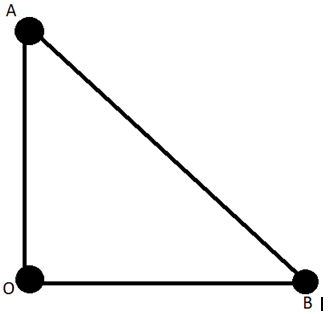
a) 1/3 (i- j) m
b) 2/3 (i + j) m
c) 1/3 (i+ j) m
d) (i- j) m
View Answer
Explanation: Sum of masses = 1 + 1 + 1 = 3
x-coordinate;
(1*0+1*0 + 1*1)/3 = 1/3
y-coordinate;
(1*1 + 1*0 + 1*0)/3 = 1/3
Position of centre of mass = 1/3 (i + j) m.
7.Four objects of mass 1 kg each are placed on 4 corners of a square of side 1 m as shown in the figure. Consider “O” to be the origin. What is the position of the centre of mass?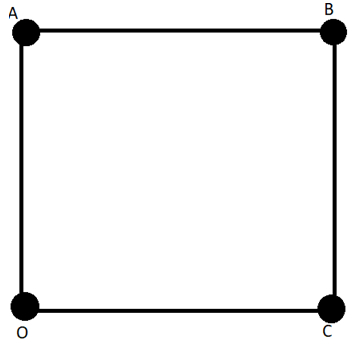
a) (i + j) m
b) 1/2 (i + j) m
c) (i– j) m
d) 1/2 (i – j) m
View Answer
Explanation: Sum of masses = 1 + 1 + 1 + 1 = 4
x-coordinate;
(1*0 + 1*1 + 1*1 + 1*0)/4 = 1/2
y-coordinate;
(1*1 + 1*1 + 1*0 + 1*0)/4 = 1/2
Position of centre of mass = 1/2 (i + j) m.
8. The distance between the centres of carbon and oxygen in the carbon monoxide molecules is 1.13 x 10⁻¹⁰ m. The distance of the centre of mass of the molecule relative to the oxygen atom is _____
a) 0.48 x 10⁻¹⁰ m
b) 0.64 x 10⁻¹⁰ m
c) 0.56 x 10⁻¹⁰ m
d) 0.36 x 10⁻¹⁰ m
View Answer
Explanation: The location of the centre of mass from an object in a two-object system is inversely proportional to the mass of the object.
The atomic mass of oxygen = 16
The atomic mass of carbon = 12
Total atomic mass = 16 + 12 = 28
The location of centre of mass relative to oxygen atom = (1.13 x 10-10) x 12 / 28
= 0.48 x 10⁻¹⁰ m.
9. Two particles of masses 2 kg and 3 kg are at rest and are separated by 10 m. If they move towards each other under the mutual force of attraction, they would meet at _____
a) 6 m from 4 kg body
b) 6 m from 6 kg body
c) 4 m from 4 kg body
d) 5 m from 6 kg body
View Answer
Explanation: The two bodies would meet at their centre of mass.
Sum of masses = 2 + 3 = 5 kg
Let us consider the 2 kg body as a reference;
The centre of mass from the 2 kg body =(3 x 10) / 5
= 6 m.
10. A ball of mass 3 kg and a ball of mass 2 kg roll towards each other on a flat surface. How far is the centre of mass from the 3 kg ball of the 2 balls are separated by 6 m?
a) 1.2 m
b) 2.4 m
c) 3.6 m
d) 4.8 m
View Answer
Explanation: Sum of masses = 3 + 2 = 5 kg
Centre of mass from 3 kg ball = (6 x 2) / 5
= 2.4 m.
11. A uniform disc of radius R is put over another uniform disc of radius 2R of same thickness and density. The edges of the two discs touch each other. What is the position of their centre of mass?
a) at 5R/3 from the centre of the larger disc
b) at 2R/3 from the centre of the larger disc
c) at 3R/5 from the centre of the larger disc
d) at 2R/5 from the centre of the larger disc
View Answer
Explanation:Since both discs have the same thickness and density;
M/(pi x R2 x t) = M’/((pi x 4 x R2 x t)
M = M’/4
M = Mass of a smaller disc
M’ = 4M = Mass of larger disc
Sum of masses = M + 4M = 5M
The distance of centres of discs = 3R
The distance of the centre of mass from larger disc = (3R x M)/5M
= 3R/5.
12. Three identical spheres each of radius R are placed such that their centres lie on a straight line. What is the location of their centre of mass from the centre of the first sphere?
a) R
b) 2R
c) 3R
d) 4R
View Answer
Explanation: Distance between first and last sphere = R + 2R + R = 4R
Since the spheres are identical and lie in a straight line, the centre of mass will lie exactly in the middle.
Hence the centre of mass lies at a distance of 2R from the centre of the first sphere.
13. The coordinates of the centre of mass of the system shown in the figures are _____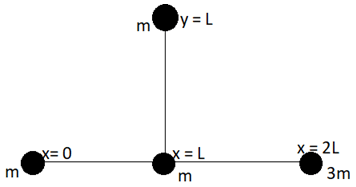
a) (0, 0)
b) (1.33L, 0.167L)
c) (L, L)
d) (0.33L, 1.67L)
View Answer
Explanation: Sum of masses = m + m + m + 3m = 6m
x-coordinate;
(m*0 + m*L + m*L + m*2L)/6m = 1.33L
y-coordinate;
(m*0 + m*L + m*0 + m*0)/6m = 0.167L.
14. From the figure, find out the perpendicular distance of the centre of mass of the system from side AB. ABCD is a square of side 2 m.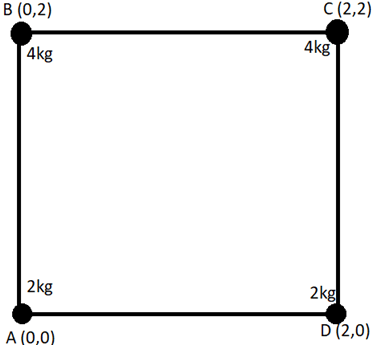
a) 1.33 m
b) 1 m
c) 1.5 m
d) 0.33 m
View Answer
Explanation:To find the perpendicular distance, we only need to find the y-coordinate.
Sum of masses = 4 + 4 + 2 + 2 = 12 kg
y-coordinate;
(2*0 + 4*2 + 4*2 + 2*0)/12 = 1.33 m.
15. Centre of mass can vary upon the application of internal force.
a) True
b) False
View Answer
Explanation: No, the centre of mass cannot vary upon the application of internal force. This is because internal force do not produce any net force. Hence the state of centre of mass in this scenario will remain unchanged.
Gravitation
1. For which of the following does the graph denote the variation of force of gravity “F” along a distance “r”?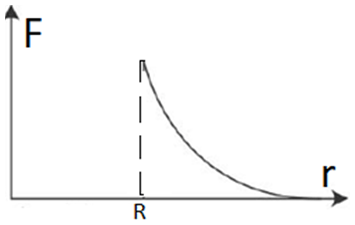
a) Solid sphere
b) Spherical shell
c) Plate
d) Point
View Answer
Explanation: The force of gravity is zero withing a spherical shell and varies similar to a point source at a distance greater than or equal to its radius.
2. For which of the following does the graph denote the variation of force of gravity “F” along a distance “r”?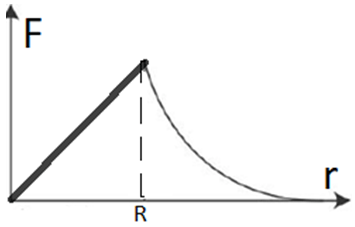
a) Solid sphere
b) Spherical shell
c) Plate
d) Point
View Answer
Explanation: The gravitational force is proportional to distance “r” until r=radius. For values of “r” greater than the radius of the sphere, the force is inversely proportional to the square of the distance.
3. What is the gravitational force experienced by an object of 10kg 200m away from an object weighing 1 ton?
a) 1.6675 N
b) 2.6675 N
c) 3.6675 N
d) 4.6675 N
View Answer
Explanation: From Newton’s law of gravitation, we have;
F = (G*M1*M2*)/R2
G = 6.67 x 10⁻¹¹ N m2/kg2
M1 = 10kg
M2 = 1000kg
R = 200m
F = (6.67 x 10-11 x 10 x 1000) / 2002
= 1.6675 N.
4. Which scientist introduced the universal law of gravitation?
a) Albert Einstein
b) Isaac Newton
c) Stephen Hawking
d) Nikola Tesla
View Answer
Explanation: The universal law of gravitation is a part of Isaac Newton’s work “Philosophiæ Naturalis Principia Mathematica (the Principia)”, first published on 5 July 1687.
5. What will be the value of acceleration due to gravity on the surface of the earth if the radius of the earth suddenly decreases to 60% of its present value, keeping the mass of the earth unchanged?
a) 9.81 m/s2
b) 5.89 m/s2
c) 16.35 m/s2
d) 27.25 m/s2
View Answer
Explanation: From Newton’s law of gravitation, we have;
g = (G*M1)/R2
Since the radius is reduced to 60% of its original value;
The new radius R’ = 0.6 x R
Therefore;
g’ = (G*M1)/(0.6*R) 2
g’ = g/(0.6) 2
= 9.81 / (0.6 x 0.6)
g’ = 27.25 m/s2.
6. The value of acceleration due to gravity of earth at the equator is less than that of the poles due to _____
a) shape and rotation of the earth
b) mass of the sun
c) mass of the earth
d) mass of the moon
View Answer
Explanation: The gravitational force is a central force. Acceleration due to gravity has different values for different points on the earth’s surface.
7. The weight of an object can be zero but the mass of an object can never be zero.
a) True
b) False
View Answer
Explanation: The weight of an object is zero when the net gravitational force acting on the object is zero. However, the mass of an object can never be zero since mass is a property of matter.
8. Gravitational force is the strongest fundamental force.
a) True
b) False
View Answer
Explanation: Gravitational force is the weakest fundamental force. The strong nuclear force is the strongest fundamental force of nature.
9. Gravitational force is _____
a) an imaginary force
b) a long-range force
c) a short-range force
d) the strongest fundamental force
View Answer
Explanation: Gravitational force is a long-range force which is inversely proportional to the square of the distance. The strong nuclear force is the strongest fundamental force and is a short-range force.
10. The universal law of gravitation becomes more inapplicable as the size and distance between objects decreases.
a) True
b) False
View Answer
Explanation: As the size and distance between objects decrease, nuclear forces become stronger and the law of gravitation cannot be applied. This calls for a new branch of physics known as “quantum physics”.
11. What is the force of gravity experienced by an object at the centre of the earth? (Assume that the earth is perfectly spherical)
a) 0 g-force
b) 1 g-force
c) 9.81 g-force
d) 10 g-force
View Answer
Explanation: Since a body at the centre of the earth would experience equal gravitational force from all sides, the vector addition of all of these forces amount to zero. Therefore, the force experienced by an object at the centre of the earth is zero.


.png)
.jpeg)
.png)


0 Comments