
Physics MCQs P 2
Mechanical Properties of Solids
1. Stress in a solid body is defined as ___________ per unit area.
a) external force applied
b) strain
c) pressure
d) internal forces developed due to externally applied forces
View Answer
Explanation: When a force is applied on a solid body, internal forces develop inside it. Pressure is the external force per unit area while stress is the internal force per unit area. Note that pressure and stress aren’t the same.

2. Stress, like pressure, is always perpendicular to a plane. True or False?
a) True
b) False
View Answer
Explanation: Stress can act along any direction to a plane. If it is parallel to the plane it is called shearing stress & if it is perpendicular to the plane it’s called normal stress. Pressure is always perpendicular to a unit area.
3. A wire with a radius of 5mm is hung freely from the ceiling. A load of 5N is applied to its free end. Find the elongation in the wire if its volume is 7.85*10-5m3 & young’s modulus is 1011N/m2.
a) 6.21*10-7m
b) 7.00*10-7m
c) 6.36*10-7m
d) 8.00*10-9m
View Answer
Explanation: The initial length of wire is Vol / πr2 = 7.85*10-5/ π*0.0052 = 1m.
Stress = Y*strain. F/A = Y*Δl / l.
Δl = F/A * l/Y = (5/πr2)*(1/1011)
= 6.37*10-7m.
a) 2.58m
b) 2.30m
c) 3.54m
d) 2.24m
View Answer
Explanation: Force = 1N. Initial area = πr2 = 2.82*10-5m2.
Stress = Y*Strain
Δl = F/A * l/Y = (1/2.82*10-5)*(1/105) = 0.35m
As volume will remain same (we can also say that product of l & r2 will be constant as other terms in expression of volume are constants).
1*32 = 1.35*R2
⇒R = 2.58m.
5. Strain can be negative. True or False?
a) True
b) False
View Answer
Explanation: Strain is defined as change in length or volume divided by initial length or volume respectively. There can be cases when length or volume decreases like when rod is compressed or body is inserted in fluid (it volume decreases due to pressure from all sides). Hence, strain can be negative.
6. In the given system, masses are released from rest. The young’s modulus of wire is 1011N/m2, length = 1m & radius = 2mm. Find elongation in wire when masses are moving. Assume pulley to be frictionless.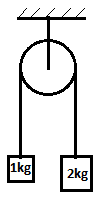
a) 1.05*10-5m
b) 2*10-5m
c) 3*10-5m
d) 0.5*10-5m
View Answer
Explanation: Let the tension in rope be ‘T’ & acceleration of masses be ‘a’.
2g-T=2a & T-1g=1a.
On solving these equations we get, T = 4g/3 = 1.33g.
For rope, Stress = Y*Strain.
∴ T/A = Y*Δl / l (where A is area of rope & l is initial length)
∴ Δl = (1.33g/πr2)*(1/1011) = 1.05*10-5 m.
Mechanical Properties of Fluids
1. A nail is made pointed at its end to ensure that pressure is more for a given amount of force applied on it. True or False?
a) True
b) False
View Answer
Explanation: Pressure is defined as force per unit area. And we need more pressure to drive the nail easily into the wall. So we make the nail pointed as it has a much lesser area than a blunt end.
2. Which device is used to measure pressure?
a) Odometer
b) Barometer
c) Dynamometer
d) Hydrometer
View Answer
Explanation: Barometer is a device used to measure air pressure. Odometer is a device used to measure the distance travelled by a wheeled vehicle (it is the speed indicator in your vehicle). Dynamometer is a device used to measure torque or rpm of an engine. Hydrometer is used to measure specific gravity of liquids. Also keep in mind that the liquid used in a barometer is mercury.
3. Which of the following quantities has the same S.I. unit as that of pressure?
a) Work
b) Energy / Velocity
c) Energy / Displacement
d) mass X (velocity)2/Volume
View Answer
Explanation: The S.I. unit of pressure is N/m2.
Work has the unit of Nm.
Energy/Velocity has the unit of Nm/(m/s) = Ns.
The unit of energy/disp is Nm/m = N.
The unit of mass X (velocity) 2/Volume is same as that of energy per unit volume because mass X (velocity)2 is equal to energy,
which is in turn equal to Nm/m3 = N/m2, therefore this is the correct option.
4. Pressure is a vector quantity. True or False?
a) True
b) False
View Answer
Explanation: When we talk about pressure at a point, we say it is exerted in all directions at that point, so it is not a vector quantity. As a vector quantity should have fixed direction with magnitude.
5. Assume a force of 30 N is distributed over a surface of area 2m2 in such a way that at each point force can be considered to act at an angle of 30° to the normal at that point. What will be the value of pressure on that plane?
a) 7.5 Pa
b) 7.5
c) 15 Pa
d) 15
View Answer
Explanation: One important thing to keep in mind is that pressure at a point is the normal component of force per unit area, NOT total force per unit area.
So, here we will take the normal component of 30N force, i.e:
30cos(30°)=15
Press = F/A = 15
= 7.5
6. What is the pressure at points A, B, C & D marked in the given mercury barometer? Assume that you have used a tube of length greater than 76cm and then filled it completely with mercury and then inverted into a jar. Let P0 be atmospheric pressure, g be acceleration due to gravity and ρ be the density of mercury.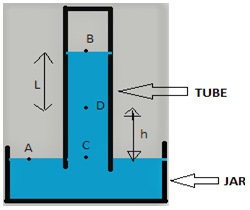
a) PA = P0, PB = P0, PC = PA, PD = P0+ ρgL
b) PA = 0, PB = P0, PC = ρg(h+L), PD = P0– ρgh
c) PA = 0, PB = 0, PC = P0, PD = P0+ ρgL
d) PA = P0, PB = 0, PC = P0, PD = ρgL
View Answer
Explanation: The assumption given in the question is to ensure that when the tub is inverted into the jar, the pressure on the top of the tube stays zero, in other words, vacuum gets created.
Point A is exposed to atmosphere, so PA = P0.
Point B is the top layer exposed to vacuum so PB = 0.
Point C is on the same level as that of A, and the fluid is stationary, so PC = PA = P0. Point D is at a depth L below point B so PD = 0 + ρgL.
∴ the correct option is PA = P0, PB = 0, PC = P0, PD = ρgL.
Also note that we can write PD as P0 – ρgh and PC as ρg(L+h).
7. A car containing a beaker of water is moving horizontally on a level road. Consider two points, A & B, inside the water such that they are on the same horizontal level and are separated by a distance L. Which of the following options is correct regarding the pressure differences between those two points?
a) If car is accelerating with acceleration a, PA – PB = ρgL
b) If car is accelerating with acceleration a, PA – PB = 0
c) If car is moving with constant velocity, PA – PB = 0
d) If car is moving with constant acceleration a, PA – PB = ρ (g+a)L
View Answer
Explanation: When the car is moving with constant velocity, points on the same horizontal level will have the same pressure.
So, PA – PB = 0.
When the car moves with constant acceleration the pressure difference between those two points will be ρaL,
as the pressure difference will be responsible for providing acceleration to the small fluid column of volume L*dA between points A & B
(where dA is an area of small element that we think of).
8. Fluid C has a relative density of 10, while fluid D has a relative density of 15. If the height of liquid C is 7cm, what will be the difference in heights of liquid D in the two tubes? In the diagram point 1 is in liquid D just after the end of liquid C.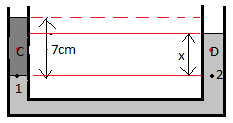
a) 5cm
b) 10.5cm
c) 15cm
d) 4.67cm
View Answer
Explanation: Pressure at points marked 1 & 2 is the same.
Pressure at point 1 is (7ρ1g).
Pressure at point 2 is (xρ2g).
We know P1 = P2;
∴ xρ2 = 7ρ1.
&rho1 = 10, ρ2 = 15
∴ x = 7*10/15 = 4.67cm.
Thermal Properties of Matter
1. Boyle’s and Charle’s law are obeyed by low density gases only. True or False?
a) True
b) False
View Answer
Explanation: Boyle’s and Charle’s law are used to arrive at the ideal gas law. And the ideal gas law is based on the assumptions of kinetic theory of gases, which are only valid for low density gases. For eg: the assumption that molecules exert no forces on each other can only be considered for low density.
2. Boyle’s law and Charle’s law together form which law?
a) PV/T = constant
b) PV2/T = constant
c) PV = constant
d) V/T = constant
View Answer
Explanation: Boyle’s law states that P ∝ 1/V.
Charle’s law states that V ∝ T.
From this we can say that
V ∝ T/P OR PV/T = constant.
Note that this is the ideal gas law.
3. Why can any low density gas be used in a constant volume gas thermometer?
a) All low density gases show the same expansion behaviour
b) They are easy to handle
c) Their pressure variation is proportional to square of the change in temperature
d) The given statement is not true
View Answer
Explanation: It has been experimentally shown that low density gases show similar expansion behaviour. If we keep the gas’s volume constant pressure increases monotonically with increasing temperature. Hence, we can use any low density gas for a constant volume gas thermometer.
a) It doesn’t use mercury for pressure measurement
b) We actually measure the pressure at constant volume and the scale is calibrated to give the temperature reading
c) Any high density gas can be used
d) Pressure ∝ Temp2
View Answer
Explanation: A constant volume gas thermometer has a mercury manometer connected to a gas bulb. With increase in temperature of the bulb, its volume is kept constant by external methods and the pressure of gas increases. The temperature scale is defined as a function of this pressure. (T = kP, where k is a constant).
5. What is absolute zero?
a) It is the minimum temperature that has been achieved
b) It is the lowest temperature of air
c) It is -273K
d) It is the temperature at which an ideal gas will have zero pressure, assuming it stays a gas
View Answer
Explanation: Absolute zero has been defined as the temperature at which an ideal gas would have zero pressure, assuming it remains a gas till then. The temperature value is obtained by extrapolating the graph of Pressure vs Temperature till the straight line cuts the temperature axis. This gives us a value of -273.15°C. Note that this temperature hasn’t been achieved yet.
a) -273.15K
b) -273.15°C
c) 0°C
d) 0k
View Answer
Explanation: The zero point on the Kelvin scale is called absolute zero, which corresponds to a temperature of -273.15°C.
Additionally, the Kelvin scale and the Celsius scale have the same unit size, meaning a 1-degree change in Celsius is equal to a 1-degree change in Kelvin.
The relationship between them is: K=273.15+ °C
7. What is the value of gas constant?
a) 8.314 kJ mol-1K-1
b) 8.314 L atm mol-1K-1
c) 0.0821 L atm mol-1K-1
d) It is equal to the constant in PV/T = constant
View Answer
Explanation: The value of universal gas constant is 0.0821 L atm mol-1K-1.
Or it is 8.314 J mol-1K-1.
The constant in PV/T = constant depends on the number of moles taken.
8. In a constant volume gas thermometer, the pressure of liquid, at a temperature of 27°C, being measured corresponds to 50cm of mercury. If the temperature increases by 20K, find the pressure.
a) 53.33cm
b) 87.03cm
c) 65.33cm
d) 97.03cm
View Answer
Explanation: For a constant volume gas thermometer, P/T = constant.
P1/T1 = P2/T2
∴ P2 = P1/T1 * T2 = 50/300 * 320 = 53.33cm.
Thermodynamics
1. ΔU=0 means that the process is isothermic. True or False?
a) True
b) False
View Answer
Explanation: Internal energy is a function of temperature only. So if ΔU=0 implies that the process will have constant temperature, or it is isothermic.
2. First law of thermodynamics is based on?
a) Conservation of energy
b) Conservation of mass
c) Conservation of momentum
d) Conservation of work
View Answer
Explanation: The first law of thermodynamics is based on the conservation of energy. It deals with work done and heat energy supplied or removed from a system. It basically says that energy supplied to a system is conserved.
3. If 315cal of heat is given to the system, and the system does 20cal of work, find the change in internal energy.
a) 295cal
b) 335cal
c) 0 cal
d) 335J
View Answer
Explanation: The first law states that ΔU=ΔQ – ΔW
= 315 – 20
= 295cal.
Work is positive as it is done by the system. Heat is positive as it is supplied to the system.
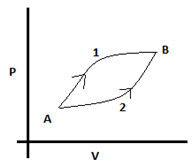
a) U1 > U2, Q1 > Q2
b) U1 < U2, Q1 > Q2
c) U1 = U2, Q1 = Q2
d) U1 = U2, Q2 > Q2
View Answer
Explanation: The initial and final states are the same for both processes, so the value of internal energy will be the same (U1 = U2).
The area under the PV curve gives work done.
In the given diagram, area under 1 is greater than area under 2. So, W1 > W2.
We know, ΔQ =ΔU + ΔW, which implies that Q1 > Q2 since U is same for both and W1 > W2.
5. A block of mass 1kg is given a velocity of 5m/s on a horizontal flat surface. What will be the change in internal energy of the block-surface system, when the block comes to rest. The coefficient of kinetic friction is 0.3 and coefficient of static friction is 0.4.
a) 25J
b) 12.5J
c) 0
d) 30J
View Answer
Explanation: The kinetic energy of the block will change into internal energy of the system.
Initial kinetic energy = 0.5*1*25 = 12.5J.
Therefore the internal energy change = 12.5J.
6. Consider a gas contained in a rigid container of volume 20m3. What will be the change in internal energy if 50J of heat is provided to it? Assume the gas exerts a pressure of 1atm on the walls.
a) 50J
b) 0
c) 70J
d) 20J
View Answer
Explanation: All the heat supplied will be equal to change in internal energy.
The work done is zero because the container is rigid hence no volume change.
Thus, ΔU = ΔQ – ΔW = 50 + 0 = 50J.
7. A disc spinning with 24J of kinetic energy is kept in a container containing a fluid having a heat capacity of 2000J/K. When the disc comes to rest what will be the change in internal energy if ΔU = 3.5ΔT.
a) 0
b) 0.042J
c) 0.021J
d) 0.028J
View Answer
Explanation: When the disc comes to rest all its kinetic energy will have been converted into internal energy of the system.
The fluid has a heat capacity of 2000J/K which means that for 24J the change in temperature will be 24/2000 = 0.012K.
Given: ΔU = 3.5ΔT
⇒ ΔU = 3.5*0.012
= 0.042J.
8. In the process A to B to C, 20J of heat is supplied from A to B. 20.5J of heat has been removed from B to C and 2J of heat has been added from C to A. Calculate the value of ‘v’ from the given conditions in the diagram. The values of pressure and volume given in the graph are in S.I. units.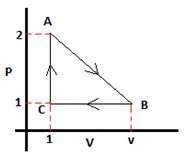
a) 4m3
b) 1.5m3
c) 3m3
d) 8m3
View Answer
Explanation: In one cycle the change in internal energy should be zero.
The heat energy supplied in one cycle is 20 – 20.5 + 2 = 1.5J.
Therefore the work done by the system in one cycle should be 1.5J.
Area under PV curve is work done,
thus 0.5*(v-1)*1 = 1.5.
∴ v = 4m3.
9. In the given system, 20J of heat is supplied to the gas molecules. The spring is initially not elongated or compressed. If the spring gets compressed by 1cm. Calculate the change in internal energy of the system. Spring constant = 200N/m. Assume piston moves slowly.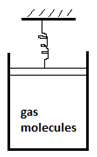
a) 19J
b) -19J
c) 21J
d) -21J
View Answer
Explanation: The work done by the piston will be stored in spring.
The energy stored in spring = 1/2kx2 = 0.5*200*0.01 = 1J.
The work done by piston = 0.01J.
ΔU = ΔQ – ΔW = 20 – 1 = 19J.
10. At constant pressure P the volume of a gas increases from V1 to V2 when ‘Q’ amount of heat is removed from the system. What will happen to internal energy?
a) Remain the same if Q = P(V1 – V2)
b) Decrease by an amount P(V2 – V1) – Q
c) Decrease by an amount Q + P(V2 – V1)
d) Increase by some unknown amount
View Answer
Explanation: The internal energy will definitely decrease as both factors heat removal and work done by gas support the same. ΔU = ΔQ – ΔW = -Q – P(V2 – V1) = -(Q + P(V2 – V1)). Thus, we can say that internal energy decreases by an amount = Q + P(V2 – V1).
Kinetic Theory
1. What is the number of molecules in 2.24L of SO2 at STP?
a) 6.023*1023
b) 6.023*1022
c) 6.023*1020
d) 6.023*1021
View Answer
Explanation: According to Avogadro’s law 22.4L of any gas at STP is 6.023*1023.
So, in 2.24L there will be 6.023*1023/10
= 6.023*1022.
2. What is the mass of 22.4L of CO2at STP?
a) 1g
b) 44g
c) 44kg
d) 1kg
View Answer
Explanation: 22.4L of a gas at STP has a weight equal to its molar mass.
So, the weight of CO2 will be 12+16+16
= 44g.
3. The behavior of real gases approaches that of ideal gas in which of these following conditions?
a) Low pressure & low temperature
b) High Pressure & high temperature
c) Low pressure & high temperature
d) high pressure & low temperature
View Answer
Explanation: Ideal gas is based on the assumptions of kinetic theory of gases(KTG). At low pressure and high temperature the intermolecular forces become less significant and the size of molecules becomes less as compared to separation between them. These are two postulates of KTG and hence in these conditions real gas behavior is similar to that of ideal gases.
a) 6Pa
b) 12Pa
c) 18Pa
d) 28Pa
View Answer
Explanation: The ratio of partial pressures will be in the same ratio as that of moles, i.e: 1:3:5.
Let the partial pressure of gas 1 be ‘x’.
Thus, x+3x+5x = 54.
x = 6Pa.
5. What is the ratio of densities of 2 gases, O2 & N2, having partial pressures in the ratio 2:3?
a) 16/21
b) 12/7
c) 21/16
d) 7/12
View Answer
Explanation: The ratio of moles is the same as the ratio of partial pressures.
The ratio of densities:
d1/d2= (m1/V)/(m2/V)
= m1/m2= (n1M1)/(n1M2),
where n is the number of moles and M is the molecular mass. d1/d2= (2/3)*(16/14)
= 16/21.
6. In the given diagram, one graph is of an ideal gas and another is of a real gas. Select the correct option.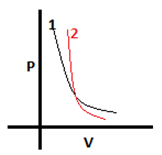
a) 1-real gas, 2-ideal gas
b) 1-ideal gas, 2-real gas
c) Both are for an ideal gas at different temperatures
d) Their graphs cannot intersect
View Answer
Explanation: Real gases, unlike ideal gases, consider volume taken up by molecules because of which mean free path decreases or collisions increase and hence pressure increases. So, at low volumes this factor will play a big role and thus for a particular volume in the low volume range, pressure of real gases will be higher. To see which graph belongs to whom we can draw a line parallel to the pressure axis at very low volume. The one having higher pressure will be that of real gases. Therefore, 2-real gas & 1-ideal gas.
Oscillations
1. Every periodic motion is oscillatory, but not vice versa. True or False?
a) True
b) False
View Answer
Explanation: Periodic motion is motion that repeats itself at regular intervals of time. Oscillatory motion is periodic motion where there is an equilibrium point. When a body is given a small displacement from this equilibrium position, a force will act on it towards the equilibrium position. Thus, we can say that every oscillatory motion is periodic but not vice versa.
2. Which of the following describes circular motion?
a) Periodic
b) Oscillatory
c) Simple Harmonic
d) Rectilinear motion
View Answer
Explanation: The motion is periodic as it repeats its path at regular intervals. It is not oscillatory because there is no specific equilibrium position. Rectilinear motion means linear motion.
3. The graph given below represents motion of what? And what type of motion is it? Assume that the downward direction in the graph is negative. Also find the value of t. Assume no loss of energy anywhere. Assume disp =0 implies ground level.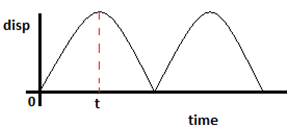
a) Ball thrown up with velocity u, periodic motion, t = u/g
b) Ball left from a height h, periodic motion, t = √(2h/g)
c) Ball thrown up with velocity u, oscillatory motion, t=u/g
d) Ball thrown up with velocity u, periodic motion, t=2u/g
View Answer
Explanation: At t=0, displacement is zero. Thus, the ball starts from the ground. When the ball is thrown upward with velocity u, using equation v=u-at, we get:
v = 0 at t = u/g, which is the topmost point of the graph. The motion is periodic with a time period 2t=2u/g.
a) True
b) False
View Answer
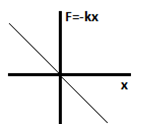
Explanation: In SHM, the extreme position is where the particle is at instantaneous rest. Force on it is given by the relation F=-kx, where x is the distance from the equilibrium position. This shows that force is maximum at extreme positions since x is maximum. The graph of force vs position also shows the same.
5. A ball is thrown up with a velocity of 2.5m/s. It collides elastically with the ground. Find the frequency of this periodic motion.
a) 1Hz
b) 2Hz
c) 3Hz
d) 0.5Hz
View Answer
Explanation: The motion will repeat itself after the ball hits the ground every time. The time taken for the ball to reach the topmost position is t = u/g.
This will also be the time to reach the ground.
Thus, total time = 2u/g.
This will be the time period.
Frequency = 1/T = g/2u
= 10/5 =2Hz.
6. A function has the equation Acos3t + Bsin3t. Find the value of time period.
a) π/3
b) 2π/3
c) Aπ/3 + Bπ/3
d) π/3A + π/3B
View Answer
Explanation: Acos3t + Bsin3t = √(A2 + B2) [sin(3t+a)],
where sin(a) = (A/√(A2 + B2)).
Thus, the time period will be 2π/3.
Here, √(A2 + B2) will be the amplitude.
7. A force given by: F = -2(x – 1)2acts on a particle at rest. Select the correct option regarding the same.
a) Force acts on particle along the positive x direction
b) Force is never zero
c) Motion is periodic but not oscillatory
d) Motion is rectilinear
View Answer
Explanation: Force always acts in the negative direction, so motion is not periodic. Motion is rectilinear since the particle will always travel in a straight line. Force is zero at x=1.
8. What is the frequency of SHM?
a) Number of oscillations per unit time
b) Time for one oscillation
c) Time taken for motion to reverse direction
d) Same as angular frequency
View Answer
Explanation: Frequency is defined as the number of oscillations per unit time. Its unit is Hz. It is related to the angular frequency w by the relation: f = w/2π.
9. Force on a particle is given by: F = -kxn. For what values of n will the motion be oscillatory?
a) 3
b) 4
c) Any integer
d) It cannot be oscillatory for any value of n
View Answer
Explanation: For motion to be oscillatory there has to be an equilibrium position towards which the force is acting throughout the motion. In the expression, F = -kxn,
If n is even, force will always act in one direction.
If n is odd, force will change direction when x changes direction and will always act towards the origin.
Hence, motion will be oscillatory if n is odd.
Thus, from the given options 3 is correct.
10. A displacement function is given by: x = exp(sin2t). It is periodic. True or False?
a) True
b) False
View Answer
Explanation: exp(sin2t) is an exponential function.
But the value of exponent sin2t repeats after every interval of π,
so the given function is periodic with a time period π.
Waves
1. If a string wave encounters a completely fixed end, what happens to its phase?
a) Stays the same
b) Changes by π
c) Changes by π/2
d) Waves gets destroyed
View Answer
Explanation: The reason for the phase to change by π is that the boundary displacement should be zero because it is rigid & by principle of superposition it is only possible if the reflected wave differs by a phase of π.
2. The equation of a wave is: y = 2sin(4x-3t). What will be the equation of the reflected wave from a free surface?
a) y = 2sin(4x+3t)
b) y = 2sin(3t-4x)
c) y = 2cos(4x+3t)
d) y = 2sin(4x-3t)
View Answer
Explanation: At the free surface reflected wave suffers no phase change.
Only the direction of wave propagation gets reversed.
So, the equation will be y = 2sin(4x+3t).
3. In a standing wave the amplitude of a particle is fixed, but varies from particle to particle. True or False?
a) True
b) False
View Answer
Explanation: A standing wave neither moves left or right, all particles between two nodes are in the same phase. The equation of a standing wave is of the form Asin(kx)cos(wt),
where Asin(kx) is the amplitude which is different for different values of x.
This shows that for each value of x we get a different value of amplitude.
4. What is the minimum distance between a node & an antinode in a standing wave?
a) λ
b) λ/2
c) 2λ
d) λ/4
View Answer
Explanation: The amplitude in a standing wave is given by Asin(kx).
Node is a point where amplitude is zero and antinode is a point where amplitude is maximum.
For a node, sin(kx) = 0
kx = 2nπ OR (2π/λ)x = nππ
x = nλ/2.
For an antinode, sin(kx) = 1
kx = (2n+1)π/2
(2π/λ)x = (2n+1)π/2
x = (2n+1) λ/4.
∴ node is at λ/2, λ, 3λ/2 …
& antinode at λ/4, 3λ/4, 5λ/4 …
∴ minimum distance = λ/2 – λ/4 = λ/4.
5. If a standing wave is vibrating in the fourth harmonic and the wavelength is λ, what is the length of the string.
a) 2λ
b) λ
c) 4λ
d) λ/4
View Answer
Explanation: If the length of string is L, then the wavelength of the standing wave is 2L/n.
Or we can say L = nλ/2, where n corresponds to nth harmonic.
∴ L = 4λ/2
= 2λ.
6. Consider the case of normal modes of vibration for the air column with only one end closed. What is the length of the air column for the fundamental harmonic?
a) λ/2
b) λ
c) 2λ
d) λ/4
View Answer
Explanation: For the given condition wavelength is related to length by: λ = 4L/(2n+1).
∴ For fundamental harmonic n=0, & L = (2n+1)λ/4
= (0 + 1)λ/4
= λ/4.
7. A pipe is open at both ends. What should be its length such that it resonates a 10Hz source in the 2nd harmonic? Speed of sound in air = 340m/s.
a) 34m
b) 68m
c) 17m
d) 51m
View Answer
Explanation: For a pipe open at both ends frequency ‘f’ = nv/2L, where n is speed of sound.
Given: f = 10 & n=2.
∴ 10 = 2*340/2L
∴ L = 680/20
= 34m.
8. Consider standing waves in an air column with one end closed. What is a pressure node?
a) Pressure variation is maximum
b) Displacement variation is minimum
c) Same as displacement node
d) Least pressure change
View Answer
Explanation: The point where there is an antinode corresponds to maximum amplitude of displacement. This also implies that here, pressure changes are minimum and it is therefore called a pressure node.
9. A pipe open at both ends has a fundamental frequency of 2Hz. If the pipe is closed at one end and half filled with water, what will be the fundamental frequency?
a) 0.5Hz
b) 2Hz
c) 4Hz
d) 1Hz
View Answer
Explanation: The fundamental frequency in the first case is given by: f1 = v/2L.
In the second case length becomes half & one end is closed,
so fundamental frequency f2 = v/(4L/2)
= v/2L = f1.
So the value of f2 = 2Hz.
10. Standing waves can be produced when two identical waves, having a phase difference of π, are travelling in the same direction. True or False?
a) True
b) False
View Answer
Explanation: The equation of standing waves is given by; y = Asin(kx)cos(wt).
This is formed by adding two waves of the form asin(kx-wt) & bsin(kx+wt)
which shows that they both must be travelling in opposite directions.
Comments
Post a Comment