
Physics MCQs Test P 11
Optics
1. Calculate the velocity of the light ray in the medium, if the critical angle for TIR from medium to the vacuum is 30°.
(a) 2 x 10⁸ m/s
(b) 1.5 x 10⁸ m/s
(c) 0.75 x 10⁸ m/s
(d) 3 x 10⁸ m/s
Answer: (b) 1.5 x 10⁸ m/s

2. Which of the following is the combination that is used in the formation of achromatic lenses?
(a) 1 convex and 1 plane mirror
(b) 2 convex lenses
(c) 1 convex and 1 concave lens
(d) 2 concave lenses
Answer: (c) 1 convex and 1 concave lens
3. How does magnifying power change for an objective lens if the focal length of the objective lens is increased?
(a) The microscope will decrease but for the telescope, it will increase
(b) The microscope will increase but for the telescope, it decreases
(c) The microscope and telescope will increase
(d) The microscope and telescope will decrease
Answer: (a) The microscope will decrease but for the telescope, it will increase
4. What is the power of the combination of lenses, if two thin lenses of focal length f1 and f2 are in contact and coaxial.

5. Following is the graph explaining the variation of v with respect to u for a mirror. What is the value of points above the marking P on the curve for values of v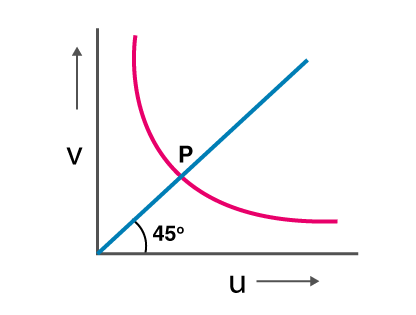
(a) Smaller than f
(b) Larger than 2f
(c) Smaller than 2f
(d) Smaller than 2
Answer: (b) Larger than 2f
6. What is the magnification produced by the plane mirror?
(a) Zero
(b) +1
(c) -1
(d) Between 0 and +∞
Answer: (b) +1
7. Which of the following graph is correct when the real image distance v formed by a convex lens is measured for different object distance u.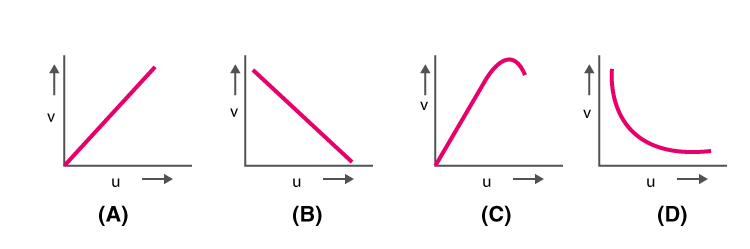
Answer: (d)
8. What happens to the refractive index on heating the liquid?(a) Increases
(b) Decreases
(c) Remains unchanged
(d) Increases or decreases depending on the rate of heating
Answer: (b) Decreases
9. Calculate the speed of light in water if the refractive index of water is 1.33(a) 4 x 10⁸ m/s
(b) 2.25 x 10⁸ m/s
(c) 1.33 x 10⁸ m/s
(d) 3 x 10⁸ m/s
Answer: (b) 2.25 x 10⁸ m/s
10. What is hypermetropia?
(a) Bad vision due to age
(b) Short-sightedness
(c) Long-sightedness
(d) Formation of a layer on the eye
Answer: (c) Long-sightedness
11. Rainbow is an example of which phenomenon?
(a) Refraction and scattering
(b) Refraction and total internal reflection
(c) Dispersion and reflection
(d) Dispersion and total internal reflection
Answer: (d) Dispersion and total internal reflection
Second Law Motion
1. A bullet of 5 gms travels with a velocity of 100 m/sec. It penetrates a wooden block up to 6 cm. What is the average force imposed on the block by the bullet?
- 0
- 417 N
- 830 N
- 830 N
Answer: (b) 417 N
2. The second law of motion gives the measure of which of the following?
- Force
- Acceleration
- Momentum
- Angular Momentum
Answer: (a) Force
3. What is the velocity of a body of mass 5 gm if a force of 100 dynes acts on the body for 10 seconds?
- 2000 cm/sec
- 200 cm/sec
- 20 cm/sec
- 2 cm/sec
Answer: (b) 200 cm/sec
4. An object will possess uniform motion as long as the
- resultant force acting on it begins to decrease
- resultant force on acting on it increases continuously
- resultant force is right angles to its rotation
- resultant force acting on it is zero
Answer: (d) resultant force acting on it is zero
5. What is the accelerating force on the Diwali rocket if it ejects 0.05 kg of gases per second at a velocity fo 400 m/s?
- 20 N
- 20 dynes
- 1000 N
- 22 dynes
Answer: (a) 20 N
6. A coin dropped in the lift takes time t1 to reach the floor when the lift is stationary and time t2 when the lift moves with a constant acceleration. Which of the following relation is true?
- t1>t2
- t2>t1
- t1=t2
- t1>>t2
Answer: (a) t1>t2
7. A person standing in the elevator finds his weight to be lesser than his actual weight in which of the following cases?
- When the elevator moves upward with constant acceleration
- When the elevator moves downward with constant acceleration
- When the elevator moves upward with constant velocity
- When the elevator moves downward with constant velocity
Answer: (b) When the elevator moves downward with constant acceleration
8. A parachutist weighing w strikes the ground with his legs fixed and comes to rest with an upward acceleration of 3 g. What is the force exerted by him during landing?
- w
- 2w
- 3w
- 4w
Answer: (d) 4w
9. A man stands on a weighing machine in the lift. When the lift is stationary his weight is recorded as 40 kg. If the lift accelerates upwards with an acceleration of 2 m/s2 what weight will the machine show?
- 40 kg
- 48 kg
- 42 kg
- 32 kg
Answer: (b) 48 kg
10. Two trolleys of mass m and 3m are connected by a string. When they are compressed and released, they move off in opposite directions and come to rest after covering a distance of S1 and S2 respectively. Assuming the coefficient of friction to be constant, the ratio of S1: S2 is
- 1:9
- 1:3
- 3:1
- 9:1
Answer: (d) 9:1
11. What will happen if the body at rest is made to move in a straight line and obstructed by an opposite force?
- The body slows down
- The body changes direction
- The body will continue to move in the same direction with the same speed
- All of the above
Answer: (a) The body slows down
12. What is the apparent weight of the body travelling upwards with an acceleration of 2 m/s2 and has a mass of 10 kg?
- 198 N
- 140 N
- 118 N
- 164 N
Answer: (c) 118 N
13. On a body of 20 kg, a force of 10 N acts for 10 seconds. What is the change in its momentum?
- 1000 kg.m/s
- 200 kg.m/s
- 100 kg.m/s
- 5 kg.m/s
Answer: (c) 100 kg.m/s
14. A machine gun fires a bullet of mass 40 g with a velocity of 1200 ms-1. The man holding it cam exert a maximum force of 144 N on the gun. How many bullets can he fire per second at the most?
- One
- Two
- Three
- Four
Answer: (c) Three
15. The figure shows a horizontal stretched net with a force of 10 N. The tension in sections BC and BF are
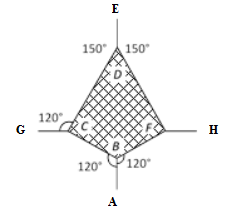
- 10 N, 10 N
- 10 N, 11 N
- 10 N, 6 N
- Can’t calculate due to insufficient data
Answer: (a) 10 N, 10 N
Relative Velocity
1. Two bikes travelling in the same direction move at a speed of 30 km/hr. The bikes are separated by a distance of 5 km. What would the speed of the car travelling in the opposite direction be if it meets these bikes at an interval of 4 minutes?
- 40 km/hr
- 45 km/hr
- 30 km/hr
- 15 km/hr
Answer: (b) 45 km/hr
2. On a rainy day, a girl standing on the road has to hold her umbrella at an angle of 300 with respect to the vertical to avoid getting drenched in the rain. She throws the umbrella and starts running at a speed of 10 km/hr. She notices that the raindrops are falling vertically on her head. What is the speed of the raindrops with respect to the ground?
- 20 km/hr
- 10 km/hr
- 30 km/hr
- 40 km/hr
Answer: (a) 20 km/hr
3. In the above problem, the speed of raindrops w.r.t to the moving girl is

4. A 150 m long train moves towards south at a speed of 10 m/s. A sparrow flying at a speed of 5 m/s towards north crosses the train. What is the time taken by the sparrow to cross the train?
- 30 s
- 15 s
- 8 s
- 10 s
Answer: (d) 10 s
5. A river flows east to west at a speed 5 m/min. A man capable of swimming 10 m/min in still water is standing on the south bank of the river. He wants to swim across the river in the shortest time possible. Which of the following path should he choose?
- Due North
- Due North-East
- Due North-East with double the speed of the river
- None of the above
Answer: (a) Due North
6. A person who aims to reach the exact opposite point on the bank of a stream swims at a speed of 0.5 m/s at an angle of 1200 following the direction of the water flow. What is the speed of water in the stream?
- 1 m/s
- 0.25 m/s
- 0.5 m/s
- 0.433 m/s
Answer: (b) 0.25 m/s
7. X moves at a speed of 65 km/hr while Y who is behind X moves at a speed of 80 km/hr. What is the relative velocity of Y with respect to X?
- 60 km/hr
- 80 km/hr
- 145 km/hr
- 15 km/hr
Answer: (d) 15 km/hr
8. A person who aims to reach the exact opposite point on the bank of a stream swims at a speed of 0.5 m/s at an angle of 1200 following the direction of the water flow. What is the speed of water in the stream?
- 1 m/s
- 0.5 m/s
- 0.25 m/s
- 0.433 m/s
Answer: (c) 0.25 m/s
9. A deer being preyed upon by the lion runs at a speed of 9 m/s. The lion chases the deer running at a speed of 10 m/s. If the instantaneous separation of deer from the lion is 100 m. How long would it take the lion to catch the deer?
- 1 second
- 19 seconds
- 90 seconds
- 100 seconds
Answer: (d) 100 seconds
10. A man travelling in a bus moves from west to east with a speed of 40 km/hr. He observes that the raindrops are falling vertically down. To another man standing on the ground, the rain will appear
- to be falling vertically down
- to be falling at an angle going from east to west
- to be falling at an angle going from west to east
- insufficient information is given to determine the direction of the rain
Answer: (c) to be falling at an angle going from west to east
11. A car accelerated from its initial position and then returned at the initial point, then
- speed is zero but velocity increases
- velocity is zero but speed increases
- both speed and velocity decrease
- both speed and velocity increase
Answer: (b) velocity is zero but speed increases
12. Which of these can be zero when a particle is in motion for some time?
- Speed
- Distance
- Displacement
- None of these
Answer: (c) Displacement
13. The slope of velocity-time graph for motion with uniform velocity is equal to
- initial velocity
- final velocity
- zero
- None of these
Answer: (c) zero
14. A ball is thrown vertically downward with a velocity of 20 m/s from the top of a tower. It hits the ground after some time with a velocity of 80 m/s. The height of the tower is (g =10 m/s2)
- 300 m
- 320 m
- 340 m
- 360 m
Answer: (a) 300 m
15. Two bullets are fired horizontally and simultaneously towards each other from roof tops of two buildings 100 m apart and of same height of 200 m with the same velocity of 25 m/s. When and where will the two bullets collides. (g= 10 m/s2 )
- They will not collide
- After 4s at a height of 120 m
- After 2s at a height of 20 m
- After 2s at a height 180 m
Answer: (d) After 2s at a height 180 m
Motion of Connected Bodies
1. A block of mass M is pulled along a horizontal frictionless surface by a rope of mass m. If P is the force exerted on the free end of the rope, what is the force exerted on the block by the rope?

3. Three weights A, B and C of mass 2 kg each are hanging on string passing through a frictionless pulley. What is the tension in the string connecting weights B and C?
- 13 N
- 19.6 N
- 3.3 N
- 0
Answer: (a) 13 N
4. A frictionless pulley kept on a horizontal table connects two blocks of masses 4 kg and 5 kg. What is the acceleration of 5 kg mass?
- 5.44 m/s2
- 2.72 m/s2
- 19.5 m/s2
- 49 m/s2
Answer: (a) 5.44 m/s2
5. Three blocks A, B and C each weighing 1, 8, and 27 kg respectively are connected to each other by an inextensible string and are moving on a smooth surface. If T3 is equal to 36 N, then what will T2 be equal to?
- 9 N
- 18 N
- 3.375 N
- 1.25 N
Answer: (a) 9 N
6. Three solid masses m1, m2 and m3 placed on a frictionless table and are connected in succession. If the mass m3 is dragged with a force T, the tension in the string between m2 and m3 are given as

7. A string passing over a frictionless pulley has a mass of 6 kg attached to one of its ends. To the other end a mass of 10 kg is attached. What is the tension in the thread?
- 2.45 N
- 24.5 N
- 73.5 N
- 79 N
Answer: (c) 73.5 N
8. What will the acceleration of the system of two masses connected to a pulley be if the masses weigh 5 kg and 10 kg?
- g
- g/2
- g/3
- g/4
Answer: (c) g/3
9. A body of weight 2 kg is suspended as shown in the figure. What is the tension T1 in the horizontal string?

10. A block of mass which weighs 4 kg is suspended through spring balances A and B. Then A and B will read respectively
- 0 kg and 4 kg
- 4 kg and 0 kg
- 4 kg and 4 kg
- 2 kg and 2 kg
Answer: (c) 4 kg
Photometry
1. What is the power of the lamp if its luminous efficiency is 2 lumen/watt and its luminous intensity is 42 candela?
- 62 W
- 138 W
- 76 W
- 264 W
Answer: (d) 264 W
2. In a movie hall, if the distance between the screen and the projector is increased by 1% what happens to the illumination on the screen?
- Increases by 1%
- Decreases by 1%
- Increases by 2%
- Decreases by 2%
Answer: (d) Decreases by 2%
3. At a height of one meter above the centre of a circular table of diameter 4m, a bulb of 100 W hangs. If the intensity at a point on its rim is I0, then what is the intensity at the centre of the table?

4. Lux is a unit of which of the following?
- Illuminance on a surface
- Luminous intensity of a source
- Luminous efficiency of the source of light
- Transmission coefficient of a surface
Answer: (a) Illuminance on a surface
5. Lux is equivalent to which of the following?
- 1 candela/m2
- 1 lumen/cm2
- 1 lumen/m2
- 1 candela/cm2
Answer: (a) 1 candela/m2
6. If a lamp has a luminous efficiency of Five lumen/watt and a luminous intensity of 35 candela. What is the power of the lamp?
- 176 W
- 88 W
- 36 W
- 80 W
Answer: (b) 88 W
7. The distance between a point source of light and a screen is 60 cm and now this distance is increased to 180 cm. By how many fractions will the intensity on the screen change as compared to the original intensity?
- 9 times
- 3 times
- (1/9) times
- (1/3) times
Answer: (c) (1/9) times
8. Venus looks brighter than other stars because
- it has no atmosphere
- atomic fission occurs on its surface
- it has a higher density than other stars
- it is closer to earth than most stars
Answer: (d) it is closer to earth than most stars
9. Which of the following sources of light is the inverse square law valid for?
- Cylindrical source
- Searchlight
- Isotropic point source
- All types of light sources
Answer: (c) Isotropic point source
10. Which of the following has more luminous efficiency?
- 40 W fluorescent tube
- 40 W bulb
- Both have the same luminous efficiency
- Cannot say
Answer: (a) 40 W fluorescent tube
11. A lamp hangs at a height of 4 m above a table. The lamp is lowered by 1 m. By how much will the illuminance increase?
- 78%
- 64%
- 40%
- 92%
Answer: (a) 78%
12. A point source of 100 candela is held 5 m above a sheet of blotting paper which reflects 75% of the incident light. What is the illuminance of blotting paper?
- 4 lux
- 4 phot
- 3 lux
- 3 phot
Answer: (a) 4 lux
Comments
Post a Comment