
Physics MCQs Test P 12
Semiconductor Device
1. Which among the following is the most commonly used semiconductor?
- Silicon
- Carbon
- Germanium
- Sulphur
Answer: (a) Silicon

2. What happens to the resistance of a pure semiconductor when heated?
- The resistance increases
- The resistance decreases
- The temperature remains the same
- Can’t say
Answer: (b) The resistance decreases
3. How many valence electrons does a pentavalent impurity have?
- 3
- 4
- 5
- 6
Answer: (c) 5
4. How many valence electrons do trivalent impurities have?
- 2
- 3
- 4
- 5
Answer: (b) 3
5. Which of the following is created when trivalent impurities are added to a semiconductor?
- Free electrons
- Holes
- Bound electrons
- Valence electrons
Answer: (b) Holes
6. Which of the following does a hole in the semiconductor define?
- A free proton
- A free neutron
- A free-electron
- An incomplete part of an electron pair bond
Answer: (d) An incomplete part of an electron pair bond
7. An electron and a hole in close proximity would tend to _____.
- attract each other
- repel each other
- have no effect on each other
- destroy each other
Answer: (a) attract each other
8. What is the random motion of free electrons and holes due to thermal agitation called?
- Pressure
- Diffusion
- Ionisation
- None of the above
Answer: (b) Diffusion
9. Why is the mobility of free electrons greater than that of holes?
- They are light
- They mutually collide less
- They require low energy to continue the motion
- They carry negative energy
Answer: (c) They require low energy to continue the motion
10. The relation between the number of free electrons in semiconductor and its temperature is given as
 11. Which of the following does the resistivity of a semiconductor depend upon?
- Length of the semiconductor
- Atomic nature of the semiconductor
- Shape and atomic nature of the semiconductor
- Shape of semiconductor
Answer: (b) Atomic nature of the semiconductor
12. Which of the following statements is true about extrinsic semiconductors?
- The gap between the conduction band and the valence bond is more than 16 eV
- The gap between the conduction band and the valence bond is about 1 eV
- The gap between the conduction band and valence band is 100 eV and more
- The conduction band and the valence band overlap.
Answer: (b) The gap between the conduction band and the valence bond is about 1 eV
Dual Nature of Matter and Radiation
1. Light of frequency 1.9 times the threshold frequency is incident on a photosensitive material. If the frequency is halved and intensity is doubled, the photocurrent becomes
- doubled
- quadrupled
- halved
- zero
Answer: (d) zero
2. For a metal having a work function W0, the threshold wavelength is λ. What is the threshold wavelength for the metal having work function 2W0?
- λ/4
- λ/2
- 2λ
- 4λ
Answer: (b) λ/2
3. Radiation of frequency ν is incident on a photosensitive metal. When the frequency of the incident radiation is doubled, what is the maximum kinetic energy of the photoelectrons?
- 4E
- 2E
- E + hν
- E – hν
Answer: (c) E + hν
4. How does the maximum kinetic energy of a photoelectron vary with the frequency (v) of the incident radiation?
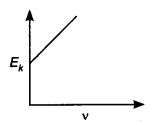
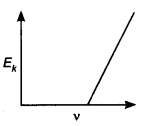
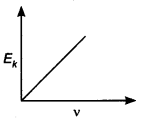
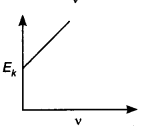
Answer: (b)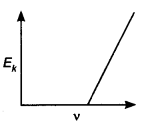
5. The stopping potential V0 for photoelectric emission from a metal surface is plotted along with the y-axis and frequency v of incident light along the x-axis. A straight line is obtained as shown. Planck’s constant is given by
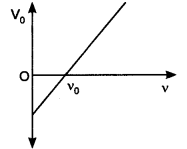
- product of the slope of the line and charge on the electron
- intercept along y-axis divided by the charge on the electron
- product of the intercept along x-axis and mass of the electron
- the slope of the line
Answer: (a) product of the slope of the line and charge on the electron
6. Calculate the de Broglie wavelength associated with the electron which has a kinetic energy of 5 eV.
- 5.47 Å
- 2.7 Å
- 5.9 Å
- None of the above
Answer: (a) 5.47 Å
7. What is the ratio of the de Broglie wavelengths proton and an α particle if they are accelerated by the same potential difference?
- 2√2: 1
- 3:2
- 3√2: 1
- 2: 1
Answer: (a) 2√2: 1
8. Which of the following graphs represent the variation of particle momentum associated with de Broglie wavelength?
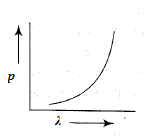
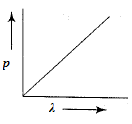
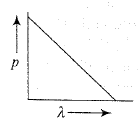
Answer: (c)
9. By what factor will the de Broglie wavelength change if the K.E if the free electron is doubled?
10. In photoelectric effect what determines the maximum velocity of the electron reacting with the collector?
- Frequency of incident radiation alone
- The potential difference between the emitter and the collector
- The work function of metal
- All of these
Answer: (d) All of these
10. Who among the following established that electric charge is quantised?
- R.A. Millikan
- Wilhelm Rontgen
- William Crookes
- J.J. Thomson
Answer: (a) R.A. Millikan
11. By which of the following physical processes can minimum energy required for the electron emission from the metal surface be supplied to the free electrons?
- Field emission
- Thermionic emission
- Photoelectric emission
- All of these
Answer: (d) All of these
12. Which of the following statements is true regarding the photoelectric experiment?
- The stopping potential increases with the increase in the intensity of incident light.
- The photocurrent increases with the intensity of light.
- The photocurrent increases with the increase in frequency
- All of the above
Answer: (b) The photocurrent increases with the intensity of light.
Motion in Straight Line

3. A body covers 16, 18, 20, 22 meters in 5th, 6th, 7th and 8th seconds respectively. Which of the following statements is true about the body?
- The body moves with a uniform velocity from rest
- The body from rest moves with uniform acceleration
- The body moves with an initial velocity and moves with uniform acceleration
- The body moves with an initial velocity and then moves with uniform velocity
Answer: (c) The body moves with an initial velocity and moves with uniform acceleration
4. What can be said about the displacement of the body if it covers a distance of zero?
- It is zero
- It cannot be zero
- It may or may not be zero
- It is negative
Answer: (a) It is zero
5. An athlete finishes a round of circular track of radius R in 40 sec. What is his displacement at the end of 2 min 20 sec?
- 2R
- 2πR
- 7πR
- Zero
Answer: (d)2R
6. Which of the following is not possible for a body in uniform motion?
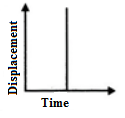
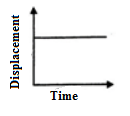
- (c) Both (a) & (b)
- (d) None of the above
Answer: (c) Both (a) & (b)
7. If a car travels ⅖ th of the total distance with a speed v1 and ⅗ th of the distance with a speed v2. The average speed is given by

8. A man leaves home for a cycle ride and comes back home after an half-an-hour ride covering a distance of one km. What is the average velocity of the ride?
- 10 kms-1
- ½ kms-1
- 2 kms-1
- Zero
Answer: (d) Zero
9. A bird flies with a speed of 10 km/hr and a car moves with uniform speed 8 km/hr. Both start from B to A at the same instant (BA = 40 km). The bird after reaching A flies back immediately to meet the approaching car. Once it reaches the car, it flies back to A. The bird repeats this until both the car and the bird reach A simultaneously. What is the total distance flown by the bird?
- 80 km
- 50 km
- 40 km
- 30 km
Answer: (b) 50 km
10. Elephants A, B and C move with a constant speed in the same direction along a straight line as shown in the figure. The speed of the elephant A is 5 m/s and the speed of the elephant C is 10 m/s. Initially, the separation between A and B is d and between B and C is also d. When B catches C, the separation between A and C becomes 3d. What will the speed of B be?
- 5 m/s
- 7.5 m/s
- 15 m/s
- 20 m/s
Answer: (c) 15 m/s
11. Which of the following remains constant if a body travels with constant acceleration?
- Time
- Velocity
- Displacement
- None of the above
Answer: (d) None of the above
12. Given here is a velocity-time graph of the motion of a body. What is the distance travelled by the body during the motion?
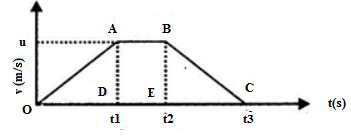

Answer: (b)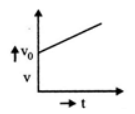
14. What does the displacement of the particle shown in the graph indicate?
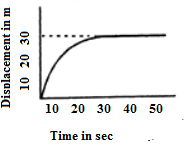
- It indicates a constant velocity
- It indicates a constant acceleration
- It indicates that the particle starts with a constant velocity and is accelerated
- It indicates that the motion is retarded and the particle stops
Answer: (d) It indicates that the motion is retarded and the particle stops
Third Law Motion
1. Walking is possible on the account of
- Newton’s First Law of Motion
- Newton’s Second Law of Motion
- Newton’s Third Law of Motion
- Newton’s Law of Gravitation
Answer: (c)Newton’s Third Law of Motion
2. When we jump out of the boat standing in still water, the boat moves
- Forward
- Backwards
- Sideways
- It doesn’t move
Answer: (b) Backwards
3. A man is at rest on perfectly smooth ice in the middle of a pond. Using the principle of which law will get him to the shore?
- Newton’s First Law
- Newton’s Second Law
- Newton’s Third Law
- All the above three laws
Answer: (c) Newton’s Third Law
4. Recoiling of a cannon after firing a shot is an example of
- Newton’s First Law
- Newton’s Second Law
- Newton’s Third Law
- Newton’s Law of Gravitation
Answer: (c) Newton’s Third Law
5. A body floats in a beaker that contains liquid. If the whole system as shown in the figure falls freely under gravity, then the upthrust on the body due to the liquid is
- Equal to the weight of the displaced liquid
- Equal to the weight of the body in the air
- Zero
- None of the above
Answer: (c) Zero
6. The gun recoils after firing a bullet due to
- Newton’sThird Law of Motion
- The backward thrust of gases
- Newton’s First Law of Motion
- Conservation of Energy
Answer: (a) Newton’s Third Law of Motion
7. A lift carrying a passenger is going up and the total mass of passenger and the lift is 1500 kg. The variation in the speed of the lift is shown in the graph given below. What is the tension in the rope pulling the lift at t = 11 sec?
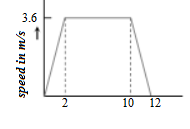
- 14700 N
- 17400 N
- 12500 N
- 12000 N
Answer: (d) 12000 N
8. In the above question, how high does the lift take the passenger?
- 36 meters
- 3.6 meters
- 44 meters
- 4.4 meters
Answer: (a) 36 meters
9. Why won’t the man attempting to pull himself by tugging on his hair not succeed?
- The frictional force in play while gripping is small.
- The exerted force is small.
- The force applied is internal to the system.
- Newton’s law of inertia is not applicable to living beings.
Answer: (c) The force applied is internal to the system.
10. The horse pulling the wagon is able to move forward because of
- the force exerted by the horse on the ground
- the force exerted by the ground on the horse
- the force exerted by the wagon on the horse
- the force exerted by the horse on the wagon
Answer: (b) the force exerted by the ground on the horse
Lamis Theorem
1. Three coplanar forces A, B and C acting at a point in the plane are in equilibrium. If the given value of A is 1.9318 kg wt and sinθ1 is 0.9659, what is the value of C?
- 1
- 2
- 0.9659
- ½
Answer: (a) 1
2. A body under the action of coplanar forces X, Y and Z, is in equilibrium as shown in the figure. Which of the following is the correct statement?
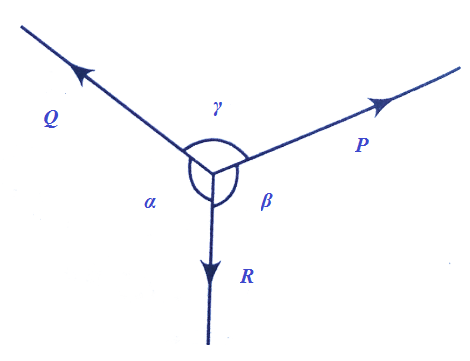

3. If the body is under equilibrium under the influence of a set of non-colinear force, then the minimum number of forces has to be
- Two
- Three
- Four
- Five
Answer: (b) Three
4. What is the minimum number of non-zero vectors in different planes that can be added to give a resultant of zero?
- Two
- Three
- Four
- Five
Answer: (c) Four
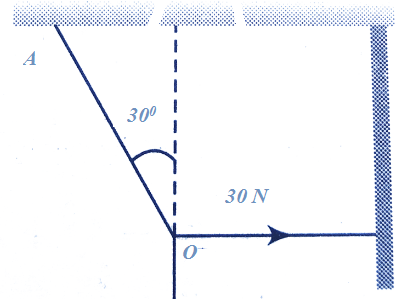
5. In the given figure, the tension in the horizontal cord is 30 N. What is the weight W and tension in the string OA in Netwon?

6. According to Lami’s theorem which of the following statements is true?
- Three forces acting at a point will be in equilibrium.
- Three forces acting upon a particle will be in equilibrium if they are represented in magnitude and direction by the sides of a triangle, taken in order.
- If three forces acting at a point are in equilibrium, each force is proportional to the sine of the angle between the other two.
- Three forces acting at a point can be represented by a triangle, each side being proportional to the force.
Answer: (c) If three forces acting at a point are in equilibrium, each force is proportional to the sine of the angle between the other two.
7. Which of the following theories states that “if a body is in equilibrium under the action of three coplanar and concurrent forces, each of the forces is proportional to the sine of the angle between the other two.”
- Parallelogram Law of Forces
- Lami’s Theorem
- Triangle Law of Forces
- Polygon Law of Forces
Answer: (b) Lami’s Theorem
8. Which of the following is true about Lami’s theorem?
- The theorem is derived based on the cosine rule of trigonometry
- The theorem is only applicable to regular shaped bodies in equilibrium
- The theorem is helpful in determining the unknown forces acting at a point for an object in equilibrium.
- The theorem determines the forces acting on a moving body.
Answer: (c) The theorem is helpful in determining the unknown forces acting at a point for an object in equilibrium.
9. A 30 kg iron block is suspended using supports A and B as shown in the figure. What is the tension in both ropes?
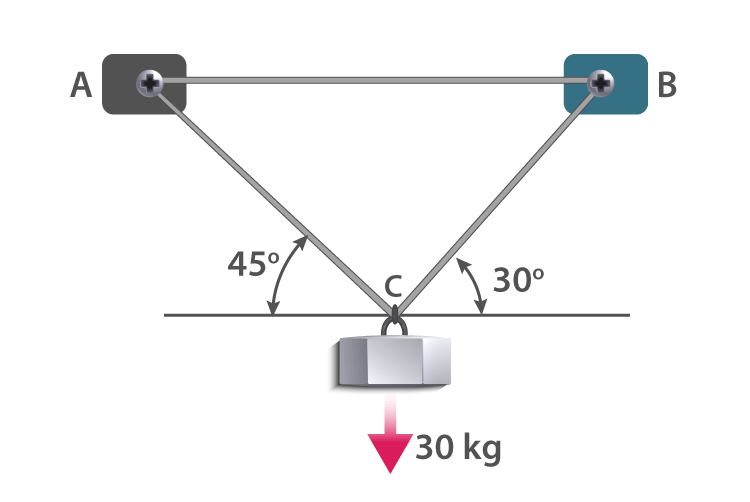
- 263.566 N and 215.2 N
- 463.566 N and 415.2 N
- 663.566 N and 615.2 N
- 863.566 N and 815.2 N
Answer: (a) 263.566 N and 215.2 N
10. A board having a mass of 6 kg is suspended by two strings which makes an angle of 450 with the signboard. How much is the tension in both the strings?
- 21.6 N
- 41.6 N
- 61.6 N
- 81.6 N
Answer: (b) 41.6 N
Comments
Post a Comment