
Sets
1. How to define a set?
a) A collection of well-defined objects or element
b) A collection of unordered objects or element
c) Any random elements
d) A collection of special characters
View Answer
Explanation: Generally, a set is defined as a collection of well defined objects or elements.
Each element in a set is unique.
Say for example, if S a set it is represented as,
S = {x: 2x2 ᵾ x< 5 and x € N}
Then the elements present in the set will be
S = {2, 8, 18, 32}.
.jpeg)
2. How is a set denoted?
a) ()
b) {}
c) []
d) **
View Answer
Explanation: A set is represented by {}.
Usually, but not necessarily a set is denoted by a capital letter e.g. A, B……. V, W, X, Y, Z.
The elements are enclosed between { } denoted by small letters a, b, ……., y, z.
3. How will you define a set of all real numbers?
a) {x: -1 < x < 1}
b) {x: 0 < x < ∞}
c) {x: -∞ < x < ∞}
d) {x: -Z < x < +Z}
View Answer
Explanation: All the numbers whether it is an integer or rational number or irrational number is defined as Real Number. The range of the real number lies between in the range (-∞, +∞).
4. How will you define Union of two sets A and B?
a) {x: x € A or x € B}
b) {x: x € A or x € B (or both)}
c) {x: x € A and B}
d) {x: x € A – B}
View Answer
Explanation: Union of two or more sets is the set of all elements that belongs to any of these sets.
The symbol used for this union of sets is ‘∪‘.
If A = {1, 2, 3, 4} and B = {2, 4, 5, 6} and C = {1, 2, 6, 8}
Then, A ∪ B ∪ C = {1, 2, 3, 4, 5, 6, 7, 8}.
5. How will you define the difference of two sets B-A?
a) {x: x € A and x Ɇ B}
b) {x: x Ɇ A and x € B}
c) {x: x € A and x € B}
d) {x: x Ɇ A and x Ɇ B}
View Answer
Explanation: The difference of a set A and B is denoted as A-B. A-B is a set of those elements that are in the set A but not in the set B. Similarly, the difference of a set B and A is denoted as B-A. It is a set of those elements that are in the set B but not in the set A.
6. What will be the set of the interval (a, b]?
a) {x: a < x < b}
b) {x: a ≤ x ≤ b}
c) {x: a < x ≤ b}
d) {x: a ≤ x < b}
View Answer
Explanation: The symbol ( ) implies that the value will always be less than or greater than the x value i.e. end points are not included.
{ } implies that all the values that does not satisfy a given interval are included inside {}.
[ ] implies that the value will always be less than equal to or greater than equal to the x value i.e. end points are included. This is possible only when both a and b are finite.
7. How to define Wavy Curve Method f(x)?
a) (x-a1)n1 / (x-a2)n2 / (x-a3)n3 …………… / (x-ak)nk * (x-b1)m1 / (x-b2)m2 / (x-b3)m3 …….. /(x-bp)mp
b) (x-a1)n1 + (x-a2)n2 +(x-a3)n3 …………… + (x-ak)nk / (x-b1)m1 + (x-b2)m2 + (x-b3)m3 …….. + (x-bp)mp
c) (x-a1)n1 (x-a2)n2 (x-a3)n3 …………… (x-ak)nk / (x-b1)m1 (x-b2)m2 (x-b3)m3 …….. (x-bp)mp
d) (x-a1)n1 – (x-a2)n2 – (x-a3)n3 …………… – (x-ak)nk / (x-b1)m1 – (x-b2)m2 – (x-b3)m3 ……..- (x-bp)mp
View Answer
Explanation: The method of intervals {or wavy curve} is used for solving inequalities of the form
f(x) = (x-a1)n1 (x-a2)n2 (x-a3)n3 …………… (x-ak)nk / (x-b1)m1 (x-b2)m2 (x-b3)m3 …….. (x-bp)mp > 0 (< 0, ≤ 0, or ≥ 0)
where, n1, n2, ,n3, …….. nk and m1, m2, m3, …….. , mp are natural numbers .
a1, a2, a3, ……..ak and b1, b2, b3, …….. bp are any real numbers such that ai ≠ bj where i = 1, 2, 3, ……. , k and j = 1, 2, 3, ….. , p.
8. How to solve for x, if |x-1| ≥ 3?
a) (-∞, -2) ∪ (4, ∞)
b) (-∞, -2] ∪ [4, ∞)
c) (0, -2] ∪ (4, 0)
d) (-∞, ∞) – {-2, 4}
View Answer
Explanation: Given, |x-1| ≥ 3
= x-1 < -3 or x – 1 ≥ 3
= x ≤ -2 or x ≥ 4
Hence, x c (-∞, -2] ∪ [4, ∞).
9. What is the interval of f(x) = (x – 1)(x – 2)(x – 3)/(x3 + 6x2 + 11x + 6) where f(x) is positive?
a) (-∞, -3) ∪ (3, ∞)
b) (3, -2) ∪ (1, 1) ∪ (2, 3)
c) (-∞, -3) ∪ (2, -1) ∪ (1, 2) ∪ (3, ∞)
d) (-∞, ∞)
View Answer
Explanation: f(x) = (x – 1)(x – 2)(x – 3)/(x3 + 6x2 + 11x+ 6)
After solving the cubic equation (x3 + 6x2 + 11x+ 6) we get (x+1)(x+2)(x+3)
Now, we can see that this implies f(x) = (x – 1)(x – 2)(x – 3)/(x + 1)(x + 2)(x + 3)
So, the critical points of x are, x = 1, 2, 3, -1, -2, -3
So, for f(x) > 0 ᵾ x € (-∞, -3) ∪ (2, -1) ∪ (1, 2) ∪ (3, ∞).
10. Which of the following is not a set of letters of word PRINCIPAL?
a) {P,R,I,N,C,A,L}
b) {C,A,P,I,N,R,L}
c) {P,R,I,N,C,I,P,A,L}
d) {L,N,I,P,C,A,R}
View Answer
Explanation: A set has all unique elements. So the set which contain all the elements of word PRINCIPAL and no letter is repeated. Hence, {P,R,I,N,C,I,P,A,L} cannot be a set.
11. A set can be a collection but a collection cannot be a set.
a) True
b) False
View Answer
Explanation: A collection becomes a set when it is well defined for example a collection of good football players is not a set since the phrase “good football players” is vague and not defined.
12. Write the set {x : x is a natural number and x2-9=0} in roster form.
a) {3}
b) {-3}
c) {3,-3}
d) {9,3}
View Answer
Explanation: Since x is given as natural number so x can be positive only. x2-9=0 => (x-3)(x+3)=0 => x=3,-3.
Here, -3 is not a natural number so, the set {x : x is a natural number and x2-9=0} can be written as {3}.
13. Let X={1,2,3,4,5,6}. Insert appropriate symbol in 9 ________ X.
a) =
b) <
c) ∈
d) ∉
View Answer
Explanation: Here, 9 is not an element of set X.
So, 9 does not belongs to set A. 9∉X.
14. Which of the following does not belong to set {x : x is a vowel in English alphabet}?
a) e
b) b
c) i
d) o
View Answer
Explanation: There are five vowels in English Alphabet a, e, i, o, u. So, set can be written in roster form as {a, e, i, o, u}. ‘b’ does not belongs to given set.
15. The number of elements in set {x : x is a letter of word TRIGONOMETRY} is __________
a) 8
b) 7
c) 9
d) 10
View Answer
Explanation: The above set can be represented as {T,R,I,G,O,N,M,E,Y}. So, the number of elements in the set is 9.
16. What is the solution set of the equation X2+3X+2=0 in roster form?
a) {-1, 2}
b) {-1, -2}
c) {1, -2}
d) {1, 2}
View Answer
Explanation: Solving the equation:
X2+2X+X+2=0
(x+2) (X+1) = 0
X= -2 and X = -1
17. Which one of the following is the correct representation for the set {x: x is a positive integer and x3<50} in roster form?
a) {0,1,2,3,4,5}
b) {-1,1,2,3}
c) {1,2,3}
d) {0,1,2,3}
View Answer
Explanation: 0 is not a positive integer moreover
33<50 and 43>50
18. Which one of the following is not a set?
a) The collection of all whole numbers less than 200
b) The collection of all boys in your class
c) The collection of talented actors in Hollywood
d) The collection of all books written by Chetan Bhagat
View Answer
Explanation: The collection of actors is not a set as there is no specific criterion to determine whether an actor is talented or not.
Relations and Functions
1. A relation is a subset of cartesian products.
a) True
b) False
View Answer
Explanation: A relation from a non-empty set A to a non-empty set B is a subset of cartesian product A X B. First element is called the preimage of second and second element is called image of first.
2. Let A={1,2,3,4,5} and R be a relation from A to A, R = {(x, y): y = x + 1}. Find the domain.
a) {1,2,3,4,5}
b) {2,3,4,5}
c) {1,2,3,4}
d) {1,2,3,4,5,6}
View Answer
Explanation: We know, domain of a relation is the set from which relation is defined i.e. set A.
So, domain = {1,2,3,4,5}.
3. Let A={1,2,3,4,5} and R be a relation from A to A, R = {(x, y): y = x + 1}. Find the codomain.
a) {1,2,3,4,5}
b) {2,3,4,5}
c) {1,2,3,4}
d) {1,2,3,4,5,6}
View Answer
Explanation: We know, codomain of a relation is the set to which relation is defined i.e. set A.
So, codomain = {1,2,3,4,5}.
4. Let A={1,2,3,4,5} and R be a relation from A to A, R = {(x, y): y = x + 1}. Find the range.
a) {1,2,3,4,5}
b) {2,3,4,5}
c) {1,2,3,4}
d) {1,2,3,4,5,6}
View Answer
Explanation: Range is the set of elements of codomain which have their preimage in domain.
Relation R = {(1,2), (2,3), (3,4), (4,5)}.
Range = {2,3,4,5}.
5. If set A has 2 elements and set B has 4 elements then how many relations are possible?
a) 32
b) 128
c) 256
d) 64
View Answer
Explanation: We know, A X B has 2*4 i.e. 8 elements. Number of subsets of A X B is 28 i.e. 256.
A relation is a subset of cartesian product so, number of possible relations are 256.
6. Is relation from set A to set B is always equal to relation from set B to set A.
a) True
b) False
View Answer
Explanation: A relation from a non-empty set A to a non-empty set B is a subset of cartesian product A X B. A relation from a non-empty set B to a non-empty set A is a subset of cartesian product B X A.
Since A X B ≠ B X A so, both relations are not equal.
7. If A={1,4,8,9} and B={1, 2, -1, -2, -3, 3,5} and R is a relation from set A to set B {(x, y): x=y2}. Find domain of the relation.
a) {1,4,9}
b) {-1,1, -2,2, -3,3}
c) {1,4,8,9}
d) {-1,1, -2,2, -3,3,5}
View Answer
Explanation: We know, domain of a relation is the set from which relation is defined i.e. set A.
So, domain = {1,4,8,9}.
8. If A={1,4,8,9} and B={1, 2, -1, -2, -3, 3,5} and R is a relation from set A to set B {(x, y): x=y2}. Find codomain of the relation.
a) {1,4,9}
b) {-1,1, -2,2, -3,3}
c) {1,4,8,9}
d) {-1,1, -2,2, -3,3,5}
View Answer
Explanation: We know, codomain of a relation is the set to which relation is defined i.e. set B.
So, codomain = {-1,1, -2,2, -3,3,5}.
9. If A={1,4,8,9} and B={1, 2, -1, -2, -3, 3,5} and R is a relation from set A to set B {(x, y): x=y2}. Find range of the relation.
a) {1,4,9}
b) {-1,1, -2,2, -3,3}
c) {1,4,8,9}
d) {-1,1, -2,2, -3,3,5}
View Answer
Explanation: Range is the set of elements of codomain which have their preimage in domain.
Relation R = {(1,1), (1, -1), (4,2), (4, -2), (9,3), (9, -3)}.
Range = {-1,1, -2,2, -3,3}.
10. Let A={1,2} and B={3,4}. Which of the following cannot be relation from set A to set B?
a) {(1,1), (1,2), (1,3), (1,4)}
b) {(1,3), (1,4)}
c) {(2,3), (2,4)}
d) {(1,3), (1,4), (2,3), (2,4)}
View Answer
Explanation: A relation from set A to set B is a subset of cartesian product of A X B. In ordered pair, first element should belong to set A and second element should belongs to set B.
In {(1,1), (1,2), (1,3), (1,4)}, 1 and 2 should also be in the set B which is not so as given in question.
Hence, {(1,1), (1,2), (1,3), (1,4)} is not a relation from set A to set B.
Trigonometric Functions
1. If sin x=0 then x = ________
a) nπ
b) (2n+1) π/2
c) (n+1) π
d) nπ/2
View Answer
Explanation: When know, sin x = 0 whenever x is 0, π, 2π, 3π,….. i.e. all integral multiples of π so, x=nπ when sin x=0.
2. If cos x=0 then x = ________
a) nπ
b) (2n+1) π/2
c) (n+1) π
d) nπ/2
View Answer
Explanation: When know, cos x =0 whenever x is π/2, 3π/2, 5π/2, ………… i.e. all odd integral multiples of π/2
so, x=(2n+1) π/2 when cos x=0.
3. If tan x = 0 then x = _________
a) nπ
b) (2n+1) π/2
c) (n+1) π
d) nπ/2
View Answer
Explanation: We know, tan x = sin x / cos x. So, tan x will be zero wherever sin x is zero except the points where cos x is also zero. We know there is no point where sin x as well as cos x both are zero. So, tan x = 0 => x=nπ.
4. 1-sin245° = ___________
a) 1/2
b) 1
c) 0
d) √3 /2
View Answer
Explanation: We know, sin245° + cos245°=1
So, 1- sin245° = cos245° = (1/√2)2 = 1/2.
5. 1-cos2x=_________
a) sin x
b) cos x
c) sin 2x
d) sin2x
View Answer
Explanation: We know, sin2x+ cos2x=1
So, 1-cos2x=sin2x.
6. 1-sec2x=_________
a) cot2x
b) tan2x
c) -tan2x
d) -cot2x
View Answer
Explanation: We know, sec2x – tan2x=1
So, 1-sec2x=-tan2x.
7. 1+ tan2x=_______________
a) sec2x
b) -sec2x
c) cosec2x
d) -cosec2x
View Answer
Explanation: We know, sec2x – tan2x=1
So, 1+ tan2x=sec2x.
8. cot2x – cosec2x = __________
a) 1
b) -1
c) sin2x
d) cos2x
View Answer
Explanation: We know, cosec2x – cot2x = 1
So, cot2x – cosec2x = -1.
9. cosec2x – 1 = ______________
a) cot2x
b) -cot2x
c) tan2x
d) -tan2x
View Answer
Explanation: We know, cosec2x – cot2x = 1
So, cosec2x – 1 = cot2x.
10. tan x is not defined for_______
a) 0
b) nπ/2
c) (2n+1) π/2
d) nπ
View Answer
Explanation: We know, tan x is not defined when cos x = 0.
cos x = 0 whenever x is π/2, 3π/2, 5π/2, ………… i.e. all odd integral multiples of π/2
so, x=(2n+1) π/2.
11. sin (-45°) = ______________
a) 1
b) -1
c) 1/√2
d) -1/√2
View Answer
Explanation: We know, sin(-x) = sin x
So, sin (-45°) = -sin 45° = -1/√2.
12. cos (-60°) = ________________
a) -√3/2
b) 1/2
c) √3/2
d) -1/2
View Answer
Explanation: We know, cos (-x) = cos x
So, cos(-60°) = cos 60°=1/2.
Principle of Mathematical Induction
1. For principle of mathematical induction to be true, what type of number should ‘n’ be?
a) Whole number
b) Natural number
c) Rational number
d) Any form of number
View Answer
Explanation: According to the Principle of Mathematical induction, X(n) can be true if X(1) is true and if X(k) is true. When X(k) is true, it implies that X(k + 1) is also true. Here n can be equal to 1, 2, 3 and so on.
2. 72n + 22n – 2. 3n – 1 is divisible by 50 by principle of mathematical induction.
a) True
b) False
View Answer
Explanation: P(n) = 72n + 22n – 2 . 3n – 1
P(1) = 72 + 20 . 30
P(1) = 50
We now assume that P(k) is divisible by 50.
Therefore, P(k) = 72k + 22k – 2 . 3k – 1
To prove P(k + 1) = 72(k – 1) + 22(k + 1) – 2 . 3(k + 1) – 1 is divisible by 50
P(k + 1) = 72k . 72 + 22k . 3k
P(k + 1) = 72 ( 72k + 22n – 2 . 3k – 1 – 22k – 2 . 3k – 1 ) + 22k . 3k
P(k + 1) = 72 x 50c – 72 . 22k – 2 . 3k – 1 + 22k . 3k
Since P(k) = 72k + 22n – 2 . 3k – 1 – 22k – 2 . 3k – 1 is divisible by 50, it can be written as 50c.
P(k + 1) = 49 x 50C – 49 . 22k – 2 . 3k – 1 + 3 x 4 x 22k – 2 . 3k – 1
P(k + 1) = 49 x 50C – 22k – 2 . 3k – 1 x 37
While the first term is divisible by 50, the second term is not.
Therefore, by principle of mathematical induction, 72n + 22n – 2 . 3n – 1 is not divisible by 50.
3. By principle of mathematical induction, 24n-1 is divisible by which of the following?
a) 8
b) 3
c) 5
d) 7
View Answer
Explanation:
P(n) = 24n – 1
P(1) = 23 = 8
Let us assume P(k) is divisible by 8 and can be written as 8c, where c is any integer.
P(k) = 24k – 1 = 8c
P(k + 1) = 24(k + 1) – 1
P(k + 1) = 24k + 3
P(k + 1) = 24 . 24k – 1
P(k + 1) = 24 . 8c
Clearly, P(k + 1) is divisible by 2, 4, 8 and 16.
4. If 103n + 24k + 1. 9 + k, is divisible by 11, then what is the least positive value of k?
a) 7
b) 6
c) 8
d) 10
View Answer
Explanation: P(n) = 103n + 24k + 1. 9 + k
P(1) = 103 + 25 . 9 + k
P(1) = 1000 + 288 + k
P(1) = 1288 + k
When 1288 is divided by 11, the remainder is 1.
Therefore, 1287 is divisible by 11.
The next number that is divisible is 1298.
k = 1298 – 1288
k = 10
5. P(n) = n(n2 – 1). Which of the following does not divide P(k+1)?
a) k
b) k + 2
c) k + 3
d) k + 1
View Answer
Explanation: P(n) = n(n2 – 1)
P(k + 1) = (k + 1) ((k + 1)2 – 1)
P(k + 1) = (k + 1) (k2 + 1 + 2k – 1)
P(k + 1) = (k + 1) (k2 + 2k)
P(k + 1) = (k + 1) k (k + 2)
Therefore, k, (k + 1), (k – 1) divide P(k + 1).
6. What would be the hypothesis of mathematical induction for n(n + 1) < n! (where n ≥ 4) ?
a) It is assumed that at n = k, k(k + 1)! > k!
b) It is assumed that at n = k, k(k + 1)! < k!
c) It is assumed that at n = k, k(k + 1)! > (k + 1)!
d) It is assumed that at n = k, (k + 1)(k + 2)! < k!
View Answer
Explanation: When we use the principle of mathematical induction, we assume that P(n) is true for P(k) and prove that P(k + 1) is also true. Here P(k) is k(k + 1)! < k!
7. If P(k) = k2 (k + 3) (k2 – 1) is true, then what is P(k + 1)?
a) (k + 1)2 (k + 3) (k2 – 1)
b) (k + 1)2 (k + 4) (k2 – 1)
c) (k + 1)2 (k + 4) k (k + 2)
d) (k + 1) (k + 4) k (k +2)
View Answer
Explanation: In mathematical induction, if P(k) is true, we need to prove that P(k + 1) is also true. Here P(k + 1) is found by substituting (k + 1) in place of k. P(k + 1) = (k + 1)2 (k + 1 + 3) ((k + 1)2 – 1)
P(k + 1) = (k + 1)2 (k + 4) (k2 + 1 + 2k – 1)
P(k + 1) = (k + 1)2 (k + 4) (k2 + 2k)
P(k + 1) = (k + 1)2 (k + 4) k (k +2)
8. n2 + 3n is always divisible by which number, provided n is an integer?
a) 2
b) 3
c) 4
d) 5
View Answer
Explanation: P(n) = n2 + 3n
P(1) = 1 + 3
P(1) = 4
Let’s assume that P(k) is true and divisible by 4. Therefore, P(k) = k2 + 3k can be written as 4c.
We need to check if P(k + 1) is divisible by 4
P(k+1) = (k + 1)2 + 3(k + 1)
P(k+1) = k2 + 1 + 2k + 3k + 3
P(k+1) = k2 + 5k + 4
P(k+1) = (k2 + 3k) + 2k + 4
P(k+1) = 4c + 2k + 4
P(k+1) = 4c + 2(k + 2)
Clearly the second part of the equation is not divisible by 4. However P(k) = 4c is divisible by 2 and
P(k + 1) is also divisible by 2. Therefore, 2 divides P(n).
9. n3 + 5n is divisible by which of the following?
a) 3
b) 5
c) 7
d) 11
View Answer
Explanation: P(n) = n3 + 5n
P(1) = 1 + 5
P(1) = 6
We assume the P(k) is true and divisible by 6.
P(k) = k3 + 5k is divisible by 6 and can be written as 6c or 3 x 2c
We need to prove that P(k + 1) is divisible by 6
P(k + 1) = (k + 1)3 + 5(k + 1)
P(k + 1) = k3 + 1 + 3k2 + 3k + 5k + 5
P(k + 1) = (k3 + 5k) + 3k2 + 3k + 6
P(k + 1) = 6c + 3(k2 + k + 2)
P(k + 1) = (3 x 2c) + 3(k2 + k + 2)
Therefore, P(k + 1) is definitely divisible by 3
10. State whether the following series is true or not.
1 + 2 + 3 +…..+ n =
a) True
b) False
View Answer
Explanation: P(n) = n(n + 1)/2
P(1) = 1
We assume P(k) to be true, therefore, P(k) =
To prove that, P(k + 1) =
Proof:
P(k + 1) = 1 + 2 + 3 +….+ k + k + 1
P(k + 1) =
P(k + 1) =
P(k + 1) =
Therefore, P(n) is true by principle of mathematical induction.
11. What will be P(k + 1) for P(n) = n3 (n + 1)?
a) (k + 1)4
b) k4 + 5k3 + 9k2 + 7k + 2
c) k4 + 6k3 + 9k2 + 7k + 2
d) k4 + 3k3 + 9k2 + 6k + 2
View Answer
Explanation: P(n) = n3 (n + 1)
P(k + 1) = (k + 1)3 (k + 1 + 1)
P(k + 1) = (k3 + 3k2 + 3k + 1) (k + 2)
P(k + 1) = k4 + 3k3 + 3k2 + k + 2k3 + 6k2 + 6k + 2
P(k + 1) = k4 + 5k3 + 9k2 + 7k + 2
Complex Numbers and Quadratic Equations
1. Value of i(iota) is ____________
a) -1
b) 1
c) (-1)1/2
d) (-1)1/4
View Answer
Explanation: Iota is used to denote complex number.
The value of i (iota) is
2. Is i(iota) a root of 1+x2=0?
a) True
b) False
View Answer
Explanation: 1+x2 = 0
1 + i2 = 1 – 1 = 0.
So, it is a root of 1 + x2 = 0.
3. In z=4+i, what is the real part?
a) 4
b) i
c) 1
d) 4+i
View Answer
Explanation: In z=a+bi, a is real part and b is imaginary part.
So, in 4+i, real part is 4.
a) 4
b) i
c) 1
d) 4+i
View Answer
Explanation: In z=a+bi, a is real part and b is imaginary part.
So, in 4+i, imaginary part is 1.
5. (x+3) + i(y-2) = 5+i2, find the values of x and y.
a) x=8 and y=4
b) x=2 and y=4
c) x=2 and y=0
d) x=8 and y=0
View Answer
Explanation: If two complex numbers are equal, then corresponding parts are equal i.e. real parts of both are equal and imaginary parts of both are equal.
x+3 = 5 and y-2 = 2
x = 5-3 and y = 2+2
x=2 and y=4.
6. If z1 = 2+3i and z2 = 5+2i, then find sum of two complex numbers.
a) 4+8i
b) 3-i
c) 7+5i
d) 7-5i
View Answer
Explanation: In addition of two complex numbers, corresponding parts of two complex numbers are added i.e. real parts of both are added and imaginary parts of both are added.
So, sum = (2+5) + (3+2) i = 7+5i.
7. 0+0i is ______________________for complex number z.
a) additive inverse
b) additive identity element
c) multiplicative identity element
d) multiplicative inverse
View Answer
Explanation: On adding zero (0+0i) to a complex number, we get same complex number so 0+0i is additive identity element for complex number z i.e. z+0 = z.
8. 1+0i is _________________ for complex number z.
a) additive inverse
b) additive identity element
c) multiplicative identity element
d) multiplicative inverse
View Answer
Explanation: On multiplying one (1+0i) to a complex number, we get same complex number so 1+0i is multiplicative identity element for complex number z i.e. z*1=z.
9. -z is _________________ for complex number z.
a) additive inverse
b) additive identity element
c) multiplicative identity element
d) multiplicative inverse
View Answer
Explanation: On adding negative of complex number (-z) to complex number z, we get additive identity element zero i.e. z+(-z)=0.
10. 1/z is _________________ for complex number z.
a) additive inverse
b) additive identity element
c) multiplicative identity element
d) multiplicative inverse
View Answer
Explanation: On multiplying reciprocal of complex number (1/z) to complex number z, we get multiplying inverse one i.e. z*1=z.
11. If z1 = 2+3i and z2 = 5+2i, then find z1-z2.
a) -3+1i
b) 3-i
c) 7+5i
d) 7-5i
View Answer
Explanation: In subtracting one complex number from other, difference of corresponding parts of two complex numbers is calculated. So, z1-z2 = (2-5) + (3-2) i = -3+1i.
Linear Inequalities
1. 7>5 is ______________________
a) linear inequality
b) quadratic inequality
c) numerical inequality
d) literal inequality
View Answer
Explanation: Since here numbers are compared with inequality sign so, it is called numerical inequality.
2. x>5 is _____________________
a) double inequality
b) quadratic inequality
c) numerical inequality
d) literal inequality
View Answer
Explanation: Since a variable ‘x’ is compared with number ‘5’ with inequality sign so it is called literal inequality.
3. ax + b > 0 is _____________________
a) double inequality
b) quadratic inequality
c) numerical inequality
d) linear inequality
View Answer
Explanation: Since it has highest power of x ‘1’ and has inequality sign so, it is called linear inequality.
It is not numerical inequality as it does not have numbers on both sides of inequality.
It does not have two inequality signs so it is not double inequality.
4. ax2+bx+c > 0 is _____________________
a) double inequality
b) quadratic inequality
c) numerical inequality
d) linear inequality
View Answer
Explanation: Since it has highest power of x ‘2’ and has inequality sign so, it is called quadratic inequality.
It is not numerical inequality as it does not have numbers on both sides of inequality.
It does not have two inequality signs so it is not double inequality.
5. ax2+bx+c ≥ 0 is a strict inequality.
a) True
b) False
View Answer
Explanation: Since it has equality sign along with inequality sign so it is a slack inequality not strict inequality.
6. If Ram has x rupees and he pay 40 rupees to shopkeeper then find range of x if amount of money left with Ram is at least 10 rupees is given by inequation __________________
a) x ≥ 10
b) x ≤ 10
c) x ≤ 50
d) x ≥ 50
View Answer
Explanation: Amount left is at least 10 rupees i.e. amount left ≥ 10.
x-40 ≥ 10 => x ≥ 50.
7. If Ram has x rupees and he pay 40 rupees to shopkeeper then find range of x if amount of money left with Ram is at most 10 rupees is given by inequation __________________
a) x ≥ 10
b) x ≤ 10
c) x ≤ 50
d) x ≥ 50
View Answer
Explanation: Amount left is at most 10 rupees i.e. amount left ≤ 10.
x-40 ≤ 10 => x ≤ 50.
Permutations and Combinations
1. Permutation is also known as selection.
a) True
b) False
View Answer
Explanation: Permutation is known as arrangement. Selection is another name for combinations.
It involves arrangement of letters, numbers, persons etc.
2. nPr = ________________
a) n!
b)
c)
d)
View Answer
Explanation: Permutation is known as arrangement. nPr means arranging r objects out of n.
nPr =
3. 6! = _____________
a) 24
b) 120
c) 720
d) 8
View Answer
Explanation: We know, n! = n.(n-1).(n-2).(n-3)…..
6! = 6.5.4.3.2.1 = 720.
4.
a) 7
b) 42
c) 230
d) 30
View Answer
Explanation: We know, n! = n.(n-1).(n-2).(n-3)…… = n(n-1)!
5.
a) 1
b) 2
c) 3
d) 4
View Answer
Explanation:
We know, n! = n.(n-1). (n-2). (n-3) …………… = n(n-1)!
=>
=>
=>
=> x=1.
6. nP0 = ________________
a) n!
b) 1
c)
d) (n-1)!
View Answer
Explanation: We know, nPr =
nP0 =
7. nPn = ________________
a) n!
b) 1
c)
d) (n-1)!
View Answer
Explanation: We know, nPr =
nPn =
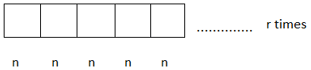
8. The number of permutations of n different objects taken r at a time, where repetition is allowed is _______________
a) n!
b) r!
c) nPr
d) nr
View Answer
Explanation:
The number of permutations of n different objects taken r at a time, where repetition is allowed is n*n*n*n*n……………. r times = nr.
9. Find the number of permutations of word DEPENDENT.
a) 13240
b) 15120
c) 16620
d) 17230
View Answer
Explanation: There are total 9 letters out of which 1T, 2N, 2D, 3E, 1P.
Total number of permutations are
10. Find the number of 5 letter words which can be formed from word IMAGE without repetition using permutations.
a) 20
b) 60
c) 120
d) 240
View Answer
Explanation: IMAGE is a 5 letters word. We have to arrange all 5 letters of the word IMAGE without repetition. So, total permutations are nPr = 5P5 = 5! = 5.4.3.2.1 = 120.
11. Find the number of 5 letter words that can be formed from word IMAGE using permutations if repetition is allowed.
a) 25
b) 120
c) 125
d) 3125
View Answer
Explanation: IMAGE is a 5 letters word. We have to arrange all 5 letters of the word IMAGE with repetition allowed. So, total permutations are nr = 55 = 3125.
Binomial Theorem
1. What is the general term of (x – y)xy?
a) x – yCr (xxy – r . yr)
b) xyCr (xx – y – r . -yr)
c) xyCr (xxy – r . -yr)
d) x – yCr (xx – y – r . yr)
View Answer
Explanation: The general term of a binomial series is given by nCr an – r br.
Here a = x, b = -y and n = xy
Therefore the general term is given by xyCr (xxy – r . -yr).
2. What is the value of n, if the coefficients of the second term of (x – y)3 is equal to the third term of the expansion (x + y)n?
a) –2
b) 3
c) 4
d) 5
View Answer
Explanation: Coefficient of the second term of (x – y)3 is 3C1 and the coefficient of the third term of the expansion (x + y)n is nC2.
3C1 = nC2
3 =
6 =
6 = n2 – n
n2 – n – 6 = 0
n2 – 3n + 2n – 6 = 0
(n – 3) (n + 2) = 0
n = 3, – 2
Since n cannot be negative, n = 3.
3. Which term will be the middle term of (xyz – x)2n?
a) (n + 1)th term
b) (n + 2)th term
c) nth term
d) (n – 1)th term
View Answer
Explanation: Clearly 2n is an even number and the binomial has 2n + 1 terms.
The middle term for a binomial with even power, is the term equal to (n/2 + 1) where n is number of terms.
In this case, (2n/2 + 1) = n + 1.
4. What is the middle term of (4 + 2x)6?
a) 11240 x2
b) 10240 x3
c) 12240 x4
d) 10340 x4
View Answer
Explanation: The middle term will be the 4th term
4th term = 6C3 (4)6 – 3(2x)3
= 20 (64) (8x3)
= 10240 x3
5. What is the middle term of (x2 + x)3?
a) 3x4
b) 6x4
c) 4x4
d) 3x6
View Answer
Explanation:
Since the power is odd, there will be even number of terms and two middle terms.
r =
Therefore, r = 2 and r = 1.
When r = 2, 3C2 (x2)3 – 2(x)2 = 3x4
When r = 1, 3C1 (x2)3 – 1(x)1 = 3x5
6. Which of the following values of n are possible, if the middle term of (x + 3y)n is the fifth term.
a) 6, 7 or 8
b) 7, 8 or 10
c) 7, 8 or 9
d) 8, 9 or 10
View Answer
Explanation: If n is the number of terms and is even, then the middle term is the
Else if n is the number of terms and is odd, there are two middle terms which are the
Case 1:
Case 2:
Case 3:
7. What is the even value of n, if the middle term of (a + b)2n – 3 is 11?
a) 12
b) 10
c) 20
d) 22
View Answer
Explanation: If 2n – 3 is even, then the middle term is the
Else if 2n – 3 is odd, there are two middle terms which are the
Case 1:
Case 2:
Case 3:
8. What is the value of n if the middle term (x + 2y)2n + 1 is the 19th term?
a) 18
b) 19
c) 35
d) 37
View Answer
Explanation: Clearly (2n + 1) is an odd number. Therefore this is a case of binomial with an odd power.
For a binomial expansion with odd power, there are two middle terms.
Case 1:
Therefore n = 18
Case 2:
Therefore n = 17
9. If the general term is 91C2 x89, what is the expansion?
a) (x)91
b) (x – 2)90
c) (x – 1)91
d) (x + 1)90
View Answer
Explanation: The general term of an expansion is nCr xn – r yr.
Clearly here n is 91 and the first term is x raised to the power 89.
The second term is raised to power 2.
y2 = 1
y = +1 or -1
Therefore the expansion can either be (x + 1)91 or (x – 1)91.
10. What is the middle term of (xyz + 3)80?
a) 80C41 (xyz)41 (3)39
b) 80C40 (xyz)40 (3)40
c) 80C39 (xyz)39 (3)40
d) 80C41 (xyz)41 (3)40
View Answer
Explanation: Since the power is even, there are odd number of terms.
The middle term is the
=
= 41st term
The 41st term = 80C40 (xyz)40 (3)40
11. What is the coefficient of the middle term of (z + y)3x, if 3x is considered to be even and the middle term is the 4th term?
a) 7C3
b) 6C2
c) 6C3
d) 7C2
View Answer
Explanation: Since the middle term is the fourth term
Considering 3x to be even,
x = 6/3
Therefore, the fourth term coefficient is 6C3
12. What is the fourth term of (x – 5y)96?
a) 125 96C3 x93 y3
b) 625 96C3 x93 y4
c) 625 96C4 x92 y4
d) 125 96C4 x92 y4
View Answer
Explanation: Tr + 1 = nCr xn – r yr
Here first term is 4 and second term is 5y.
n = 96
r = 3
Therefore, Tr + 1 = 96C3 x96 – 3 (5y)3
= 125 96C3 x93 y3

.jpeg)
.jpeg)
.png)

.jpeg&description=Maths MCQ P 1)
0 Comments