
Gravitation
1. What happens to the gravitational potential at the centre of the uniform spherical shell which shrinks gradually?
(a) Remains constant
(b) Decreases
(c) Increases
(d) Oscillates
Answer: (b) Decreases

2. What is the relation between the escape velocity and orbital velocity of a satellite, if the satellite is close to the earth’s surface?

(b) 15R
(c) 5R
(d) 3R
Answer: (d) 3R
4. What is the maximum height attained by the rocket above the surface of the earth if the mass of the rocket is M, and the initial speed to be V. Assume that R is the radius of the earth.

5. What is the increase in the potential energy of the body with mass m if the body is taken at the height h which is equal to the radius of the earth?
(a) mgR
(b) 2mgR

7. Choose the factor on which the orbital velocity does not depend when the satellite is orbiting close to the earth’s surface
(a) The mass of the earth
(b) The mass of the satellite
(c) The orbital radius
(d) The radius of the earth
Answer: (b) The mass of the satellite
8. If a satellite takes time T for revolution, the the kinetic energy is proportional to

9. The atmosphere around the earth is held by
(a) Gravity
(b) Winds
(c) Clouds
(d) None of the above
Answer: (a) Gravity
The physical parameters also known as physical quantities are used for expressing all the laws of Physics. These quantities are
- Fundamental quantities
- Derived quantities
The above-mentioned quantities are expressed using the system of units and they are:
- MKS (metre, kilogram, second)
- CGS (centimetre, gram, second)
- FPS (foot, pound, second)
- SI (International System of Units
1.How many numbers of base SI units are there?
(a) 5
(b) 10
(c) 7
(d) 9
Answer: (c) 7
2. What is the percentage error in the measurement of the kinetic energy of a body, if there is a positive error of 50% in the speed of the body
(a) 125%
(b) 30%
(c) 50%
(d) 100%
Answer: (d) 100 %
3. What is the dimensional formula of torque and energy
(a) [ML-3T-2] and [MLT-2]
(b) [ML2T-2] and [MLT-2]
(c) [ML2T-2] and [ML2T2]
(d) [MLT2] and [ML2T2]
Answer: (c) [ML2T-2] and [ML2T2]
4. Find the relative error of y, if y=x2
(a)

5. Identify the physical parameters that are having the same dimensions from the below-given list:
(i) Magnetic field
(ii) Energy density
(iii) Refractive index
(iv) Young’s modulus
(v) Dielectric constant
(a) (ii) and (iv)
(b) (i) and (v)
(c) (iii) and (iv)
(d) (iv) and (iii)
Answer: (a) (ii) and (iv)
6. Which the following is a dimensionless quantity
(a) Refractive index
(b) Gravitational constant
(c) Velocity
(d) Planck’s constant
Answer: (a) Refractive index
7. Calculate the value of the dot product of the two vectors whose magnitudes are 3 units and 4 units and their resultant is 1 unit.
(a) +6 units
(b) 0
(c) -12 units
(d) -1 unit
Answer: (c) -12 units
8. From the given three fundamental constants, select the combination that gives the dimension of length
(i) Newton’s gravitational constant (G)
(ii) Speed of light in a vacuum (c)
(iii) Planck’s constant (h)
(a)

9. Following are the readings obtained while measuring the diameter of a wire by using the screw gauge0 mm is the main scale reading
52 divisions are the circular scale reading
What is the diameter of the wire if 1 mm on the main scale is equal to the 100 divisions on the circular scale
(a) 0.016 cm
(b) 0.052 cm
(c) 0.15 cm
(d) 0.05 cm
Answer: (b) 0.052 cm
Laws Of Motion
Newton’s laws of motion are the fundamental laws that are used for describing the motion of the body. There are three laws of motion and they are as follows:
- An object continues to be in the state of uniform motion or in the state of rest unless an external force acts on it. (Also known as the law of inertia)
- Force is a product of mass and acceleration.
- For every action, there is an equal and opposite reaction. (Also known as conservation of momentum)
1. A particle of mass m is given an impulse such that the velocity of the particle changes from v1 to v2. The impulse is equal to
(a) m(v2 + v1)
(b) m (v2 – v1)
(c) m (|v2|-|v1|)
(d)

3. Choose the correct statement
(a) A body can be accelerated by frictional force
(b) There can be zero friction
(c) Kinetic friction is greater than rolling friction
(d) Frictional force and area of contact between the two surfaces are proportional
Answer: (c) Kinetic friction is greater than rolling friction
4. Consider a car that overturns while taking a turn. Select the option that is experienced by the wheels of the car.
(a) First, both inner, as well as the outer wheel, leave the ground
(b) First, the inner wheel leaves the ground
(c) The inner wheel experiences no change
(d) None of the above
Answer: (b) First, the inner wheel leaves the ground
5. Let two bodies be with masses 2kg and 5kg respectively. Let these bodies be at rest with the same force acting on them. Calculate the ratio of times that is required by both the bodies to reach the final velocity.
(a) 2:5
(b) 25:4
(c) 5:3
(d) 4:25
Answer: (a) 2:5
6. What is the force acting on the particle if the motion of the particle is given as

(b) F = 0
(c) F = mg
(d) F ≠ 0
Answer: (c) F = mg
7. Consider two bodies of masses A and B such that these two bodies are connected by using a massless spring. Also, force F is acting on the body B. What will be the acceleration of B if A has an acceleration of a?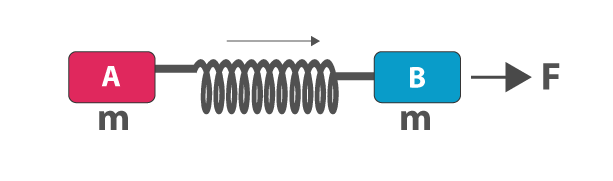
(a) a
(b) F – T
(c)

(a) 3.3N
(b) 0
(c) 13.1N
(d) 19.6N
Answer: (c) 13.1N
9. Consider three masses of 1kg, 3kg and 6kg which are connected to each other and are placed horizontally on the table. Calculate the acceleration of this system. Consider g = 10m/s.

(a) 3
(b) 0
(c) 1
(d) 2
Answer: (d) 2
10. From the following diagram, select the correct diagram when a vessel containing water is given a constant acceleration towards the right along the straight line.

Answer: (c)
11. Consider a man standing on the spring balance such that the reading on the spring balance is 60kg. If the man jumps out of the spring balance what will be the final reading of the spring balance?(a) Remains unchanged
(b) Increases
(c) Decreases
(d) First increases then decrease to zero
Answer: (d) First increases then decreases to zero
12.Which of the following should be constant for a body to have a constant momentum?
(a) Acceleration
(b) Force
(c) Velocity
(d) All of the above
Answer: (d) All of the above
Oscillations and Waves
- Which of the following graph depicts the variation in the potential energy for a particle executing SHM at the origin x = 0?
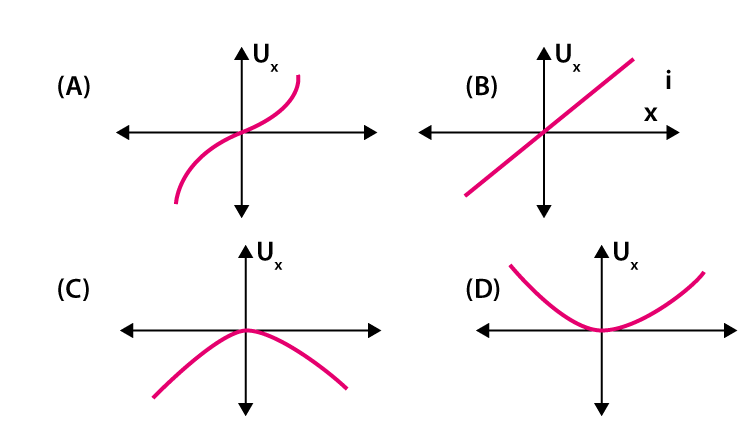
Answer: (d)
2. Which of the following graph represents the variation in the potential energy as a function of time t and displacement x if the displacement of the particle is x = A cos⍵t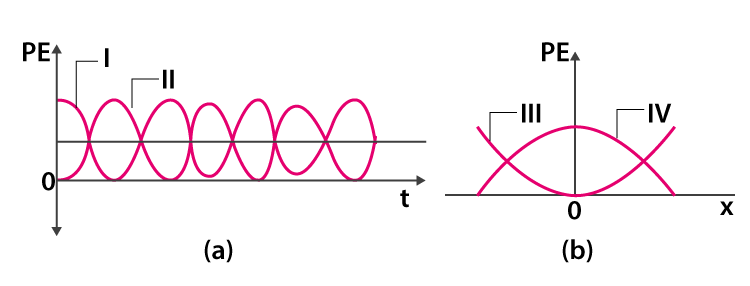
(a)I,IV
(b) II, III
(c) I,III
(d) II,IV
Answer: (c) I,III
3. What is the time taken by a particle executing SHM with a time period T sec from a positive extreme position to half of the amplitude?

Answer: (d) a2
5. Calculate the amplitude for a SHM using the equation x = 3sin2pt + 4cos3pt
(a) 3
(b) 5
(c) 4
(d) 7
Answer: (b) 5
6. What is the constant of propotionality of an oscillator if the damping force is directly propotional to the velocity
(a) kg.s-1
(b) kg.m.s-1
(c) kg.s
(d) kg.m.s-2
Answer: (a) kg.s-1
7. Choose the equation that cannot represent a plane progressive wave

8. What is the phase difference between the prongs of the tuning fork
(a) 5π
(b) π
(c) 2π
(d) 3π
Answer: (b) π
9. What is the change in the phase if a wave is reflected from a denser medium
(a) 3π
(b) 0
(c) π
(d) 2π
Answer: (c) π
10. The observer hears a sound from the source which is moving away from the observer who is stationary. Determine the frequency of the sound
(a) It is halved
(b) It remains the same
(c) It reaches infinity
(d) It gets doubled
Answer: (a) It is halved
11. The length of the pendulum which is displaying SHM is increased by 21%. Calculate the percentage increase in the periodic time of the pendulum.
(a) 21%
(b) 10%
(c) 11%
(d) 42%
Answer: (b) 10%
12. Which of the following does not exhibit polarization
(a) Longitudinal wave in a gas
(b) Transverse wave in a gas
(c) Neither (a) nor (b)
(d) Both (a) and (b)
Answer: (a) Longitudinal wave in a gas
Current Electricity
1. What does the internal resistance of a cell mean?
(a) The resistance of the material used in the cell
(b) The vessel of the cell
(c) The electrodes of the cell
(d) The electrolyte used in the cell
Answer: (d) The electrolyte used in the cell
2. A potentiometer is considered a versatile and accurate device to make an electrical measurement of EMF. Why?
(a) Because the method involves a combination
(b) There are cells involved
(c) Because of potential gradients
(d) As there is no flow of current through the galvanometer
Answer: (d) As there is no flow of current through the galvanometer
3. Consider copper and aluminium wire whose length and resistance are the same. Also, the specific resistance of aluminium is more than copper. Select the correct statement
(a) Copper and aluminium mass are the same
(b) Copper wire has more mass than the aluminium wire
(c) Copper wire has less mass than the aluminium wire
(d) The information given is incomplete
Answer: (d) The information given is incomplete
4. Following is the graph which represents the thermo EMF of two different metals which are joined end to end. One end of the metal is kept at a constant temperature while the other end is heated at very high temperature.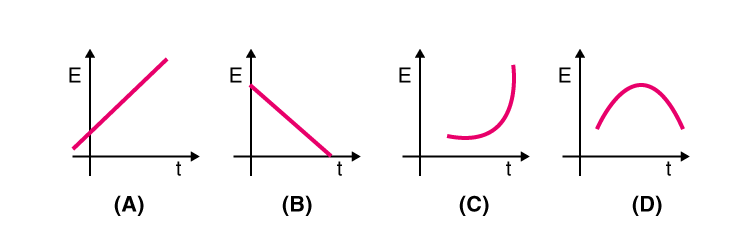
Answer: (d)
5. Select the graph which depicts the variation in thermoelectric power and the temperature difference between the hot and cold junction in the thermocouples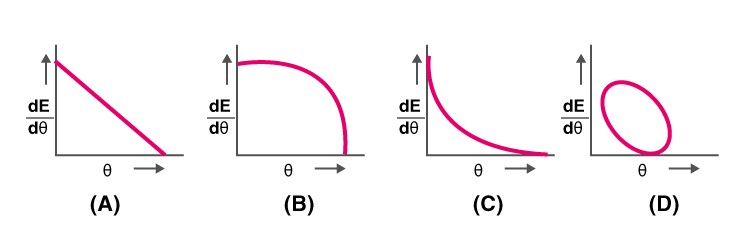
Answer: (a)
6. Which of the following represents the relationship between the current flowing, i through the electric heater and the time taken, t.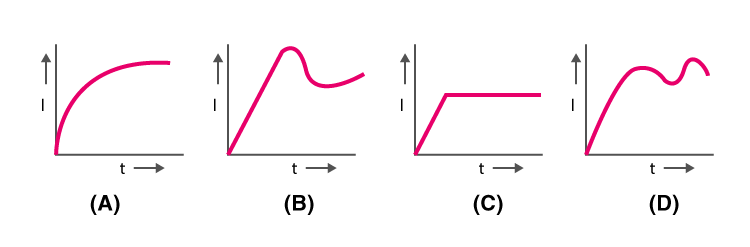
Answer: (b)
7. Consider three voltmeters A, B, and C with resistance R, 1.5R, and 3R respectively. Potential difference is applied across the points X and Y, the voltmeter readings are VA, VB, and VC.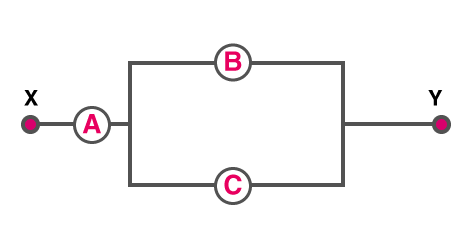
(a) VA = VB ≠ VC
(b) VA ≠ VB ≠ VC
(c) VA = VB = VC
(d) VA ≠ VB = VC
Answer: (c) VA = VB = VC
8. What is the ratio of power dissipated if two electric bulbs are connected in series and the ratio of their resistance is 1:2?
(a) 1:4
(b) 1:2
(c) 2:1
(d) 1: 1
Answer: (b) 1:2
9. What is the principle behind thermocouple
(a) Joule effect
(b) Thomson effect
(c) Seebeck effect
(d) Peltier effect
Answer: (c) Seebeck effect
10. According to Faraday’s laws of electrolysis, to which of the following is the amount of decomposition proportional to?
(a) The electrochemical equivalent of the substance



.jpeg)
.jpeg)
.png)


0 Comments